Get certified for free when you join Fabric Data Days 2026 and dive into Fabric, Power BI, SQL, AI, and other essential data skills.
Join nowJuly 7 - July 17 | Round 2 of the Power BI Dataviz World Championships. Don't miss your chance! Learn more
Hi
I am trying to implement dynamic RLS but having trouble and it would be great if I could some help.
I have the below two tables and I have the below formula
[email] = USERPRINCIPALNAME()
It works fine for the first two customerIDs (A and B) but it does not work for Customer IDs C and D.
It would work if I create multiple rows for C and D but that would make the table relationship many to many and produces wrong data.
How could I implement dynamic RLS in this situation ?
| ID | Amount | CustomerID |
| 1 | 100 | A |
| 2 | 200 | A |
| 3 | 300 | B |
| 4 | 400 | B |
| 5 | 500 | B |
| 6 | 600 | C |
| 7 | 700 | C |
| 8 | 800 | D |
| 9 | 900 | D |
| 10 | 1000 | D |
| CustomerID | Customer Name | |
| A | AAA | [email protected] |
| B | BBB | [email protected] |
| C | CCC | [email protected],[email protected] |
| D | DDD | [email protected],[email protected] |
Below table would work but the data would be wrong since it would be many to many relationship.
| CustomerID | Customer Name | |
| A | AAA | [email protected] |
| B | BBB | [email protected] |
| C | CCC | [email protected] |
| C | CCC | [email protected] |
| D | DDD | [email protected] |
| D | DDD | [email protected] |
Solved! Go to Solution.
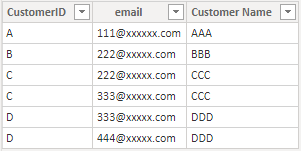
I build two tables like yours to have a test.
Data Table:
User Table (It has been transformed in Power Query editor by Split.):
Build a many to many relationship between CustomerID columns in two tables.
Then Add two Dax expression in Mange roles.
In Data table:
[CustomerID] =
CALCULATE (
MAX(Data[CustomerID]),
FILTER (
User,
User[email] = USERPRINCIPALNAME()
&& User[CustomerID] = Data[CustomerID]
)
)In User table:
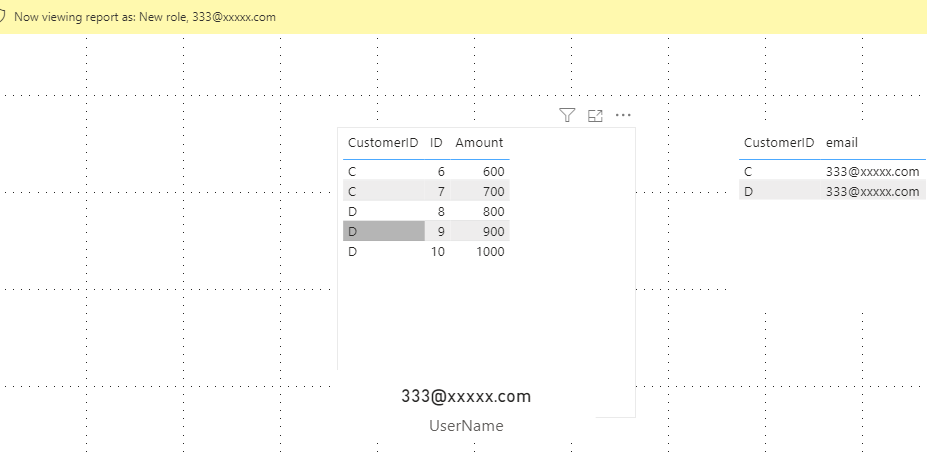
[email] = USERPRINCIPALNAME()Let's use view as to see the result.
You can download the pbix file from this link: Dynamic RLS with multiple USERPRINCIPALNAME()
Best Regards,
Rico Zhou
If this post helps, then please consider Accept it as the solution to help the other members find it more quickly.
I build two tables like yours to have a test.
Data Table:
User Table (It has been transformed in Power Query editor by Split.):
Build a many to many relationship between CustomerID columns in two tables.
Then Add two Dax expression in Mange roles.
In Data table:
[CustomerID] =
CALCULATE (
MAX(Data[CustomerID]),
FILTER (
User,
User[email] = USERPRINCIPALNAME()
&& User[CustomerID] = Data[CustomerID]
)
)In User table:
[email] = USERPRINCIPALNAME()Let's use view as to see the result.
You can download the pbix file from this link: Dynamic RLS with multiple USERPRINCIPALNAME()
Best Regards,
Rico Zhou
If this post helps, then please consider Accept it as the solution to help the other members find it more quickly.
@hideakisuzuki01 , c is having same email ID as B ? Same for D same email ID as C.
Yes, B and C has the same email, because I want both users ([email protected] and [email protected]) to have access to Company B and C`s data.
Does it make sense ?
Join us in Barcelona for FabCon and SQLCon, the Fabric, Power BI, SQL, and AI community event. Save €200 with code FABCMTY200.
Join Fabric Data Days 2026: 60 days of free live/on-demand sessions, challenges, study groups, and certification opportunities.
| User | Count |
|---|---|
| 23 | |
| 22 | |
| 18 | |
| 17 | |
| 13 |
| User | Count |
|---|---|
| 63 | |
| 44 | |
| 42 | |
| 40 | |
| 40 |