This is best Fabric, Power BI, SQL and AI community event. How do we know? The last event sold out! Save €200 with code FABCMTY200.
Register nowThe Fabric community is upgrading! Read all of the details including the timeline and what you can expect. Learn more
Hello,
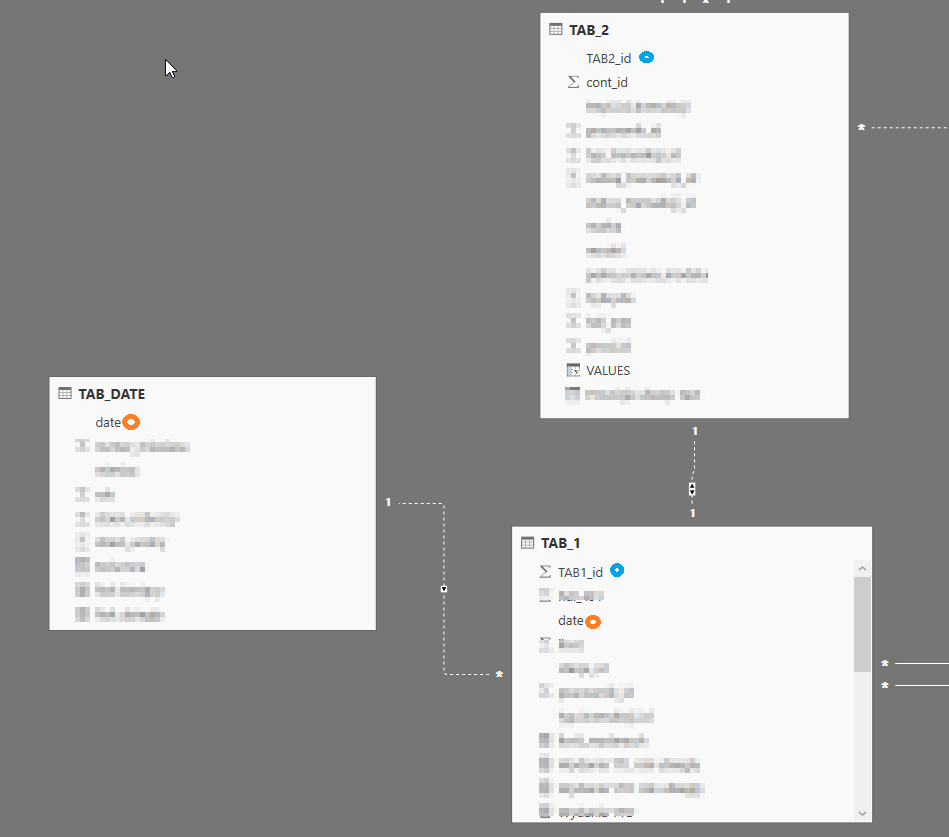
I want to create measure in the table "TAB_1", which sums up tle values "VALUES" from the table "TAB_2" only then if in the table "TAB_2" appears "cont_id" bigger than 0. I enclose screencast of my model. In my opinion, I have to activate inactive relationships. These relationships must be inactive in the model. I have now created something like this:
Values = CALCULATE(sum(TAB_2[VALUES]); USERELATIONSHIP(TAB_1[TAB1_id];TAB_2[TAB2_id]); TAB_2[cont_id]>0; USERELATIONSHIP(TAB_1[date];TAB_DATE[date]))
Unfortunately, this measure sums up everything from "VALUES" and it doesn't work on date filters.
Hi @nice_boy,
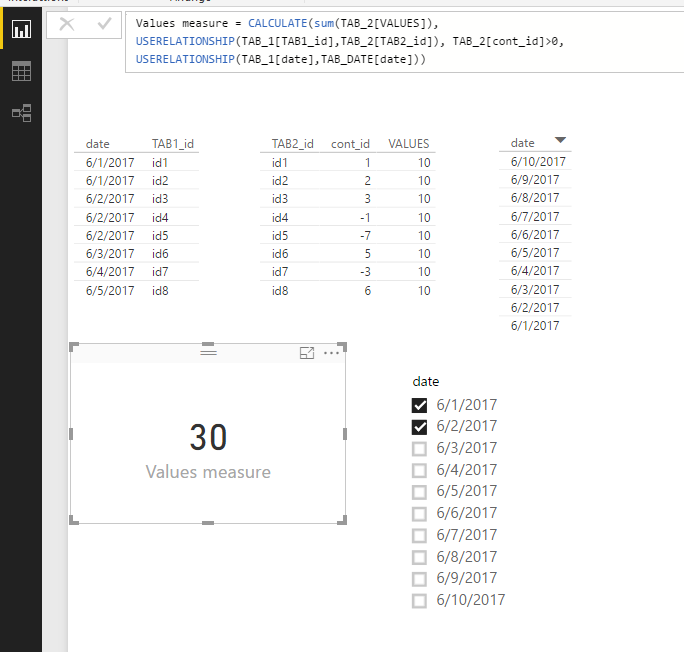
Based on my test, the above measure you provided works fine to generate the sum value. Below is the result in my test. I used a card visual to display the measure value.
In your scenario, what visualization did you use? Please show us the current output which does not meet your requirement.
Regards,
Yuliana Gu
Unfortunately still not working date filter
Change the link between the date table and Tab_1 to be Both directions.
I changed it but did not change
There must be something else at play here thats bigger than what is presented. It would be worth double checking your date slicers and making sure they come from one of those 3 tables.
To me it looks like you are overcompliating the measure itself. You already have the table relationships so just try this simple measure:
Values = CALCULATE( sum(TAB_2[VALUES]), TAB_2[cont_id] > 0 )
Join us in Barcelona for FabCon and SQLCon, the Fabric, Power BI, SQL, and AI community event. Save €200 with code FABCMTY200.
| User | Count |
|---|---|
| 24 | |
| 22 | |
| 20 | |
| 18 | |
| 14 |
| User | Count |
|---|---|
| 32 | |
| 26 | |
| 23 | |
| 20 | |
| 20 |