Join us at FabCon Atlanta from March 16 - 20, 2026, for the ultimate Fabric, Power BI, AI and SQL community-led event. Save $200 with code FABCOMM.
Register now!The Power BI Data Visualization World Championships is back! Get ahead of the game and start preparing now! Learn more
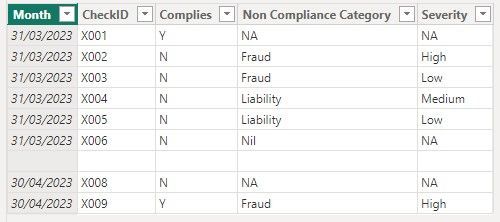
How can I create a DAX measure to display the most frequent non-compliance outcome for a given month on a card? The measure should exclude rows with "Y" in the compliance column and "NA" or 'Nil' in the non-compliance category column. In case of ties, the measure should use severity as the tiebreaker (Low, Medium, High - assume 1,2 3 if helps?).
Initially assumed it would be straightforward, I have spent hours experimenting with various approaches involving filters, calculated tables, addcolumns, summarize, and rankx functions. Now i'm just more confused and going in circles.
Table: Compliance
The desired outcome for March 2023, the card would display "Fraud".
Any assistance or guidance would be greatly appreciated. Thank you in advance.
Solved! Go to Solution.
Hi,
I am not sure how your datamodel looks like, but I tried to create a sample pbix file like below.
Please check the below picture and the attached pbix file.
Expected outcome measure: =
VAR _t =
ADDCOLUMNS (
FILTER (
Compliance,
Compliance[Compliance] <> "Y"
&& NOT ( Compliance[Non Compliance] IN { "NA", "Nil" } )
),
"@tiebreaker",
SWITCH (
TRUE (),
Compliance[Severity] = "High", 3,
Compliance[Severity] = "Medium", 2,
Compliance[Severity] = "Low", 1
)
)
VAR _grouptable =
GROUPBY (
_t,
Compliance[Date],
Compliance[Non Compliance],
"@count", SUMX ( CURRENTGROUP (), 1 ),
"@tiebreak", SUMX ( CURRENTGROUP (), [@tiebreaker] )
)
VAR _highest =
MAXX (
ADDCOLUMNS ( _grouptable, "@value", [@count] * 10 + [@tiebreak] ),
[@value]
)
RETURN
IF (
HASONEVALUE ( Compliance[Date] ),
CONCATENATEX (
FILTER (
ADDCOLUMNS ( _grouptable, "@value", [@count] * 10 + [@tiebreak] ),
[@value] = _highest
),
Compliance[Non Compliance],
", "
)
)
This solution is perfect, thank you so much 🙂
Hi,
I am not sure how your datamodel looks like, but I tried to create a sample pbix file like below.
Please check the below picture and the attached pbix file.
Expected outcome measure: =
VAR _t =
ADDCOLUMNS (
FILTER (
Compliance,
Compliance[Compliance] <> "Y"
&& NOT ( Compliance[Non Compliance] IN { "NA", "Nil" } )
),
"@tiebreaker",
SWITCH (
TRUE (),
Compliance[Severity] = "High", 3,
Compliance[Severity] = "Medium", 2,
Compliance[Severity] = "Low", 1
)
)
VAR _grouptable =
GROUPBY (
_t,
Compliance[Date],
Compliance[Non Compliance],
"@count", SUMX ( CURRENTGROUP (), 1 ),
"@tiebreak", SUMX ( CURRENTGROUP (), [@tiebreaker] )
)
VAR _highest =
MAXX (
ADDCOLUMNS ( _grouptable, "@value", [@count] * 10 + [@tiebreak] ),
[@value]
)
RETURN
IF (
HASONEVALUE ( Compliance[Date] ),
CONCATENATEX (
FILTER (
ADDCOLUMNS ( _grouptable, "@value", [@count] * 10 + [@tiebreak] ),
[@value] = _highest
),
Compliance[Non Compliance],
", "
)
)
The Power BI Data Visualization World Championships is back! Get ahead of the game and start preparing now!
Check out the November 2025 Power BI update to learn about new features.
| User | Count |
|---|---|
| 59 | |
| 46 | |
| 42 | |
| 23 | |
| 18 |
| User | Count |
|---|---|
| 190 | |
| 122 | |
| 96 | |
| 66 | |
| 47 |