This time we’re going bigger than ever. Fabric, Power BI, SQL, AI and more. We're covering it all. You won't want to miss it.
Learn moreDid you hear? There's a new SQL AI Developer certification (DP-800). Start preparing now and be one of the first to get certified. Register now
Hi,
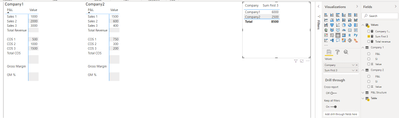
In the attached simplified example below, I'd like to create a measure which will always sum the first three row values in the table.
The current measure I've written is a calculate measure but uses the expression as the Company 1 values. This means it's specific to Company 1 so for Company 2 I'd have to duplicate it.
The new measure would ideally not require a specific company to be used in the measure expression to calculate the first three rows.
https://1drv.ms/u/s!Ajcv_9xvRfBd5ztQeRbRnFa5h1Am?e=mO0Ncf
Hope that makes sense.
Thanks for reading.
Solved! Go to Solution.
Hi, @smitpau
Based on your description, you may create a measure as below. The pbix file is attached in the end.
Sum First 3 =
SUMX(
SUMMARIZE(
'Table',
'Table'[Company],
"Result",
SWITCH(
[Company],
"Company1",
CALCULATE(
SUM('Company 1'[Value]),
FILTER(
ALL('Company 1'),
VALUE([SI])<4
)
),
"Company2",
CALCULATE(
SUM('Company 2'[Value]),
FILTER(
ALL('Company 2'),
VALUE([SI])<4
)
)
)
),
[Result]
)
Result:
Best Regards
Allan
If this post helps, then please consider Accept it as the solution to help the other members find it more quickly.
Hi, @smitpau
Based on your description, you may create a measure as below. The pbix file is attached in the end.
Sum First 3 =
SUMX(
SUMMARIZE(
'Table',
'Table'[Company],
"Result",
SWITCH(
[Company],
"Company1",
CALCULATE(
SUM('Company 1'[Value]),
FILTER(
ALL('Company 1'),
VALUE([SI])<4
)
),
"Company2",
CALCULATE(
SUM('Company 2'[Value]),
FILTER(
ALL('Company 2'),
VALUE([SI])<4
)
)
)
),
[Result]
)
Result:
Best Regards
Allan
If this post helps, then please consider Accept it as the solution to help the other members find it more quickly.
For each company sum up the values where [SI] is between 1 and 3.
Why do you have separate tables per company? You shoud combine the tables into one, either via DAX UNION() or better in Power Query.
Check out the April 2026 Power BI update to learn about new features.
If you have recently started exploring Fabric, we'd love to hear how it's going. Your feedback can help with product improvements.
| User | Count |
|---|---|
| 36 | |
| 32 | |
| 31 | |
| 21 | |
| 15 |
| User | Count |
|---|---|
| 68 | |
| 57 | |
| 31 | |
| 29 | |
| 22 |