Don't miss your chance to take the Fabric Data Engineer (DP-700) exam on us!
Learn moreNext up in the FabCon + SQLCon recap series: The roadmap for Microsoft SQL and Maximizing Developer experiences in Fabric. All sessions are available on-demand after the live show. Register now
Hello:
I have a "Table" with three columns, A, B and C, filled with many different string values.
I want to find how many rows of that table have all three columns equal to another row in the table. In other words, find rows with duplicate "A+B+C". In a visual I would need a number, indicating how many non unique values there are, combining the three columns.
Is there a formula to achieve this or do I have to concatenate all three columns in one first and then somehow count the duplicates?
Thank you very much and regards.
Hi @superjam
In general that depends on the filter context which essentially depens on the visual itself. However, The following should work in a card visual
Count =
COUNTROWS (
DISTINCT ( SELECTCOLUMNS ( "A", 'Table'[A], "B", 'Table'[B], "C", 'Table'[C] ) )
)
Hello,
Just after posting the last response, I figured it out: create a new column concatenating the three columns and then use the idea of @FreemanZ to calculate the duplicate ones.
Thank you, @FreemanZ
The function DISTINCT() counts unique values in one column of the table. So, your measure gives the repeated values in one column.
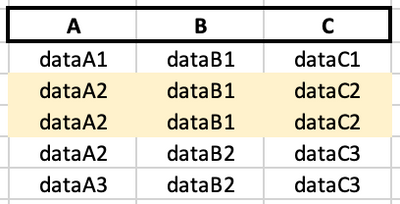
But how about the following example:
Only one row is duplicated (marked in yellow), because only in that case all three columns are equal with each other. I hope this clarifies the problem.
Thanks again.
If you have recently started exploring Fabric, we'd love to hear how it's going. Your feedback can help with product improvements.
A new Power BI DataViz World Championship is coming this June! Don't miss out on submitting your entry.
Share feedback directly with Fabric product managers, participate in targeted research studies and influence the Fabric roadmap.
| User | Count |
|---|---|
| 9 | |
| 6 | |
| 3 | |
| 2 | |
| 1 |
| User | Count |
|---|---|
| 21 | |
| 14 | |
| 11 | |
| 5 | |
| 5 |