Join us at FabCon Atlanta from March 16 - 20, 2026, for the ultimate Fabric, Power BI, AI and SQL community-led event. Save $200 with code FABCOMM.
Register now!Get Fabric Certified for FREE during Fabric Data Days. Don't miss your chance! Request now
I have a table with ordered SKU's. One line is a one position on one order. In one order client can buy many different SKU's. I'd like to calculate and analize average basket size (value) included next SKU's. Could you help me?
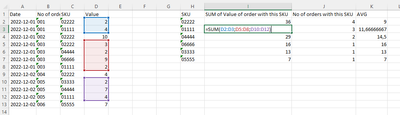
For example for SKU 01111 it will be (order 001) SUM=6; (order 003) SUM=16, so avg order is (16+6)/2=11
| Date | | No of order | | SKU | | Value |
| 2022-12-01 | | 001 | | 02222 | | 2 |
| 2022-12-01 | | 001 | | 01111 | | 4 |
| 2022-12-01 | | 002 | | 02222 | | 10 |
| 2022-12-01 | | 003 | | 02222 | | 3 |
| 2022-12-01 | | 003 | | 04444 | | 2 |
| 2022-12-01 | | 003 | | 06666 | | 9 |
| 2022-12-01 | | 003 | | 01111 | | 2 |
| 2022-12-02 | | 004 | | 02222 | | 4 |
| 2022-12-02 | | 005 | | 03333 | | 2 |
| 2022-12-02 | | 005 | | 04444 | | 7 |
| 2022-12-02 | | 005 | | 01111 | | 4 |
| 2022-12-02 | | 006 | | 05555 | | 7 |
| SKU | | Avg basket size with SKU |
| 011111 | | 11 |
| 022222 | | ? |
Solved! Go to Solution.
Hi @Rpxx ,
Here are the steps you can follow:
1. Create measure.
Avg basket size with SKU =
var _column=SELECTCOLUMNS(FILTER(ALL('Table'),'Table'[Date]=MAX('Table'[Date])&&'Table'[SKU]=MAX('Table'[SKU])),"1",[No of order])
var _count=
CALCULATE(DISTINCTCOUNT('Table'[No of order]),FILTER(ALL('Table'),
'Table'[SKU]=MAX('Table'[SKU])&&'Table'[Date]=MAX('Table'[Date])))
var _sum=
SUMX(FILTER(ALL('Table'),'Table'[No of order] in _column&&'Table'[Date]=MAX('Table'[Date])),[Value])
return
DIVIDE(_sum,_count)
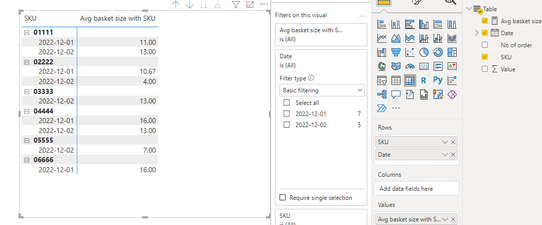
2. Result:
Best Regards,
Liu Yang
If this post helps, then please consider Accept it as the solution to help the other members find it more quickly
Hi @Rpxx ,
Here are the steps you can follow:
1. Create measure.
Avg basket size with SKU =
var _column=SELECTCOLUMNS(FILTER(ALL('Table'),'Table'[Date]=MAX('Table'[Date])&&'Table'[SKU]=MAX('Table'[SKU])),"1",[No of order])
var _count=
CALCULATE(DISTINCTCOUNT('Table'[No of order]),FILTER(ALL('Table'),
'Table'[SKU]=MAX('Table'[SKU])&&'Table'[Date]=MAX('Table'[Date])))
var _sum=
SUMX(FILTER(ALL('Table'),'Table'[No of order] in _column&&'Table'[Date]=MAX('Table'[Date])),[Value])
return
DIVIDE(_sum,_count)
2. Result:
Best Regards,
Liu Yang
If this post helps, then please consider Accept it as the solution to help the other members find it more quickly
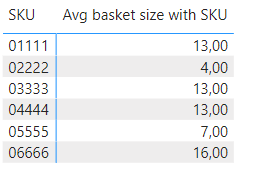
This is my expected result. Could you help me? Date is not important...
Could you describe what is the next steps to calculate these numbers in your file? I don't understand...
Check out the November 2025 Power BI update to learn about new features.
Advance your Data & AI career with 50 days of live learning, contests, hands-on challenges, study groups & certifications and more!
| User | Count |
|---|---|
| 11 | |
| 9 | |
| 9 | |
| 6 | |
| 5 |
| User | Count |
|---|---|
| 27 | |
| 22 | |
| 19 | |
| 17 | |
| 11 |