
This time we’re going bigger than ever. Fabric, Power BI, SQL, AI and more. We're covering it all. You won't want to miss it.
Learn moreDid you hear? There's a new SQL AI Developer certification (DP-800). Start preparing now and be one of the first to get certified. Register now
Hello,
I have the following problem,
Based on the row where the ----- appear, you can determine a way to separate with that example into columns and assume the division of asterisks to be another sheet. Marked wih yellow
Thanks
Solved! Go to Solution.
Hi @vazmor ,
you could count them or use this function:
(myTable as table, RowPosition as number, optional ColumnName as text) =>
let
ColName = if ColumnName = null then "Column1" else ColumnName,
Source = myTable,
#"Kept Range of Rows" = Table.Range(Source, RowPosition-1,1),
Custom1 = Record.ToList( #"Kept Range of Rows"{0} ){0},
Custom2 = Text.PositionOf( Custom1, " ", Occurrence.All),
SplitPositions = {0} & Custom2,
#"Split Column by Positions" = Table.SplitColumn(Source, ColName, Splitter.SplitTextByPositions(SplitPositions))
in
#"Split Column by Positions"
It assumes that your column to split is called "Column1".
If not, pass the column name into the 3rd (optional) parameter.
Imke Feldmann (The BIccountant)
If you liked my solution, please give it a thumbs up. And if I did answer your question, please mark this post as a solution. Thanks!
How to integrate M-code into your solution -- How to get your questions answered quickly -- How to provide sample data -- Check out more PBI- learning resources here -- Performance Tipps for M-queries
Hi @vazmor ,
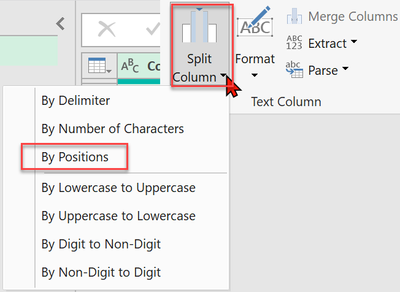
in the Split Column-dialogue, there is an option to split by positions.
It accepts a comma separated list of positions (where your blanks are) to split the table.
Just make sure to start with a 0 as a starting point.
Imke Feldmann (The BIccountant)
If you liked my solution, please give it a thumbs up. And if I did answer your question, please mark this post as a solution. Thanks!
How to integrate M-code into your solution -- How to get your questions answered quickly -- How to provide sample data -- Check out more PBI- learning resources here -- Performance Tipps for M-queries
Hello, Thank you, if I can use this option but how can I use the character function based on only one row or that the position function is dynamic based on that row of the -------.
Hi @vazmor ,
you could count them or use this function:
(myTable as table, RowPosition as number, optional ColumnName as text) =>
let
ColName = if ColumnName = null then "Column1" else ColumnName,
Source = myTable,
#"Kept Range of Rows" = Table.Range(Source, RowPosition-1,1),
Custom1 = Record.ToList( #"Kept Range of Rows"{0} ){0},
Custom2 = Text.PositionOf( Custom1, " ", Occurrence.All),
SplitPositions = {0} & Custom2,
#"Split Column by Positions" = Table.SplitColumn(Source, ColName, Splitter.SplitTextByPositions(SplitPositions))
in
#"Split Column by Positions"
It assumes that your column to split is called "Column1".
If not, pass the column name into the 3rd (optional) parameter.
Imke Feldmann (The BIccountant)
If you liked my solution, please give it a thumbs up. And if I did answer your question, please mark this post as a solution. Thanks!
How to integrate M-code into your solution -- How to get your questions answered quickly -- How to provide sample data -- Check out more PBI- learning resources here -- Performance Tipps for M-queries
Thanks,
Check out the April 2026 Power BI update to learn about new features.
Sign up to receive a private message when registration opens and key events begin.
If you have recently started exploring Fabric, we'd love to hear how it's going. Your feedback can help with product improvements.