Get Fabric or SQL Certified for Free.
Get certified for free when you join Fabric Data Days 2026 and dive into Fabric, Power BI, SQL, AI, and other essential data skills.
Join now- Power BI forums
- Get Help with Power BI
- Desktop
- Service
- Report Server
- Power Query
- Mobile Apps
- Developer
- DAX Commands and Tips
- Custom Visuals Development Discussion
- Health and Life Sciences
- Power BI Spanish forums
- Translated Spanish Desktop
- Training and Consulting
- Instructor Led Training
- Dashboard in a Day for Women, by Women
- Galleries
- Data Stories Gallery
- Themes Gallery
- Contests Gallery
- QuickViz Gallery
- Quick Measures Gallery
- Visual Calculations Gallery
- Notebook Gallery
- Translytical Task Flow Gallery
- TMDL Gallery
- R Script Showcase
- Webinars and Video Gallery
- Ideas
- Custom Visuals Ideas (read-only)
- Issues
- Issues
- Events
- Upcoming Events
Try your skills in the Power BI Dataviz World Championship! Round one ends June 26. Join now
- Power BI forums
- Forums
- Get Help with Power BI
- Power Query
- Read a complex excel file with Power Query
- Subscribe to RSS Feed
- Mark Topic as New
- Mark Topic as Read
- Float this Topic for Current User
- Bookmark
- Subscribe
- Printer Friendly Page


- Mark as New
- Bookmark
- Subscribe
- Mute
- Subscribe to RSS Feed
- Permalink
- Report Inappropriate Content
Read a complex excel file with Power Query
Hi all,
I have some excel files with this format (Problem Is I need to gather Title 1 and title 2 cell values)
I need to keep all Green values, Table below and Title1 and Title 2 values
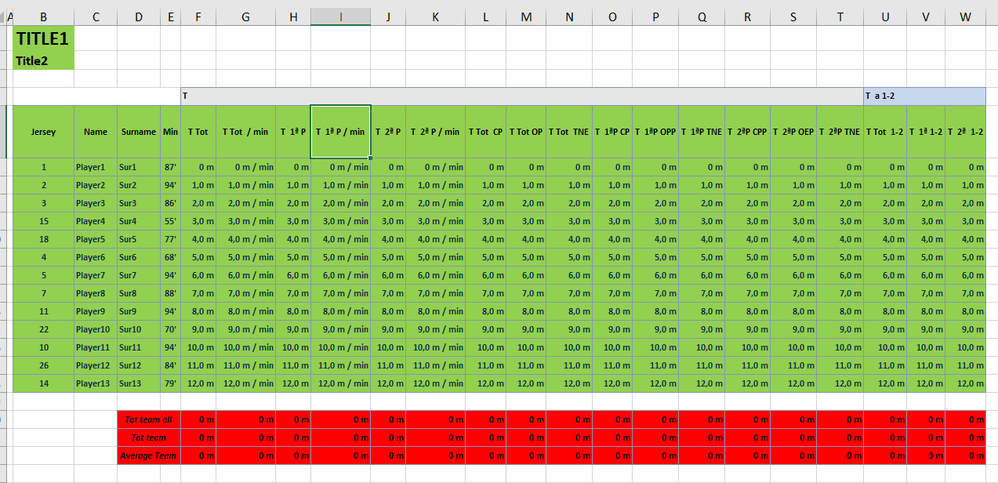
I need to add this 2 values Title 1 and Title 2 as 2 new columns
Something like this should be my final table

Here it is attached Excel source (https://1drv.ms/x/s!Am7buNMZi-gwn3FB9LodiYT-VQTk)
Regards
Solved! Go to Solution.
- Mark as New
- Bookmark
- Subscribe
- Mute
- Subscribe to RSS Feed
- Permalink
- Report Inappropriate Content
@dpombal,
Please use the following M code instead.
let
    Source = Excel.Workbook(File.Contents("yourfolderpath\My_File.xlsx"), null, true),
    Sheet1_Sheet = Source{[Item="Sheet1",Kind="Sheet"]}[Data],
    #"Removed Bottom Rows" = Table.RemoveLastN(Sheet1_Sheet,4),
    #"Filtered Rows" = Table.SelectRows(#"Removed Bottom Rows", each ([Column1] <> null and [Column1] <> "")),
    Custom1 = Record.Field(#"Filtered Rows"{0},"Column1"),
    Custom3 = Record.Field(#"Filtered Rows"{1},"Column1"),
    Custom2 = #"Filtered Rows",
    #"Added Custom" = Table.AddColumn(Custom2, "Custom", each Custom1),
    #"Added Custom1" = Table.AddColumn(#"Added Custom", "Custom.1", each Custom3),
    #"Reordered Columns" = Table.ReorderColumns(#"Added Custom1",{"Custom", "Custom.1", "Column1", "Column2", "Column3", "Column4", "Column5", "Column6", "Column7", "Column8", "Column9", "Column10", "Column11", "Column12", "Column13", "Column14", "Column15", "Column16", "Column17", "Column18", "Column19", "Column20", "Column21", "Column22"}),
    #"Removed Top Rows" = Table.Skip(#"Reordered Columns",2),
    #"Promoted Headers" = Table.PromoteHeaders(#"Removed Top Rows", [PromoteAllScalars=true]),
    #"Changed Type" = Table.TransformColumnTypes(#"Promoted Headers",{{"TITLE1", type text}, {"Title2", type text}, {"Jersey", Int64.Type}, {"Name", type text}, {"Surname", type text}, {"Min", type number}, {"T Tot ", Int64.Type}, {"T Tot  / min", Int64.Type}, {"T  1ª P", Int64.Type}, {"T  1ª P / min", Int64.Type}, {"T  2ª P", Int64.Type}, {"T  2ª P / min", Int64.Type}, {"T Tot  CP", Int64.Type}, {"T Tot OP", Int64.Type}, {"T Tot  TNE", Int64.Type}, {"T  1ªP CP", Int64.Type}, {"T  1ªP OPP", Int64.Type}, {"T  1ªP TNE", Int64.Type}, {"T  2ªP CPP", Int64.Type}, {"T  2ªP OEP", Int64.Type}, {"T  2ªP TNE", Int64.Type}, {"T Tot  1-2", Int64.Type}, {"T  1ª 1-2", Int64.Type}, {"T  2ª  1-2", Int64.Type}})
in
    #"Changed Type"
Regards,
Lydia

- Mark as New
- Bookmark
- Subscribe
- Mute
- Subscribe to RSS Feed
- Permalink
- Report Inappropriate Content
@dpombal,
Add a blank query in Power BI Desktop, paste one of the following code to the Advanced Editor of the blank query .
let
    Source = Excel.Workbook(File.Contents("yourfolderpath\My_File.xlsx"), null, true),
    Sheet1_Sheet = Source{[Item="Sheet1",Kind="Sheet"]}[Data],
    #"Removed Bottom Rows" = Table.RemoveLastN(Sheet1_Sheet,4),
    #"Filtered Rows" = Table.SelectRows(#"Removed Bottom Rows", each ([Column1] <> null and [Column1] <> "")),
    #"Added Custom" = Table.AddColumn(#"Filtered Rows", "Custom", each "TITLE1"),
    #"Added Custom1" = Table.AddColumn(#"Added Custom", "Custom.1", each "Title2"),
    #"Reordered Columns" = Table.ReorderColumns(#"Added Custom1",{"Custom", "Custom.1", "Column1", "Column2", "Column3", "Column4", "Column5", "Column6", "Column7", "Column8", "Column9", "Column10", "Column11", "Column12", "Column13", "Column14", "Column15", "Column16", "Column17", "Column18", "Column19", "Column20", "Column21", "Column22"}),
    #"Removed Top Rows" = Table.Skip(#"Reordered Columns",2),
    #"Promoted Headers" = Table.PromoteHeaders(#"Removed Top Rows", [PromoteAllScalars=true]),
    #"Changed Type" = Table.TransformColumnTypes(#"Promoted Headers",{{"TITLE1", type text}, {"Title2", type text}, {"Jersey", Int64.Type}, {"Name", type text}, {"Surname", type text}, {"Min", type number}, {"T Tot ", Int64.Type}, {"T Tot  / min", Int64.Type}, {"T  1ª P", Int64.Type}, {"T  1ª P / min", Int64.Type}, {"T  2ª P", Int64.Type}, {"T  2ª P / min", Int64.Type}, {"T Tot  CP", Int64.Type}, {"T Tot OP", Int64.Type}, {"T Tot  TNE", Int64.Type}, {"T  1ªP CP", Int64.Type}, {"T  1ªP OPP", Int64.Type}, {"T  1ªP TNE", Int64.Type}, {"T  2ªP CPP", Int64.Type}, {"T  2ªP OEP", Int64.Type}, {"T  2ªP TNE", Int64.Type}, {"T Tot  1-2", Int64.Type}, {"T  1ª 1-2", Int64.Type}, {"T  2ª  1-2", Int64.Type}})
in
    #"Changed Type"
let
    Source = Excel.Workbook(File.Contents("yourfolderpath\My_File.xlsx"), null, true),
    Sheet1_Sheet = Source{[Item="Sheet1",Kind="Sheet"]}[Data],
    #"Removed Bottom Rows" = Table.RemoveLastN(Sheet1_Sheet,4),
    #"Filtered Rows" = Table.SelectRows(#"Removed Bottom Rows", each ([Column1] <> null and [Column1] <> "")),
    #"Duplicated Column" = Table.AddColumn(#"Filtered Rows", "Column1 - Copy", each [Column1], type any),
    #"Added Custom" = Table.AddColumn(#"Duplicated Column", "Custom", each if [#"Column1 - Copy"]="TITLE1" then [#"Column1 - Copy"] else null),
    #"Filled Down" = Table.FillDown(#"Added Custom",{"Custom"}),
    #"Promoted Headers" = Table.PromoteHeaders(#"Filled Down", [PromoteAllScalars=true]),
    #"Changed Type" = Table.TransformColumnTypes(#"Promoted Headers",{{"TITLE1", type any}, {"Column2", type text}, {"Column3", type text}, {"Column4", type any}, {"Column5", type any}, {"Column6", type any}, {"Column7", type any}, {"Column8", type any}, {"Column9", type any}, {"Column10", type any}, {"Column11", type any}, {"Column12", type any}, {"Column13", type any}, {"Column14", type any}, {"Column15", type any}, {"Column16", type any}, {"Column17", type any}, {"Column18", type any}, {"Column19", type any}, {"Column20", type any}, {"Column21", type any}, {"Column22", type any}, {"TITLE1_1", type any}, {"TITLE1_2", type text}}),
    #"Added Custom1" = Table.AddColumn(#"Changed Type", "Custom", each if [TITLE1_1]="Title2" then [TITLE1_1] else null),
    #"Filled Down1" = Table.FillDown(#"Added Custom1",{"Custom"}),
    #"Reordered Columns" = Table.ReorderColumns(#"Filled Down1",{"TITLE1_2", "Custom", "TITLE1", "Column2", "Column3", "Column4", "Column5", "Column6", "Column7", "Column8", "Column9", "Column10", "Column11", "Column12", "Column13", "Column14", "Column15", "Column16", "Column17", "Column18", "Column19", "Column20", "Column21", "Column22", "TITLE1_1"}),
    #"Removed Columns" = Table.RemoveColumns(#"Reordered Columns",{"TITLE1_1"}),
    #"Removed Top Rows" = Table.Skip(#"Removed Columns",1),
    #"Promoted Headers1" = Table.PromoteHeaders(#"Removed Top Rows", [PromoteAllScalars=true]),
    #"Changed Type1" = Table.TransformColumnTypes(#"Promoted Headers1",{{"TITLE1", type text}, {"Title2", type text}, {"Jersey", Int64.Type}, {"Name", type text}, {"Surname", type text}, {"Min", type number}, {"T Tot ", Int64.Type}, {"T Tot  / min", Int64.Type}, {"T  1ª P", Int64.Type}, {"T  1ª P / min", Int64.Type}, {"T  2ª P", Int64.Type}, {"T  2ª P / min", Int64.Type}, {"T Tot  CP", Int64.Type}, {"T Tot OP", Int64.Type}, {"T Tot  TNE", Int64.Type}, {"T  1ªP CP", Int64.Type}, {"T  1ªP OPP", Int64.Type}, {"T  1ªP TNE", Int64.Type}, {"T  2ªP CPP", Int64.Type}, {"T  2ªP OEP", Int64.Type}, {"T  2ªP TNE", Int64.Type}, {"T Tot  1-2", Int64.Type}, {"T  1ª 1-2", Int64.Type}, {"T  2ª  1-2", Int64.Type}})
in
    #"Changed Type1"
Regards,
Lydia

- Mark as New
- Bookmark
- Subscribe
- Mute
- Subscribe to RSS Feed
- Permalink
- Report Inappropriate Content
I need something like this... can you help
https://exceleratorbi.com.au/convert-a-cell-value-into-a-column-with-power-query/
- Mark as New
- Bookmark
- Subscribe
- Mute
- Subscribe to RSS Feed
- Permalink
- Report Inappropriate Content
@dpombal,
Please use the following M code instead.
let
    Source = Excel.Workbook(File.Contents("yourfolderpath\My_File.xlsx"), null, true),
    Sheet1_Sheet = Source{[Item="Sheet1",Kind="Sheet"]}[Data],
    #"Removed Bottom Rows" = Table.RemoveLastN(Sheet1_Sheet,4),
    #"Filtered Rows" = Table.SelectRows(#"Removed Bottom Rows", each ([Column1] <> null and [Column1] <> "")),
    Custom1 = Record.Field(#"Filtered Rows"{0},"Column1"),
    Custom3 = Record.Field(#"Filtered Rows"{1},"Column1"),
    Custom2 = #"Filtered Rows",
    #"Added Custom" = Table.AddColumn(Custom2, "Custom", each Custom1),
    #"Added Custom1" = Table.AddColumn(#"Added Custom", "Custom.1", each Custom3),
    #"Reordered Columns" = Table.ReorderColumns(#"Added Custom1",{"Custom", "Custom.1", "Column1", "Column2", "Column3", "Column4", "Column5", "Column6", "Column7", "Column8", "Column9", "Column10", "Column11", "Column12", "Column13", "Column14", "Column15", "Column16", "Column17", "Column18", "Column19", "Column20", "Column21", "Column22"}),
    #"Removed Top Rows" = Table.Skip(#"Reordered Columns",2),
    #"Promoted Headers" = Table.PromoteHeaders(#"Removed Top Rows", [PromoteAllScalars=true]),
    #"Changed Type" = Table.TransformColumnTypes(#"Promoted Headers",{{"TITLE1", type text}, {"Title2", type text}, {"Jersey", Int64.Type}, {"Name", type text}, {"Surname", type text}, {"Min", type number}, {"T Tot ", Int64.Type}, {"T Tot  / min", Int64.Type}, {"T  1ª P", Int64.Type}, {"T  1ª P / min", Int64.Type}, {"T  2ª P", Int64.Type}, {"T  2ª P / min", Int64.Type}, {"T Tot  CP", Int64.Type}, {"T Tot OP", Int64.Type}, {"T Tot  TNE", Int64.Type}, {"T  1ªP CP", Int64.Type}, {"T  1ªP OPP", Int64.Type}, {"T  1ªP TNE", Int64.Type}, {"T  2ªP CPP", Int64.Type}, {"T  2ªP OEP", Int64.Type}, {"T  2ªP TNE", Int64.Type}, {"T Tot  1-2", Int64.Type}, {"T  1ª 1-2", Int64.Type}, {"T  2ª  1-2", Int64.Type}})
in
    #"Changed Type"
Regards,
Lydia
- Mark as New
- Bookmark
- Subscribe
- Mute
- Subscribe to RSS Feed
- Permalink
- Report Inappropriate Content
You are setting a fixed text value
"TITLE1"
what I need is to get the value on this cell, dynamic on each excel
Helpful resources

Data Days 2026
Don't miss out on Data Days, June 15 through August 7. Learn Fabric, Power BI, SQL, AI and more.

Power BI DataViz World Championships - June 2026
A new Power BI DataViz World Championship is coming this June! Don't miss out on submitting your entry.


| User | Count |
|---|---|
| 12 | |
| 6 | |
| 5 | |
| 5 | |
| 5 |


