
Don't miss your chance to take the Fabric Data Engineer (DP-700) exam on us!
Learn moreWe've captured the moments from FabCon & SQLCon that everyone is talking about, and we are bringing them to the community, live and on-demand. Starts on April 14th. Register now
Hey all,
I am trying to create a Power Query from a folder which contains a CSV file.
Unfortunatly i am getting an error.
After clicking on the " Binary" sign, i get the error below.
I think it's due to the Delimiter.
But i don't know how to solve it.
Does anybody now how to solve this?
Thanks in advance!!!!
Solved! Go to Solution.
Hi @Anonymous
Try this:
let
Source = Folder.Files("O:\EXPIRATIES"),
#"Sorted Rows" = Table.Sort(Source,{{"Date created", Order.Descending}}),
#"Kept First Rows" = Table.FirstN(#"Sorted Rows",1),
ImportCSV = Csv.Document(#"Kept First Rows"{0}[Content],[Delimiter=";", Columns=1, Encoding=65001, QuoteStyle=QuoteStyle.None])
in
ImportCSV
Kind regards,
JB
Hi @Anonymous ,
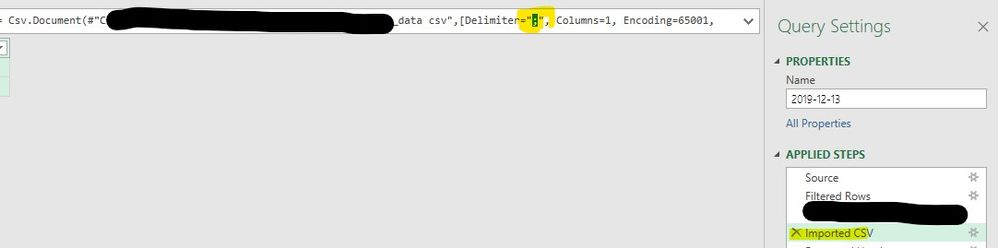
We can change the "Imported CSV" step, from
= Csv.Document(#"Previous Step Name",[Delimiter=",", Columns=1, Encoding=65001, QuoteStyle=QuoteStyle.None])
To
= Csv.Document(#"Previous Step Name",[Delimiter=";", Columns=1, Encoding=65001, QuoteStyle=QuoteStyle.None])
Then we can add a "Use First Row as Headers" step after imported CSV
Best regards,
Hey v-lid-msft,
Thanks for your response 🙂
Unfortunately i seem to be unable to adjust your steps 😞
Do you perhaps know what i should add in the advanced editor?
Thanks in advance,
Vianney123
let
Source = Folder.Files("O:\EXPIRATIES"),
#"Sorted Rows" = Table.Sort(Source,{{"Date created", Order.Descending}}),
#"Kept First Rows" = Table.FirstN(#"Sorted Rows",1)
in
#"Kept First Rows"
Hi @Anonymous
Try this:
let
Source = Folder.Files("O:\EXPIRATIES"),
#"Sorted Rows" = Table.Sort(Source,{{"Date created", Order.Descending}}),
#"Kept First Rows" = Table.FirstN(#"Sorted Rows",1),
ImportCSV = Csv.Document(#"Kept First Rows"{0}[Content],[Delimiter=";", Columns=1, Encoding=65001, QuoteStyle=QuoteStyle.None])
in
ImportCSV
Kind regards,
JB
@Anonymous Works like a charm! Thanks!!!
Hello @Anonymous
what is the idea to read from the folder and then from csv-file?
If you only need this file only, query your file directly with the TXT/CSV function. This help importing your data with a special wizard. If you need do read the binary data from your flder consider using this csv-converting function like this (your file seems european standard and devided with semicolon)
= Csv.Document(YourBinaryDataUsindForExampleFileContents,[Delimiter=";", Columns=4, Encoding=1252, QuoteStyle=QuoteStyle.None])
If this post helps or solves your problem, please mark it as solution (to help other users find useful content and to acknowledge the work of users that helped you)
Kudoes are nice too
Have fun
Jimmy
If you have recently started exploring Fabric, we'd love to hear how it's going. Your feedback can help with product improvements.
A new Power BI DataViz World Championship is coming this June! Don't miss out on submitting your entry.
Share feedback directly with Fabric product managers, participate in targeted research studies and influence the Fabric roadmap.
| User | Count |
|---|---|
| 5 | |
| 4 | |
| 3 | |
| 3 | |
| 2 |
| User | Count |
|---|---|
| 9 | |
| 8 | |
| 7 | |
| 6 | |
| 5 |