Join us at FabCon Atlanta from March 16 - 20, 2026, for the ultimate Fabric, Power BI, AI and SQL community-led event. Save $200 with code FABCOMM.
Register now!Vote for your favorite vizzies from the Power BI Dataviz World Championship submissions. Vote now!
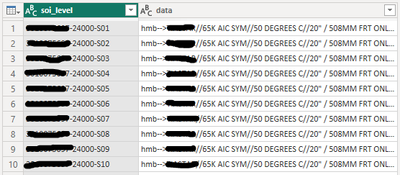
I have a list of Values coming from a source SQL. This list of values is related to a Sales Order and is not in the a "clean" format for configuration buidling. My idea is to have a table as follows:
Where the data represents a single designed configuration of values based on the Sales Order. Example in row 1,
for "-S01" the values are "65K AIC SYM", "50 DEGREES C", etc.
I then want to convert this using values that are "clean" in my opinion. For this, I have a value to value conversion table. For example, the value "65K AIC SYM" converts to "65K".
My final table I would like to look like this:
Col 1 Row 1 = hmb-->65K AIC SYM//50 DEGREES C//...
Col 2 Row 1 = hmb-->65K//50C//...
This will allow Col 1 to relate to my customer sales orders and Col 2 to relate to my configuration. Any help would be greatly appreciated as I have been stuck on this for some time.
hello, @zbaker83 first you need to wrap your replacements into a record with "old" values as record fields and "new" values as field values like [65K AIC SYM = 65K, 50 DEGREES C = 50C, ...]. You can create this manually but better to create this table in Excel. This should be table with 2 columns: Name and Value. Then load it to PQ and apply Record.FromTable function to this table.
rec = Record.FromTable(rec_tbl)
this gives you your record. Then use it in Record.FieldOrDefault function like this:
new_col = Table.AddColumn(
data_table, "my_configuration",
(x) =>
[lst = Splitter.SplitTextByAnyDelimiter({"//", "/"})(x[data]),
tx = List.Transform(lst, (w) => Record.FieldOrDefault(rec, w, w)),
txt = Text.Combine(tx, "//")][txt]
)
The Power BI Data Visualization World Championships is back! It's time to submit your entry.
If you love stickers, then you will definitely want to check out our Community Sticker Challenge!
Check out the January 2026 Power BI update to learn about new features.