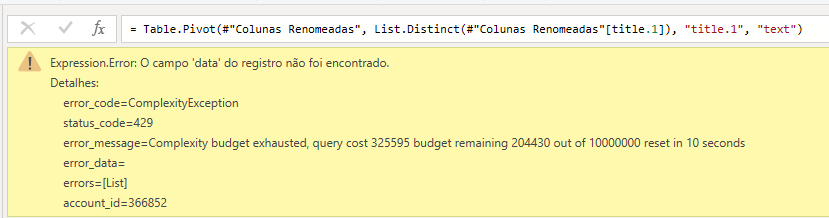
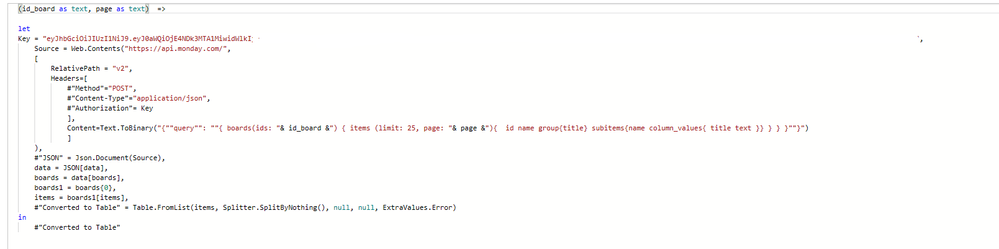
I have a similar issue, We have a Power BI dashboard set up to connect Monday.com with using the API key. We’re receiving a time-out error when trying to refresh the data, but the error is only coming across for only one of the boards, we have connected three boards in total and only one of the board is giving us the time out error.
I did go through the below link https://blog.crossjoin.co.uk/2021/12/17/simulating-slow-data-sources-in-power-bi/
Could you please help where it has to be applied to the current M-Query we have been using.

let
Source = Web.Contents("https://api.monday.com/" & "v2",
[
Headers=[
#"Method"="POST",
#"Content-Type"="application/json",
#"Authorization"="Bearer <APIKey>"
],
Content=Text.ToBinary("{""query"": ""{ boards (ids: <BoardID>) { items { id name column_values { title text } } } }""}")
]
),
#"JSON" = Json.Document(Source,65001),
data = JSON[data],
boards = data[boards],
boards1 = boards{0},
items = boards1[items],
#"Converted to Table" = Table.FromList(items, Splitter.SplitByNothing(), null, null, ExtraValues.Error),
#"Expanded Column1" = Table.ExpandRecordColumn(#"Converted to Table", "Column1", {"name", "column_values"}, {"Column1.name", "Column1.column_values"}),
#"Expanded Column1.column_values" = Table.ExpandListColumn(#"Expanded Column1", "Column1.column_values"),
#"Expanded Column1.column_values1" = Table.ExpandRecordColumn(#"Expanded Column1.column_values", "Column1.column_values", {"title", "text"}, {"Column1.column_values.title", "Column1.column_values.text"}),
#"Changed Type" = Table.TransformColumnTypes(#"Expanded Column1.column_values1",{{"Column1.column_values.title", type text}}),
#"Pivoted Column" = Table.Pivot(#"Changed Type", List.Distinct(#"Changed Type"[Column1.column_values.title]), "Column1.column_values.title", "Column1.column_values.text"),
#"Renamed Columns" = Table.RenameColumns(#"Pivoted Column",{{"Column1.name", "Name"}})
in
#"Renamed Columns"