Don't miss your chance to take the Fabric Data Engineer (DP-700) exam on us!
Learn moreThe FabCon + SQLCon recap series starts April 14th at 8am Pacific. If you’re tracking where AI is going inside Fabric, this first session is a can't miss. Register now
Dear community,
actually i want to solve an easy task but i am struggling and hope that someone can help me.
I have the following table:
| Alfred | Alfred_1 | Alfred_2 | Bert | Bert_1 | Bert_2 | Claudia | Claudia_1 | Claudia_2 |
| 01.01.2023 | 01.06.2023 | 10 | 01.06.2023 | 01.03.2024 | 100 | 01.01.2023 | 01.07.2023 | 4 |
| 01.02.2023 | 01.06.2023 | 20 | 01.07.2023 | 01.03.2024 | 110 | 01.02.2023 | 01.07.2023 | 5 |
| 01.03.2023 | 01.06.2023 | 30 | 01.08.2023 | 01.03.2024 | 120 | 01.03.2023 | 01.07.2023 | 6 |
| 01.04.2023 | 01.06.2023 | 40 | 01.09.2023 | 01.03.2024 | 130 | 01.04.2023 | 01.07.2023 | 7 |
| 01.05.2023 | 01.06.2023 | 50 | 01.10.2023 | 01.03.2024 | 140 | 01.05.2023 | 01.07.2023 | 8 |
| 01.11.2023 | 01.03.2024 | 150 | 01.06.2023 | 01.07.2023 | 9 | |||
| 01.12.2023 | 01.03.2024 | 160 | ||||||
| 01.01.2024 | 01.03.2024 | 170 | ||||||
| 01.02.2024 | 01.03.2024 | 180 |
and i want to transform the table to the following:
| Start | End | Value | Name |
| 01.01.2023 | 01.06.2023 | 10 | Alfred |
| 01.02.2023 | 01.06.2023 | 20 | Alfred |
| 01.03.2023 | 01.06.2023 | 30 | Alfred |
| 01.04.2023 | 01.06.2023 | 40 | Alfred |
| 01.05.2023 | 01.06.2023 | 50 | Alfred |
| 01.06.2023 | 01.03.2024 | 100 | Bert |
| 01.07.2023 | 01.03.2024 | 110 | Bert |
| 01.08.2023 | 01.03.2024 | 120 | Bert |
| 01.09.2023 | 01.03.2024 | 130 | Bert |
| .. | .. | .. | .. |
I would be happy to receive all solutions
Greetings jb257
Solved! Go to Solution.
Hi,
let
Source = Your_Source,
Name = List.Alternate(Table.ColumnNames(Source),2,1,1),
Data = List.Transform(List.Split(Table.ToColumns(Source),3), each Table.FromColumns(_, {"Start", "End", "Value"})),
#"Data+Name" = Table.FromColumns({Data}&{Name}, {"Data", "Name"}),
Expand = Table.ExpandTableColumn(#"Data+Name", "Data", {"Start", "End", "Value"}, {"Start", "End", "Value"}),
NotNull = Table.SelectRows(Expand, each [Start] <> null)
in
NotNull
Stéphane
You can also use this version. Just change 2nd step YourSource = Source to your data
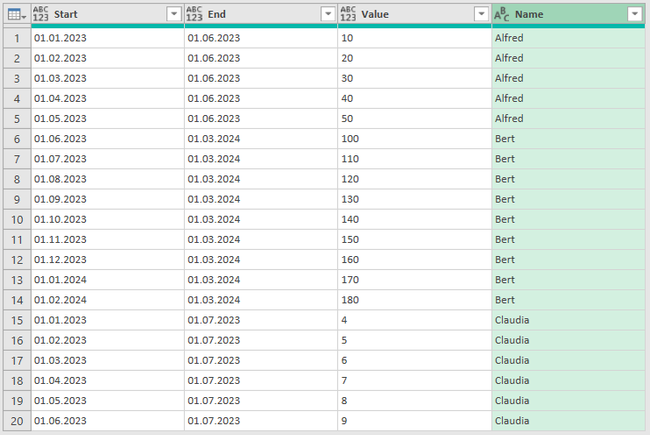
let
Source = Table.FromRows(Json.Document(Binary.Decompress(Binary.FromText("hdJdDoQgDATgqxiezab0B/AsxvtfYwVto+wkm0jigPP1QfY9Uf6cDxNLWkcoHjLNOz1IDzqO/fxVrx40HevFM+SZ5sabj/EMeQteIC9eb5iP8QL5ErxCXr2+YT7GK+Rr8AZ5u+uZMB/jDfJt8Mv55qtbGVsG/3NYG7QYW4Ue3y2oed0W/WnW/03GzTY1jy8=", BinaryEncoding.Base64), Compression.Deflate)), let _t = ((type nullable text) meta [Serialized.Text = true]) in type table [Alfred = _t, Alfred_1 = _t, Alfred_2 = _t, Bert = _t, Bert_1 = _t, Bert_2 = _t, Claudia = _t, Claudia_1 = _t, Claudia_2 = _t]),
YourSource = Source,
#"Added Index" = Table.AddIndexColumn(YourSource, "Index", 0, 1, Int64.Type),
#"Unpivoted Other Columns" = Table.UnpivotOtherColumns(#"Added Index", {"Index"}, "Attribute", "Value"),
Ad_Name = Table.AddColumn(#"Unpivoted Other Columns", "Name", each Text.BeforeDelimiter([Attribute], "_"), type text),
#"Grouped Rows" = Table.Group(Ad_Name, {"Name"}, {{"All", each _, type table [Index=number, Attribute=text, Value=text, Name=text]}, {"Start", each Table.SelectRows(_, (r)=> r[Attribute] = r[Name])[Value], type list}, {"End", each Table.SelectRows(_, (r)=> r[Attribute] = r[Name] & "_1")[Value], type list}, {"Value", each Table.SelectRows(_, (r)=> r[Attribute] = r[Name] & "_2")[Value], type list}}),
Ad_MergedListsToTable = Table.AddColumn(#"Grouped Rows", "MergedListsToTable", each Table.SelectRows(Table.FromColumns({[Start], [End], [Value]}, {"Start", "End", "Value"}), (r)=> Text.Trim(r[Start]) <> null and Text.Trim(r[Start]) <> ""), type table),
#"Removed Other Columns" = Table.SelectColumns(Ad_MergedListsToTable,{"MergedListsToTable", "Name"}),
#"Expanded MergedTables" = Table.ExpandTableColumn(#"Removed Other Columns", "MergedListsToTable", {"Start", "End", "Value"}, {"Start", "End", "Value"})
in
#"Expanded MergedTables"
Hi,
let
Source = Your_Source,
Name = List.Alternate(Table.ColumnNames(Source),2,1,1),
Data = List.Transform(List.Split(Table.ToColumns(Source),3), each Table.FromColumns(_, {"Start", "End", "Value"})),
#"Data+Name" = Table.FromColumns({Data}&{Name}, {"Data", "Name"}),
Expand = Table.ExpandTableColumn(#"Data+Name", "Data", {"Start", "End", "Value"}, {"Start", "End", "Value"}),
NotNull = Table.SelectRows(Expand, each [Start] <> null)
in
NotNull
Stéphane
Awesome, thank you very much!
If you have recently started exploring Fabric, we'd love to hear how it's going. Your feedback can help with product improvements.
A new Power BI DataViz World Championship is coming this June! Don't miss out on submitting your entry.
Share feedback directly with Fabric product managers, participate in targeted research studies and influence the Fabric roadmap.
| User | Count |
|---|---|
| 5 | |
| 4 | |
| 3 | |
| 2 | |
| 2 |
| User | Count |
|---|---|
| 8 | |
| 6 | |
| 6 | |
| 6 | |
| 5 |