Join us at FabCon Atlanta from March 16 - 20, 2026, for the ultimate Fabric, Power BI, AI and SQL community-led event. Save $200 with code FABCOMM.
Register now!Learn from the best! Meet the four finalists headed to the FINALS of the Power BI Dataviz World Championships! Register now
Hello. I am looking to create column D of the table below in power query. You can see the excel formula to the right. I need to add columns from the current row and add a previously calculated row above. I am stuck and do not know how to proceed. Any help would be appreciated.
| A | B | C | D | ||
| Date | Production | Demand | Final Inventory | Formula in Column D | |
| 1 | 5/1/2021 | 80,287 | 96,419 | 158,276 | N/A |
| 2 | 6/1/2021 | 77,325 | 86,650 | 148,951 | B3-C3+D2 |
| 3 | 7/1/2021 | 83,763 | 83,179 | 149,535 | B4-C4+D3 |
| 4 | 8/1/2021 | 81,890 | 74,075 | 157,350 | B5-C5+D4 |
Solved! Go to Solution.
Hi @drewswiney
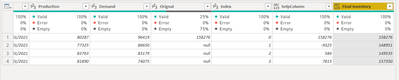
Add a helpColumn and an Index column
let
Source = Table.FromRows(Json.Document(Binary.Decompress(Binary.FromText("bY7JDYAwDARbQXmvhO3gI7Wg9EYtVEYAKZza1zxm7HlOpCPxKCSckNZl3xAECb+4GCYund8bWAPilipaz749d2TRW99gSo1Pw38+yHDLD2Yv3YgfgxGFbjcnkOth1A0=", BinaryEncoding.Base64), Compression.Deflate)), let _t = ((type nullable text) meta [Serialized.Text = true]) in type table [Date = _t, Production = _t, Demand = _t, Orignal = _t]),
#"Changed Type" = Table.TransformColumnTypes(Source,{{"Date", type date}, {"Production", Int64.Type}, {"Demand", Int64.Type}, {"Orignal", Int64.Type}}),
#"Added Index" = Table.AddIndexColumn(#"Changed Type", "Index", 0, 1, Int64.Type),
#"Added Custom" = Table.AddColumn(#"Added Index", "helpColumn", each if [Index]=0 then [Orignal]
else [Production]- [Demand]),
#"Added Custom1" = Table.AddColumn(#"Added Custom", "Final Inventory", each List.Sum(List.FirstN(#"Added Custom"[helpColumn],[Index]+1)))
in
#"Added Custom1"
Hi @drewswiney
Add a helpColumn and an Index column
let
Source = Table.FromRows(Json.Document(Binary.Decompress(Binary.FromText("bY7JDYAwDARbQXmvhO3gI7Wg9EYtVEYAKZza1zxm7HlOpCPxKCSckNZl3xAECb+4GCYund8bWAPilipaz749d2TRW99gSo1Pw38+yHDLD2Yv3YgfgxGFbjcnkOth1A0=", BinaryEncoding.Base64), Compression.Deflate)), let _t = ((type nullable text) meta [Serialized.Text = true]) in type table [Date = _t, Production = _t, Demand = _t, Orignal = _t]),
#"Changed Type" = Table.TransformColumnTypes(Source,{{"Date", type date}, {"Production", Int64.Type}, {"Demand", Int64.Type}, {"Orignal", Int64.Type}}),
#"Added Index" = Table.AddIndexColumn(#"Changed Type", "Index", 0, 1, Int64.Type),
#"Added Custom" = Table.AddColumn(#"Added Index", "helpColumn", each if [Index]=0 then [Orignal]
else [Production]- [Demand]),
#"Added Custom1" = Table.AddColumn(#"Added Custom", "Final Inventory", each List.Sum(List.FirstN(#"Added Custom"[helpColumn],[Index]+1)))
in
#"Added Custom1"
This calculation should probably be done on the DAX side with a measure or a column, but here is an example of how to do it in the query editor. To see how it works, just create a blank query, open the Advanced Editor and replace the text there with the M code below.
let
Source = Table.FromRows(Json.Document(Binary.Decompress(Binary.FromText("fY/JDcMwDARbMfhewKQkXrUI6i21pLI4fthOBAj7ms9gtnfSXfbCRQj0fn23BaOE35yGJnnx/zbRQHGjgU422dxRiz7sBlNe2FogVU6bz20VbvWHxVdtLaFVT1vMNkEkP1ob2HX19DhzxI/xAQ==", BinaryEncoding.Base64), Compression.Deflate)), let _t = ((type nullable text) meta [Serialized.Text = true]) in type table [Date = _t, Production = _t, Demand = _t, #"Final Inventory" = _t]),
#"Changed Type" = Table.TransformColumnTypes(Source,{{"Date", type date}, {"Production", Int64.Type}, {"Demand", Int64.Type}, {"Final Inventory", Int64.Type}}),
#"Added Index" = Table.AddIndexColumn(#"Changed Type", "Index", 0, 1, Int64.Type),
#"Added Custom" = Table.AddColumn(#"Added Index", "Custom", each if [Index] = 0 then null else [Production] - [Demand] + #"Changed Type"{[Index]-1}[Final Inventory], type number)
in
#"Added Custom"
Pat
To learn more about Power BI, follow me on Twitter or subscribe on YouTube.
Share feedback directly with Fabric product managers, participate in targeted research studies and influence the Fabric roadmap.
Check out the February 2026 Power BI update to learn about new features.