Get Fabric or SQL Certified for Free.
Get certified for free when you join Fabric Data Days 2026 and dive into Fabric, Power BI, SQL, AI, and other essential data skills.
Join now- Power BI forums
- Get Help with Power BI
- Desktop
- Service
- Report Server
- Power Query
- Mobile Apps
- Developer
- DAX Commands and Tips
- Custom Visuals Development Discussion
- Health and Life Sciences
- Power BI Spanish forums
- Translated Spanish Desktop
- Training and Consulting
- Instructor Led Training
- Dashboard in a Day for Women, by Women
- Galleries
- Data Stories Gallery
- Themes Gallery
- Contests Gallery
- QuickViz Gallery
- Quick Measures Gallery
- Visual Calculations Gallery
- Fabric Apps Gallery
- Notebook Gallery
- Translytical Task Flow Gallery
- TMDL Gallery
- R Script Showcase
- Webinars and Video Gallery
- Ideas
- Custom Visuals Ideas (read-only)
- Issues
- Issues
- Events
- Upcoming Events
July 28 - August 9 | Final Round of the Power BI Dataviz World Championships. This is your chance. Learn more
- Power BI forums
- Forums
- Get Help with Power BI
- Power Query
- Re: Denormalize automaticly a datadate
- Subscribe to RSS Feed
- Mark Topic as New
- Mark Topic as Read
- Float this Topic for Current User
- Bookmark
- Subscribe
- Printer Friendly Page


- Mark as New
- Bookmark
- Subscribe
- Mute
- Subscribe to RSS Feed
- Permalink
- Report Inappropriate Content
Denormalize automaticly a datadate
Hi the community,
I recieve a dataset very normalized with 2 differents kind of data : D001=Work order Data, D002 = Pumped Volume Data
Data Code TX1_VALUE TX2_VALUE TX3_VALUE TX4_VALUE
D001 Agent1 Equip1 1/1/2020 WO1
D001 Agent2 Equip2 2/1/2020 WO2
D002 Pump1 500 2018 4500
D002 Pump2 600 2019 5000
etc. with many different data code which represent very different types of data (and I have up to 10 TXn_VALUE fields)
For my exemple of course I receive another table with the parameters :
Data Code Field FieldNature
D001 TX1_VALUE AgentCode
D001 TX2_VALUE EquipmentCode
D001 TX3_VALUE WorkOrderDate
D001 TX3_VALUE WorkOrderNumber
D002 TX1_VALUE PumpNumber
D002 TX2_VALUE NomimalVolume
D002 TX3_VALUE Year
D002 TX4_VALUE PumpedVolume
And of course for Power BI, I need to automaticly add field with the "Field Nature" as the name of the data and the related data extract. Something like that :
Data Code AgentCode EquipmentCode WorkOrderDate WorkOrderNumber PumpNumber NomimalVolume Year PumpedVolume
D001 Agent1 Equip1 1/1/2020 WO1
D001 Agent2 Equip2 2/1/2020 WO2
D002 Pump1 500 2018 4500
D002 Pump2 600 2019 5000
I can rename the field of every table/chart of my dashboards but I really want to avoid that...
I'va tested a lot of different solutions but no success.
Any Idea in PowerQuery/M ? (or DAX but I don't believe).
Thanks a lot.
Solved! Go to Solution.
- Mark as New
- Bookmark
- Subscribe
- Mute
- Subscribe to RSS Feed
- Permalink
- Report Inappropriate Content
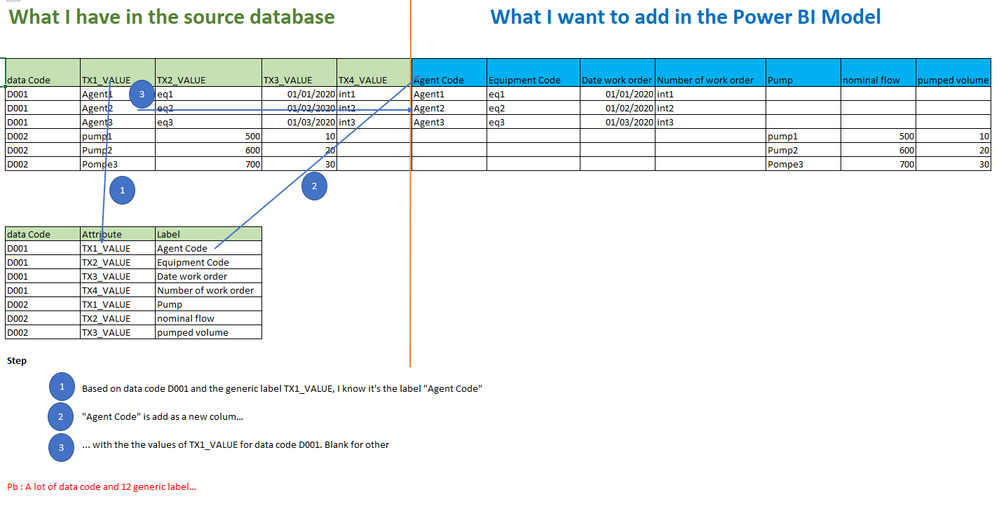
Sorry, I can understand than it's not understable :=)
Probably better with the image below. Tell me if it's better even if you don't have any solution. Thanks.
Laurent


- Mark as New
- Bookmark
- Subscribe
- Mute
- Subscribe to RSS Feed
- Permalink
- Report Inappropriate Content
Hi @lhdp
Check my pbix below, if you have any problem, feel free to let me know.
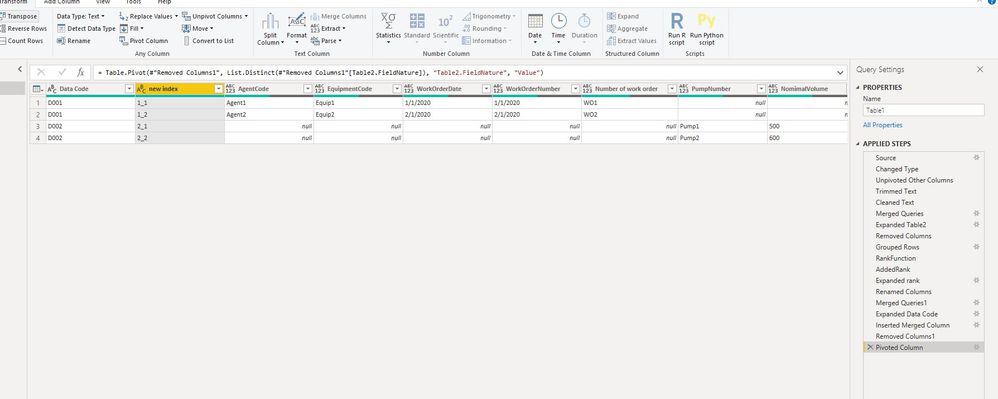
Table1
let
    Source = Table.FromRows(Json.Document(Binary.Decompress(Binary.FromText("i45WcjEwMDy0QElHyTE9Na8Ewjy0wLWwNLMAxjHUN9Q3MjAyAHPD/Q2VYnXQ9Rkh64NxjFD1GcH0QeQDSnPhNpgaGMD0GBhagJkmEDEMLTDDzZC1WIKZQB1gLbEA", BinaryEncoding.Base64), Compression.Deflate)), let _t = ((type text) meta [Serialized.Text = true]) in type table [#"Data Code " = _t, #" TX1_VALUE " = _t, TX2_VALUE = _t, TX3_VALUE = _t, TX4_VALUE = _t]),
    #"Changed Type" = Table.TransformColumnTypes(Source,{{"Data Code ", type text}, {" TX1_VALUE ", type text}, {"TX2_VALUE", type text}, {"TX3_VALUE", type text}, {"TX4_VALUE", type text}}),
    #"Unpivoted Other Columns" = Table.UnpivotOtherColumns(#"Changed Type", {"Data Code "}, "Attribute", "Value"),
    #"Trimmed Text" = Table.TransformColumns(#"Unpivoted Other Columns",{{"Data Code ", Text.Trim, type text}, {"Attribute", Text.Trim, type text}, {"Value", Text.Trim, type text}}),
    #"Cleaned Text" = Table.TransformColumns(#"Trimmed Text",{{"Data Code ", Text.Clean, type text}, {"Attribute", Text.Clean, type text}, {"Value", Text.Clean, type text}}),
    #"Merged Queries" = Table.NestedJoin(#"Cleaned Text", {"Data Code ", "Attribute"}, Table2, {"Data Code", "Field"}, "Table2", JoinKind.LeftOuter),
    #"Expanded Table2" = Table.ExpandTableColumn(#"Merged Queries", "Table2", {"FieldNature"}, {"Table2.FieldNature"}),
    #"Removed Columns" = Table.RemoveColumns(#"Expanded Table2",{"Attribute"}),
    #"Grouped Rows" = Table.Group(#"Removed Columns", {"Data Code ", "Table2.FieldNature"}, { {"rank", each _, type table [#"Data Code "=text, Value=text, Table2.FieldNature=text]}}),
    RankFunction = (tabletorank as table) as table =>
     let
      SortRows = Table.Sort(tabletorank,{{"Value", Order.Ascending}}),
      AddIndex = Table.AddIndexColumn(SortRows, "Rank", 1, 1)
     in
      AddIndex,
    AddedRank = Table.TransformColumns(#"Grouped Rows", {"rank", each RankFunction(_)}),
    #"Expanded rank" = Table.ExpandTableColumn(AddedRank, "rank", {"Value", "Rank"}, {"rank.Value", "rank.Rank"}),
    #"Renamed Columns" = Table.RenameColumns(#"Expanded rank",{{"rank.Value", "Value"}, {"rank.Rank", "Rank"}}),
    #"Merged Queries1" = Table.NestedJoin(#"Renamed Columns", {"Data Code "}, #"Data Code", {"Data Code"}, "Data Code", JoinKind.LeftOuter),
    #"Expanded Data Code" = Table.ExpandTableColumn(#"Merged Queries1", "Data Code", {"Index"}, {"Data Code.Index"}),
    #"Inserted Merged Column" = Table.AddColumn(#"Expanded Data Code", "new index", each Text.Combine({Text.From([Data Code.Index], "en-US"), Text.From([Rank], "en-US")}, "_"), type text),
    #"Removed Columns1" = Table.RemoveColumns(#"Inserted Merged Column",{"Rank", "Data Code.Index"}),
    #"Pivoted Column" = Table.Pivot(#"Removed Columns1", List.Distinct(#"Removed Columns1"[Table2.FieldNature]), "Table2.FieldNature", "Value")
in
    #"Pivoted Column"
Best Regards
Maggie
Community Support Team _ Maggie Li
If this post helps, then please consider Accept it as the solution to help the other members find it more quickly.
- Mark as New
- Bookmark
- Subscribe
- Mute
- Subscribe to RSS Feed
- Permalink
- Report Inappropriate Content
Hi @lhdp
Check my pbix below, if you have any problem, feel free to let me know.
Table1
let
    Source = Table.FromRows(Json.Document(Binary.Decompress(Binary.FromText("i45WcjEwMDy0QElHyTE9Na8Ewjy0wLWwNLMAxjHUN9Q3MjAyAHPD/Q2VYnXQ9Rkh64NxjFD1GcH0QeQDSnPhNpgaGMD0GBhagJkmEDEMLTDDzZC1WIKZQB1gLbEA", BinaryEncoding.Base64), Compression.Deflate)), let _t = ((type text) meta [Serialized.Text = true]) in type table [#"Data Code " = _t, #" TX1_VALUE " = _t, TX2_VALUE = _t, TX3_VALUE = _t, TX4_VALUE = _t]),
    #"Changed Type" = Table.TransformColumnTypes(Source,{{"Data Code ", type text}, {" TX1_VALUE ", type text}, {"TX2_VALUE", type text}, {"TX3_VALUE", type text}, {"TX4_VALUE", type text}}),
    #"Unpivoted Other Columns" = Table.UnpivotOtherColumns(#"Changed Type", {"Data Code "}, "Attribute", "Value"),
    #"Trimmed Text" = Table.TransformColumns(#"Unpivoted Other Columns",{{"Data Code ", Text.Trim, type text}, {"Attribute", Text.Trim, type text}, {"Value", Text.Trim, type text}}),
    #"Cleaned Text" = Table.TransformColumns(#"Trimmed Text",{{"Data Code ", Text.Clean, type text}, {"Attribute", Text.Clean, type text}, {"Value", Text.Clean, type text}}),
    #"Merged Queries" = Table.NestedJoin(#"Cleaned Text", {"Data Code ", "Attribute"}, Table2, {"Data Code", "Field"}, "Table2", JoinKind.LeftOuter),
    #"Expanded Table2" = Table.ExpandTableColumn(#"Merged Queries", "Table2", {"FieldNature"}, {"Table2.FieldNature"}),
    #"Removed Columns" = Table.RemoveColumns(#"Expanded Table2",{"Attribute"}),
    #"Grouped Rows" = Table.Group(#"Removed Columns", {"Data Code ", "Table2.FieldNature"}, { {"rank", each _, type table [#"Data Code "=text, Value=text, Table2.FieldNature=text]}}),
    RankFunction = (tabletorank as table) as table =>
     let
      SortRows = Table.Sort(tabletorank,{{"Value", Order.Ascending}}),
      AddIndex = Table.AddIndexColumn(SortRows, "Rank", 1, 1)
     in
      AddIndex,
    AddedRank = Table.TransformColumns(#"Grouped Rows", {"rank", each RankFunction(_)}),
    #"Expanded rank" = Table.ExpandTableColumn(AddedRank, "rank", {"Value", "Rank"}, {"rank.Value", "rank.Rank"}),
    #"Renamed Columns" = Table.RenameColumns(#"Expanded rank",{{"rank.Value", "Value"}, {"rank.Rank", "Rank"}}),
    #"Merged Queries1" = Table.NestedJoin(#"Renamed Columns", {"Data Code "}, #"Data Code", {"Data Code"}, "Data Code", JoinKind.LeftOuter),
    #"Expanded Data Code" = Table.ExpandTableColumn(#"Merged Queries1", "Data Code", {"Index"}, {"Data Code.Index"}),
    #"Inserted Merged Column" = Table.AddColumn(#"Expanded Data Code", "new index", each Text.Combine({Text.From([Data Code.Index], "en-US"), Text.From([Rank], "en-US")}, "_"), type text),
    #"Removed Columns1" = Table.RemoveColumns(#"Inserted Merged Column",{"Rank", "Data Code.Index"}),
    #"Pivoted Column" = Table.Pivot(#"Removed Columns1", List.Distinct(#"Removed Columns1"[Table2.FieldNature]), "Table2.FieldNature", "Value")
in
    #"Pivoted Column"
Best Regards
Maggie
Community Support Team _ Maggie Li
If this post helps, then please consider Accept it as the solution to help the other members find it more quickly.
- Mark as New
- Bookmark
- Subscribe
- Mute
- Subscribe to RSS Feed
- Permalink
- Report Inappropriate Content
Thanks to you ! 😀It's ok with of course some adjustment depend on my context.


- Mark as New
- Bookmark
- Subscribe
- Mute
- Subscribe to RSS Feed
- Permalink
- Report Inappropriate Content
Follow on LinkedIn
@ me in replies or I'll lose your thread!!!
Instead of a Kudo, please vote for this idea
Become an expert!: Enterprise DNA
External Tools: MSHGQM
YouTube Channel!: Microsoft Hates Greg
Latest book!: DAX For Humans
DAX is easy, CALCULATE makes DAX hard...
- Mark as New
- Bookmark
- Subscribe
- Mute
- Subscribe to RSS Feed
- Permalink
- Report Inappropriate Content
Sorry, I can understand than it's not understable :=)
Probably better with the image below. Tell me if it's better even if you don't have any solution. Thanks.
Laurent

Helpful resources

FabCon & SQLCon – Barcelona 2026
Join us in Barcelona for FabCon and SQLCon, the Fabric, Power BI, SQL, and AI community event. Save €200 with code FABCMTY200.

Fabric Community Sticker Challenge - Barcelona 2026
If you love stickers, then you will definitely want to check out our community sticker challenge, Barcelona edition!

Power BI Monthly Update - July 2026
Check out the July 2026 Power BI update to learn about new features.

Power BI DataViz World Championships - June 2026
A new Power BI DataViz World Championship is coming this June! Don't miss out on submitting your entry.


