Get certified for free when you join Fabric Data Days 2026 and dive into Fabric, Power BI, SQL, AI, and other essential data skills.
Join nowTry your skills in the Power BI Dataviz World Championship! Round one ends June 26. Join now
Hi all,
I would like to create a 3 columns table in Power Query giving the complete combinations from 3 dimensions. E.g.:
- Agent : Bob, Cathy, Bernie (actually this list could contain 100 names)
- Year : 2021, 2022, 2023
- Week : 1 to 52
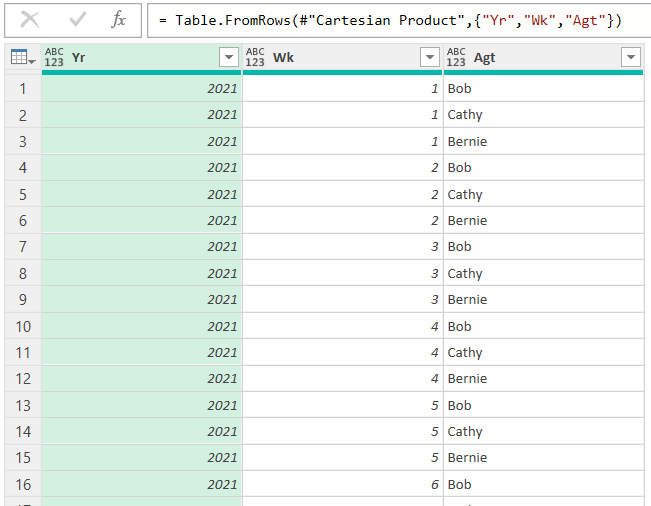
The result should give something like :
| Year | Week | Agent |
| 2021 | 1 | Bob |
| 2021 | 1 | Cathy |
| 2021 | 1 | Bernie |
| 2021 | 2 | Bob |
| 2021 | 2 | Cathy |
| 2021 | 2 | Bernie |
| 2021 | 3 | Bob |
| 2021 | 3 | Cathy |
| 2021 | 3 | Bernie |
and so on, until 2023; 52; Bernie.
Any tips?
Thanks a lot !
Solved! Go to Solution.
This is called a Cartesian product or a cross-join.
You can use this method twice for 3 dimensions:
Cross join - Power Query | Microsoft Learn
Enjoy elegance of Power Query!
let
Agents = {"Bob","Cathy","Bernie"},
Years = {2021 .. 2023},
Weeks = {1 .. 52},
#"Cartesian Product" =
List.Accumulate(
{Agents,Weeks,Years},
{{}},
(s,c) => List.TransformMany(c, each s, (x,y) => {x} & (if Value.Is(y, type list) then y else {y}))
),
#"To Table" = Table.FromRows(#"Cartesian Product",{"Yr","Wk","Agt"})
in
#"To Table"Expertise = List.Accumulate( {Days as from Today}, {Skills and Knowledge}, (Current, Everyday) => Current & Day.LearnAndPractise(Everyday) ) |
This is called a Cartesian product or a cross-join.
You can use this method twice for 3 dimensions:
Cross join - Power Query | Microsoft Learn
So easy 🙂
Thanks a lot !
Don't miss out on Data Days, June 15 through August 7. Learn Fabric, Power BI, SQL, AI and more.
Check out the May 2026 Power BI update to learn about new features.
| User | Count |
|---|---|
| 4 | |
| 4 | |
| 2 | |
| 2 | |
| 1 |
| User | Count |
|---|---|
| 11 | |
| 10 | |
| 5 | |
| 4 | |
| 4 |