Join us at FabCon Atlanta from March 16 - 20, 2026, for the ultimate Fabric, Power BI, AI and SQL community-led event. Save $200 with code FABCOMM.
Register now!The Power BI Data Visualization World Championships is back! It's time to submit your entry. Live now!
I cannot see the Salesforce work order object via the power query or power BI desktop connector. I can succesfully view and query many other objects but the work object does not appear in the power query navigator view (see screenshot). This article states that the work order object is supported by API version 36.0 and later so perhaps power query uses an earlier version?
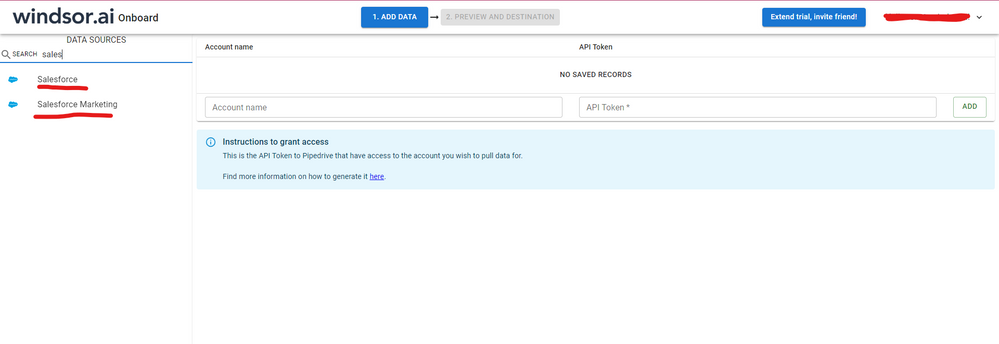
Hi, were you able to find a solution? As a workaround maybe you can try to test your connection with a 3rd party connector, which pulls data directly from the SF objects API. I've tried windsor.ai, supermetrics and funnel.io. I stayed with windsor because it is much cheaper so just to let you know other options. In case you wonder, to make the connection first search for the Salesforce connector in the data sources list:
After that, just grant access to your Salesforce account using your credentials, then on preview and destination page you will see a preview of your Salesforce fields:
There just select the fields you need. It is also compatible with custom fields and custom objects, so you'll be able to export them through windsor. Finally, just select PBI as your data destination and finally just copy and paste the url on PBI --> Get Data --> Web --> Paste the url.
Hi @Anonymous,
I am not able to view your screenshot.
However, if you have sufficient permissions on these standard objects in Salesforce, and you are not able to view all standard objects which are available in API version 36.0 or later, I agree with you, the Power BI Desktop may use earlier version of Salesforce API.
Thanks,
Lydia Zhang
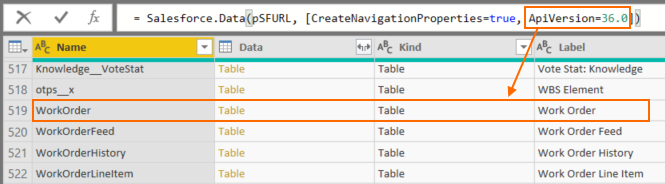
To access Work Order, you can specify the version of the API used by the connector :
Salesforce.Data(URL, [CreateNavigationProperties=true, ApiVersion=36.0]
Please accept @Anonymous solution,
I can confirm this works. FYI API version at this point in time is up to v45
| User | Count |
|---|---|
| 19 | |
| 12 | |
| 8 | |
| 8 | |
| 7 |