
Don't miss your chance to take the Fabric Data Engineer (DP-700) exam on us!
Learn moreWe've captured the moments from FabCon & SQLCon that everyone is talking about, and we are bringing them to the community, live and on-demand. Starts on April 14th. Register now
Hello PBI Community Good Day!
What I'm trying to accomplish:
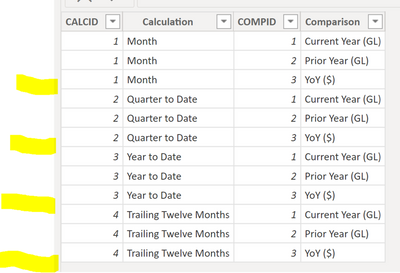
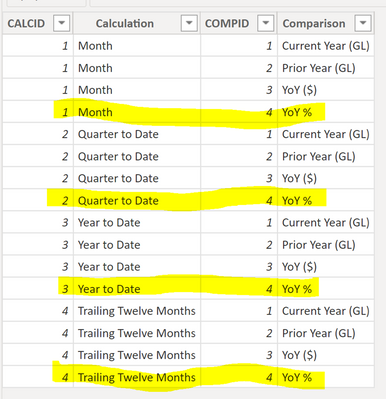
I need to add 4 rows to an existing independent table in my .pbix, so I can show YoY % in my matrix visual.
Screen shots below
Wondering if this is possibile, if how would I go about doing it?
Much appreciate your time.
Thank you
*****Existing table*****
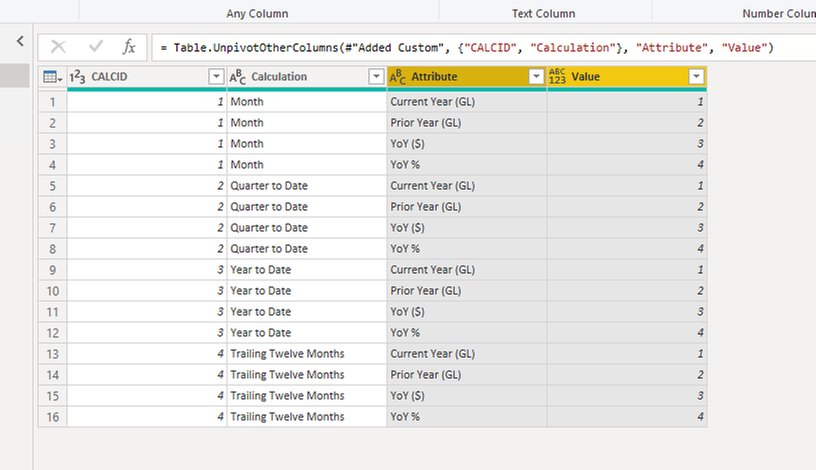
***Want to add the rows highlighted****
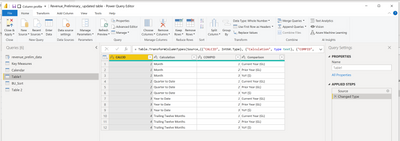
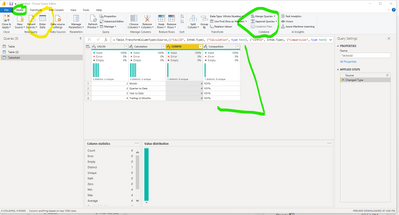
Here is the existing table in Power Query
Solved! Go to Solution.
Hi @PBI-Curious ,
If I understand your question, create a new table in Power Query by Enter Data, as I have done. Then select your original table. Next append Queries. Select your new table as the second table.
Let me know if you have any questions.
If this solves your issues, please mark it as the solution, so that others can find it easily. Kudos 👍are nice too.
Nathaniel
Proud to be a Super User!
Hi @PBI-Curious ,
Here's my solution.
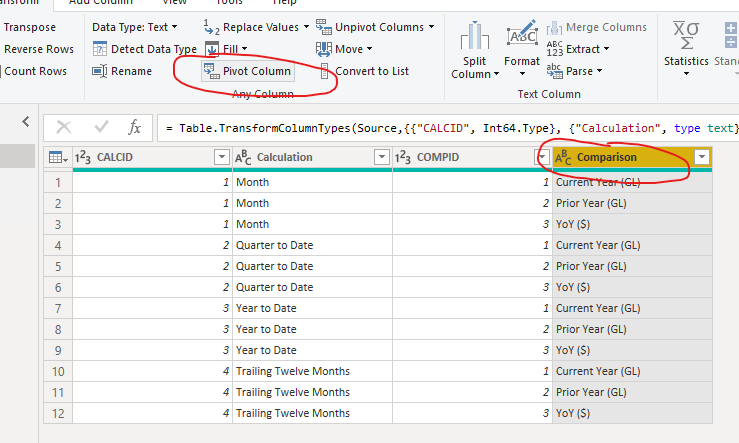
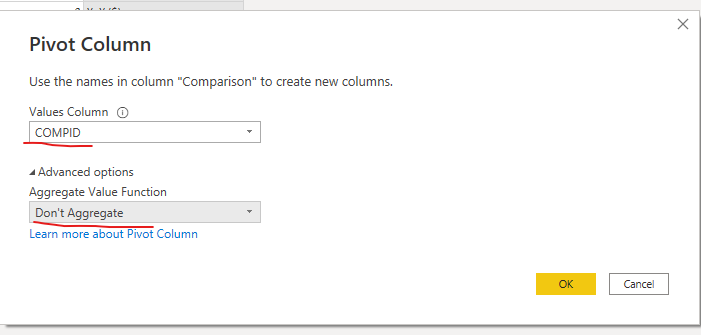
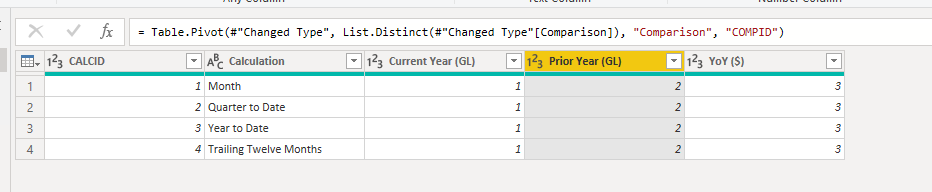
1.Select the Comparsion column, then click 'Pivot Column'.
Set up as follows and click OK.
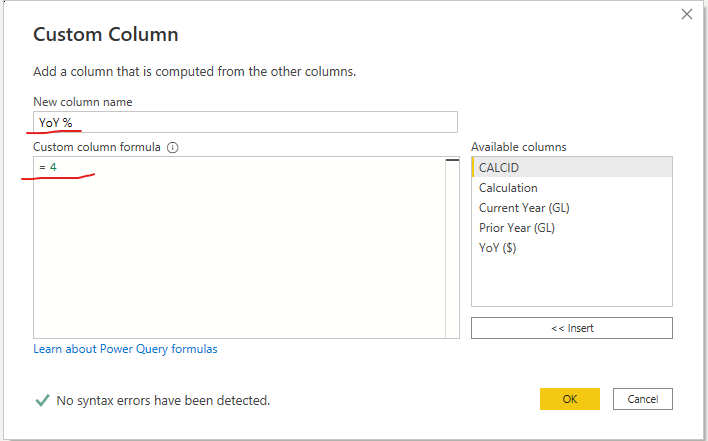
2.Add a custom column named 'YoY %', the value is 4.
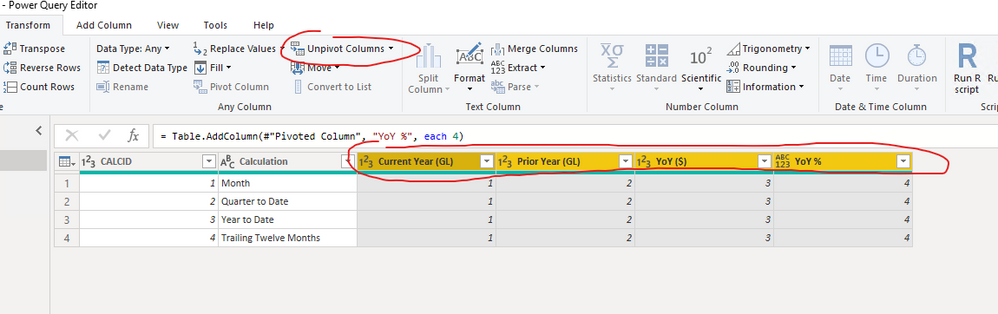
3.Unpivot the 4 columns and rename the columns.
Best Regards,
Stephen Tao
If this post helps, then please consider Accept it as the solution to help the other members find it more quickly.
NewStep=Table.Combine(Table.Group(PreviousStepName,"CALCID",{"n",each _&#table(Table.ColumnNames(_),{{[CALCID]{0},[Calculation]{0},4,"YoY %"}})})[n])
Hi @PBI-Curious ,
Here's my solution.
1.Select the Comparsion column, then click 'Pivot Column'.
Set up as follows and click OK.
2.Add a custom column named 'YoY %', the value is 4.
3.Unpivot the 4 columns and rename the columns.
Best Regards,
Stephen Tao
If this post helps, then please consider Accept it as the solution to help the other members find it more quickly.
Hi @PBI-Curious ,
Let me know if you have any questions.
If this solves your issues, please mark it as the solution, so that others can find it easily. Kudos 👍are nice too.
Nathaniel
Proud to be a Super User!
Hi @PBI-Curious ,
If I understand your question, create a new table in Power Query by Enter Data, as I have done. Then select your original table. Next append Queries. Select your new table as the second table.
Let me know if you have any questions.
If this solves your issues, please mark it as the solution, so that others can find it easily. Kudos 👍are nice too.
Nathaniel
Proud to be a Super User!
If you have recently started exploring Fabric, we'd love to hear how it's going. Your feedback can help with product improvements.
A new Power BI DataViz World Championship is coming this June! Don't miss out on submitting your entry.
Share feedback directly with Fabric product managers, participate in targeted research studies and influence the Fabric roadmap.
| User | Count |
|---|---|
| 5 | |
| 4 | |
| 3 | |
| 3 | |
| 2 |
| User | Count |
|---|---|
| 8 | |
| 7 | |
| 6 | |
| 6 | |
| 5 |