This is best Fabric, Power BI, SQL and AI community event. How do we know? The last event sold out! Save €200 with code FABCMTY200.
Register nowA new Data Days event is coming soon! This time we’re going bigger than ever. Fabric, Power BI, SQL, AI and more. Don't miss out.
Hi,
I would like to add new row, Using M Query, for each word after a comma, where all data is the same except for the word after the comma:
Would become:
Solved! Go to Solution.
hi @BrianPBI37QF ,
sample input:
See output using sample data:
the steps are below:
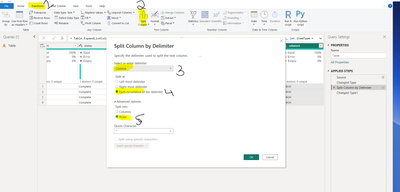
select the column you want to split then:
step1: click on "Transform" tab.
step2: Select split column by delimiter
step3: select the delimeter ( in this case Comma)
step4: Each occurence of delimiter
step5: choose advanced options, select split into rows. then OK.
Alterntatively:
create a blank query. Copy and paste the code below into the advanced editor:
let
Source = Table.FromRows(Json.Document(Binary.Decompress(Binary.FromText("i45WclTSUXLOzy3ISS1JBTKN9Q2M9I0MjIyBbCN9A2MY29nfN8AvBMjw9AsOcfTxAbJ8XZ09dOCEUqxOtJITHsMskDg4TFOKjQUA", BinaryEncoding.Base64), Compression.Deflate)), let _t = ((type nullable text) meta [Serialized.Text = true]) in type table [part = _t, status = _t, date = _t, date2 = _t, column1 = _t, column2 = _t, column3 = _t]),
#"Changed Type" = Table.TransformColumnTypes(Source,{{"part", type text}, {"status", type text}, {"date", type date}, {"date2", type text}, {"column1", type text}, {"column2", type text}, {"column3", type text}}),
#"Split Column by Delimiter" = Table.ExpandListColumn(Table.TransformColumns(#"Changed Type", {{"column3", Splitter.SplitTextByDelimiter(",", QuoteStyle.Csv), let itemType = (type nullable text) meta [Serialized.Text = true] in type {itemType}}}), "column3")
in
#"Split Column by Delimiter"
hi @BrianPBI37QF ,
sample input:
See output using sample data:
the steps are below:
select the column you want to split then:
step1: click on "Transform" tab.
step2: Select split column by delimiter
step3: select the delimeter ( in this case Comma)
step4: Each occurence of delimiter
step5: choose advanced options, select split into rows. then OK.
Alterntatively:
create a blank query. Copy and paste the code below into the advanced editor:
let
Source = Table.FromRows(Json.Document(Binary.Decompress(Binary.FromText("i45WclTSUXLOzy3ISS1JBTKN9Q2M9I0MjIyBbCN9A2MY29nfN8AvBMjw9AsOcfTxAbJ8XZ09dOCEUqxOtJITHsMskDg4TFOKjQUA", BinaryEncoding.Base64), Compression.Deflate)), let _t = ((type nullable text) meta [Serialized.Text = true]) in type table [part = _t, status = _t, date = _t, date2 = _t, column1 = _t, column2 = _t, column3 = _t]),
#"Changed Type" = Table.TransformColumnTypes(Source,{{"part", type text}, {"status", type text}, {"date", type date}, {"date2", type text}, {"column1", type text}, {"column2", type text}, {"column3", type text}}),
#"Split Column by Delimiter" = Table.ExpandListColumn(Table.TransformColumns(#"Changed Type", {{"column3", Splitter.SplitTextByDelimiter(",", QuoteStyle.Csv), let itemType = (type nullable text) meta [Serialized.Text = true] in type {itemType}}}), "column3")
in
#"Split Column by Delimiter"
Check out the May 2026 Power BI update to learn about new features.
Sign up to receive a private message when registration opens and key events begin.
If you have recently started exploring Fabric, we'd love to hear how it's going. Your feedback can help with product improvements.
| User | Count |
|---|---|
| 7 | |
| 6 | |
| 6 | |
| 6 | |
| 4 |

