Don't miss your chance to take the Fabric Data Engineer (DP-600) exam for FREE! Find out how by watching the DP-600 session on-demand now through April 28th.
Learn moreJoin the FabCon + SQLCon recap series. Up next: Power BI, Real-Time Intelligence, IQ and AI, and Data Factory take center stage. All sessions are available on-demand after the live show. Register now
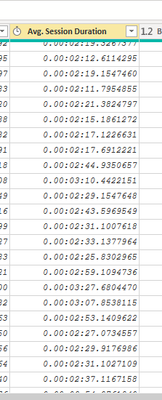
Hi!, I have a column in table1 , like this:
then I have the same column name and format in 2 different tables : Table2 and Table3 .
I need the average of these 3 columns : (table1[avg.Session.Duration] + table2[avg.Session.Duration]+table3[avg.Session.Duration])/3
but the result must be shown in a card in a time format...I mean... if table1 avg time = 1min 10 seg, table2 avg time = 1min 20 seg and table3 avg time = 1min 30 seg, I need to show in a card 00:01:20 in time format (hh:nn:ss) ....How could it be done?
Thanks in advance-!!!!
Solved! Go to Solution.
Hi,
Table1AvgTime =
AVERAGEX(Table1, Table1[Avg. Session Duration])
Table2AvgTime =
AVERAGEX(Table2, Table2[Avg. Session Duration])
Table3AvgTime =
AVERAGEX(Table3, Table3[Avg. Session Duration])
TotalAvg =
DIVIDE(Table1AvgTime + Table2AvgTime + Table3AvgTime, 3)
It would help if you showed the structure of the tabels and model. Ideally you should have dimension tables for fields common to all tables, which would make the calculation straightforward. Having said that, you can try the following measure:
Average Time =
VAR _T1 = SELECTCOLUMNS('Table 1', "Duration", 'Table 1'[Duration 1])
VAR _T2 = SELECTCOLUMNS('Table 2', "Duration", 'Table 2'[Duration 2])
VAR _T3 = SELECTCOLUMNS('Table 3', "Duration", 'Table 3'[Duration 3])
VAR _FinalTable = UNION(_T1, _T2, _T3)
RETURN
CONVERT(AVERAGEX(_FinalTable, [Duration]), DATETIME)
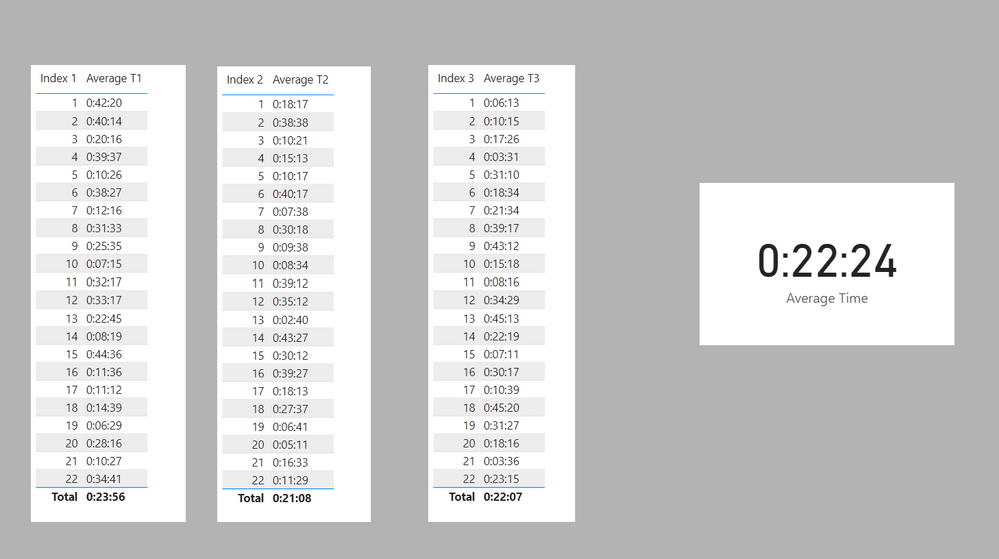
Sample file attached
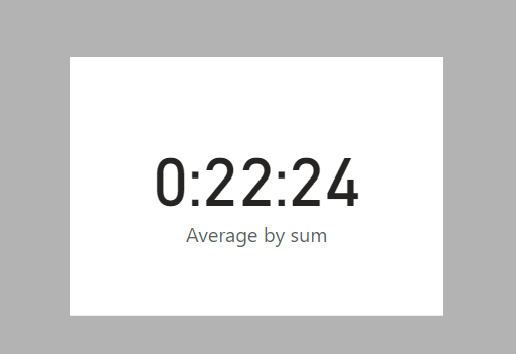
EDIT: I just tested @lukiz84 approach and it delivers the same answer, and is of course much simpler!
Average by sum =
VAR _T1 = AVERAGE('Table 1'[Duration 1])
VAR _T2 = AVERAGE('Table 2'[Duration 2])
VAR _T3 = AVERAGE('Table 3'[Duration 3])
RETURN
CONVERT(DIVIDE(_T1 + _T2 + _T3, 3), DATETIME)
Proud to be a Super User!
Paul on Linkedin.
It would help if you showed the structure of the tabels and model. Ideally you should have dimension tables for fields common to all tables, which would make the calculation straightforward. Having said that, you can try the following measure:
Average Time =
VAR _T1 = SELECTCOLUMNS('Table 1', "Duration", 'Table 1'[Duration 1])
VAR _T2 = SELECTCOLUMNS('Table 2', "Duration", 'Table 2'[Duration 2])
VAR _T3 = SELECTCOLUMNS('Table 3', "Duration", 'Table 3'[Duration 3])
VAR _FinalTable = UNION(_T1, _T2, _T3)
RETURN
CONVERT(AVERAGEX(_FinalTable, [Duration]), DATETIME)
Sample file attached
EDIT: I just tested @lukiz84 approach and it delivers the same answer, and is of course much simpler!
Average by sum =
VAR _T1 = AVERAGE('Table 1'[Duration 1])
VAR _T2 = AVERAGE('Table 2'[Duration 2])
VAR _T3 = AVERAGE('Table 3'[Duration 3])
RETURN
CONVERT(DIVIDE(_T1 + _T2 + _T3, 3), DATETIME)
Proud to be a Super User!
Paul on Linkedin.
Hi,
Table1AvgTime =
AVERAGEX(Table1, Table1[Avg. Session Duration])
Table2AvgTime =
AVERAGEX(Table2, Table2[Avg. Session Duration])
Table3AvgTime =
AVERAGEX(Table3, Table3[Avg. Session Duration])
TotalAvg =
DIVIDE(Table1AvgTime + Table2AvgTime + Table3AvgTime, 3)
Check out the April 2026 Power BI update to learn about new features.
If you have recently started exploring Fabric, we'd love to hear how it's going. Your feedback can help with product improvements.
A new Power BI DataViz World Championship is coming this June! Don't miss out on submitting your entry.
| User | Count |
|---|---|
| 41 | |
| 37 | |
| 34 | |
| 21 | |
| 16 |
| User | Count |
|---|---|
| 64 | |
| 58 | |
| 31 | |
| 25 | |
| 25 |