Get Fabric or SQL Certified for Free.
Get certified for free when you join Fabric Data Days 2026 and dive into Fabric, Power BI, SQL, AI, and other essential data skills.
Join now- Power BI forums
- Get Help with Power BI
- Desktop
- Service
- Report Server
- Power Query
- Mobile Apps
- Developer
- DAX Commands and Tips
- Custom Visuals Development Discussion
- Health and Life Sciences
- Power BI Spanish forums
- Translated Spanish Desktop
- Training and Consulting
- Instructor Led Training
- Dashboard in a Day for Women, by Women
- Galleries
- Data Stories Gallery
- Themes Gallery
- Contests Gallery
- QuickViz Gallery
- Quick Measures Gallery
- Visual Calculations Gallery
- Notebook Gallery
- Translytical Task Flow Gallery
- TMDL Gallery
- R Script Showcase
- Webinars and Video Gallery
- Ideas
- Custom Visuals Ideas (read-only)
- Issues
- Issues
- Events
- Upcoming Events
July 7 - July 17 | Round 2 of the Power BI Dataviz World Championships. Don't miss your chance! Learn more
- Power BI forums
- Forums
- Get Help with Power BI
- Desktop
- Re: difference from previous Friday
- Subscribe to RSS Feed
- Mark Topic as New
- Mark Topic as Read
- Float this Topic for Current User
- Bookmark
- Subscribe
- Printer Friendly Page


- Mark as New
- Bookmark
- Subscribe
- Mute
- Subscribe to RSS Feed
- Permalink
- Report Inappropriate Content
difference from previous Friday
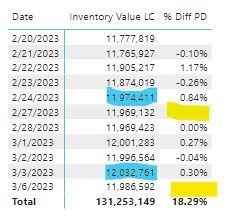
I need to calculate the difference between the amount taken on a day and the amount taken on the previous day. The problem is that on Satruday and Sunday the amount doesn't change, so on Monday my difference ends up being Zero. So I end up with only four days.
I need to subtract Monday from the previous Friday amount.
I have a standard Date Table with offsets and "IsWeekday" type columns.
The blue highlight below shows the amount on prevous Friday. The yellow highlight shows the % amount diff from previous day, or DATEADD, -1, DAY.
Solved! Go to Solution.


- Mark as New
- Bookmark
- Subscribe
- Mute
- Subscribe to RSS Feed
- Permalink
- Report Inappropriate Content
Hi,
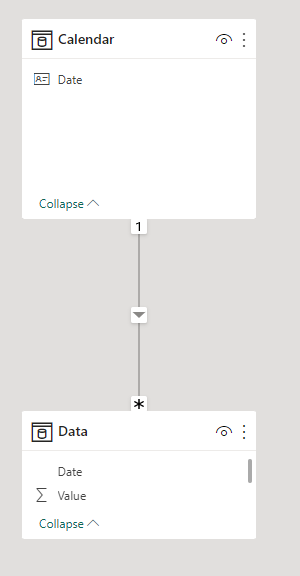
I am not sure how your datamodel looks like, but I tried to create a sample pbix file like below.
There are some ways to achieve this, and I think it depends on how the business process for Saturday and Sunday is defined. I assume there are blank (not zero) data on Sat and Sun, and one of ways to achieve this is using lastnonblank DAX function.
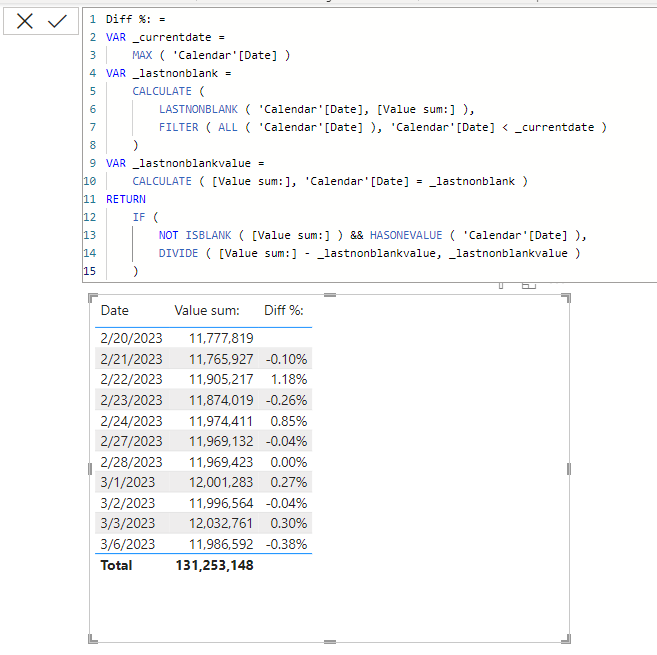
Diff %: =
VAR _currentdate =
    MAX ( 'Calendar'[Date] )
VAR _lastnonblank =
    CALCULATE (
        LASTNONBLANK ( 'Calendar'[Date], [Value sum:] ),
        FILTER ( ALL ( 'Calendar'[Date] ), 'Calendar'[Date] < _currentdate )
    )
VAR _lastnonblankvalue =
    CALCULATE ( [Value sum:], 'Calendar'[Date] = _lastnonblank )
RETURN
    IF (
        NOT ISBLANK ( [Value sum:] ) && HASONEVALUE ( 'Calendar'[Date] ),
        DIVIDE ( [Value sum:] - _lastnonblankvalue, _lastnonblankvalue )
    )
If this post helps, then please consider accepting it as the solution to help other members find it faster, and give a big thumbs up.
Click here to visit my LinkedIn page
- Mark as New
- Bookmark
- Subscribe
- Mute
- Subscribe to RSS Feed
- Permalink
- Report Inappropriate Content
Thank you so much for the assitance! This worked perfectly.

- Mark as New
- Bookmark
- Subscribe
- Mute
- Subscribe to RSS Feed
- Permalink
- Report Inappropriate Content
hi @RobRayborn
apparently Jihwan's solution works.
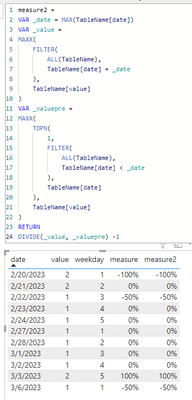
I tried to simulate your case with such data:
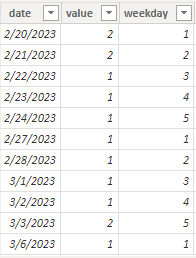
verified by creating a table visual with data, value columns and a measure like:
measure =
VAR _date = MAX(TableName[date])
VAR _value =
MAXX(
    FILTER(
        ALL(TableName),
        TableName[date] = _date
    ),
    TableName[value]
)
VAR _datepre =
MAXX(
    FILTER(
        ALL(TableName),
        TableName[date] < _date
    ),
    TableName[date]
)
VAR _valuepre =
MAXX(
    FILTER(
        ALL(TableName),
        TableName[date] = _datepre
    ),
    TableName[value]
)
RETURN
DIVIDE(_value, _valuepre) -1
or like:
measure2 =
VAR _date = MAX(TableName[date])
VAR _value =
MAXX(
    FILTER(
        ALL(TableName),
        TableName[date] = _date
    ),
    TableName[value]
)
VAR _valuepre =
MAXX(
    TOPN(
        1,
        FILTER(
            ALL(TableName),
            TableName[date] < _date
        ),
        TableName[date]
    ),
    TableName[value]
)
RETURN
DIVIDE(_value, _valuepre) -1
it worked like:
- Mark as New
- Bookmark
- Subscribe
- Mute
- Subscribe to RSS Feed
- Permalink
- Report Inappropriate Content
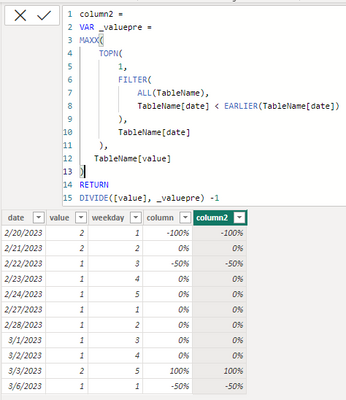
if you also accept calculated columns, try like:
column =
VAR _datepre =
MAXX(
    FILTER(
        ALL(TableName),
        TableName[date] < EARLIER(TableName[date])
    ),
    TableName[date]
)
VAR _valuepre =
MAXX(
    FILTER(
        ALL(TableName),
        TableName[date] = _datepre
    ),
    TableName[value]
)
RETURN
DIVIDE([value], _valuepre) -1
or
column2 =
VAR _valuepre =
MAXX(
    TOPN(
        1,
        FILTER(
            ALL(TableName),
            TableName[date] < EARLIER(TableName[date])
        ),
        TableName[date]
    ),
   TableName[value]
)
RETURN
DIVIDE([value], _valuepre) -1
it worked like:
- Mark as New
- Bookmark
- Subscribe
- Mute
- Subscribe to RSS Feed
- Permalink
- Report Inappropriate Content
Hi,
I am not sure how your datamodel looks like, but I tried to create a sample pbix file like below.
There are some ways to achieve this, and I think it depends on how the business process for Saturday and Sunday is defined. I assume there are blank (not zero) data on Sat and Sun, and one of ways to achieve this is using lastnonblank DAX function.
Diff %: =
VAR _currentdate =
    MAX ( 'Calendar'[Date] )
VAR _lastnonblank =
    CALCULATE (
        LASTNONBLANK ( 'Calendar'[Date], [Value sum:] ),
        FILTER ( ALL ( 'Calendar'[Date] ), 'Calendar'[Date] < _currentdate )
    )
VAR _lastnonblankvalue =
    CALCULATE ( [Value sum:], 'Calendar'[Date] = _lastnonblank )
RETURN
    IF (
        NOT ISBLANK ( [Value sum:] ) && HASONEVALUE ( 'Calendar'[Date] ),
        DIVIDE ( [Value sum:] - _lastnonblankvalue, _lastnonblankvalue )
    )
If this post helps, then please consider accepting it as the solution to help other members find it faster, and give a big thumbs up.
Click here to visit my LinkedIn page
- Mark as New
- Bookmark
- Subscribe
- Mute
- Subscribe to RSS Feed
- Permalink
- Report Inappropriate Content
This does what I asked for it to do, however it seems to have broken the TOTALYTD and DATESYTD measures. I cannot produce a Rolling Annual amount with this solution. Any ideas on how to fix this?

Helpful resources

FabCon & SQLCon – Barcelona 2026
Join us in Barcelona for FabCon and SQLCon, the Fabric, Power BI, SQL, and AI community event. Save €200 with code FABCMTY200.

Data Days 2026
Join Fabric Data Days 2026: 60 days of free live/on-demand sessions, challenges, study groups, and certification opportunities.

Power BI DataViz World Championships - June 2026
A new Power BI DataViz World Championship is coming this June! Don't miss out on submitting your entry.

| User | Count |
|---|---|
| 22 | |
| 20 | |
| 17 | |
| 13 | |
| 13 |


| User | Count |
|---|---|
| 62 | |
| 40 | |
| 38 | |
| 38 | |
| 38 |


