Don't miss your chance to take the Fabric Data Engineer (DP-600) exam for FREE! Find out how by attending the DP-600 session on April 23rd (pacific time), live or on-demand.
Learn moreJoin the FabCon + SQLCon recap series. Up next: Power BI, Real-Time Intelligence, IQ and AI, and Data Factory take center stage. All sessions are available on-demand after the live show. Register now
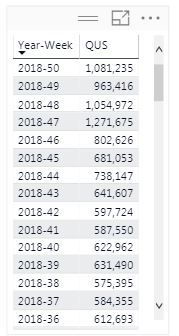
I have a set of data with a Year-Week column.
I want to create a couple of measures for This Year QUS and Last Year QUS so I can see the year on year variance.
So effectively it will show Year-Week 2018-50 as one measure and 2017-50 as another.
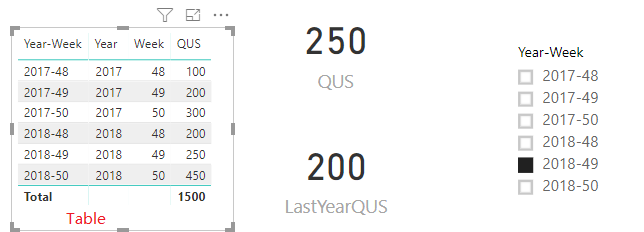
Also, when I have a slicer with the Year-Weeks in if I selected 2018-49 it would then show 2017-49.
If I had a date column I could use SAMEPERIODLASTYEAR but unfortunately I don't
Solved! Go to Solution.
Hi @Anonymous
You may create the Year column and Week column. Then you may get the last year QUS as below.
LastYearQUS =
CALCULATE (
[QUS],
FILTER (
ALL ( Table ),
Table[Year]
= SELECTEDVALUE ( Table[Year] ) - 1
&& Table[Week] = SELECTEDVALUE ( Table[Week] )
)
)
Regards,
Cherie
Hi @Anonymous
You may create the Year column and Week column. Then you may get the last year QUS as below.
LastYearQUS =
CALCULATE (
[QUS],
FILTER (
ALL ( Table ),
Table[Year]
= SELECTEDVALUE ( Table[Year] ) - 1
&& Table[Week] = SELECTEDVALUE ( Table[Week] )
)
)
Regards,
Cherie
Hi @Anonymous
I would suggest you create a new thread on forum so that more community members can see it and provide advice. Please remember to post dummy data and desired result.
Regards,
Cherie
Check out the April 2026 Power BI update to learn about new features.
If you have recently started exploring Fabric, we'd love to hear how it's going. Your feedback can help with product improvements.
A new Power BI DataViz World Championship is coming this June! Don't miss out on submitting your entry.
| User | Count |
|---|---|
| 48 | |
| 46 | |
| 41 | |
| 20 | |
| 17 |
| User | Count |
|---|---|
| 70 | |
| 69 | |
| 32 | |
| 27 | |
| 26 |