Get Fabric or SQL Certified for Free.
Get certified for free when you join Fabric Data Days 2026 and dive into Fabric, Power BI, SQL, AI, and other essential data skills.
Join now- Power BI forums
- Get Help with Power BI
- Desktop
- Service
- Report Server
- Power Query
- Mobile Apps
- Developer
- DAX Commands and Tips
- Custom Visuals Development Discussion
- Health and Life Sciences
- Power BI Spanish forums
- Translated Spanish Desktop
- Training and Consulting
- Instructor Led Training
- Dashboard in a Day for Women, by Women
- Galleries
- Data Stories Gallery
- Themes Gallery
- Contests Gallery
- QuickViz Gallery
- Quick Measures Gallery
- Visual Calculations Gallery
- Fabric Apps Gallery
- Notebook Gallery
- Translytical Task Flow Gallery
- TMDL Gallery
- R Script Showcase
- Webinars and Video Gallery
- Ideas
- Custom Visuals Ideas (read-only)
- Issues
- Issues
- Events
- Upcoming Events
July 7 - July 17 | Round 2 of the Power BI Dataviz World Championships. Don't miss your chance! Learn more
- Power BI forums
- Forums
- Get Help with Power BI
- Desktop
- Re: Transpose Table
- Subscribe to RSS Feed
- Mark Topic as New
- Mark Topic as Read
- Float this Topic for Current User
- Bookmark
- Subscribe
- Printer Friendly Page


- Mark as New
- Bookmark
- Subscribe
- Mute
- Subscribe to RSS Feed
- Permalink
- Report Inappropriate Content
Transpose Table
Hi,
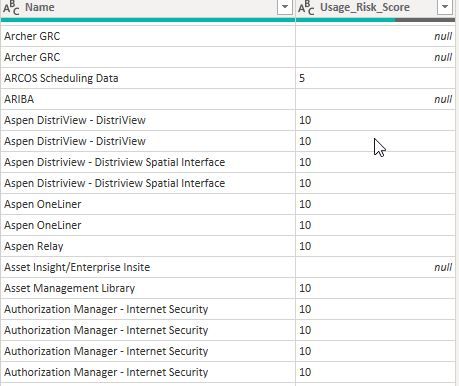
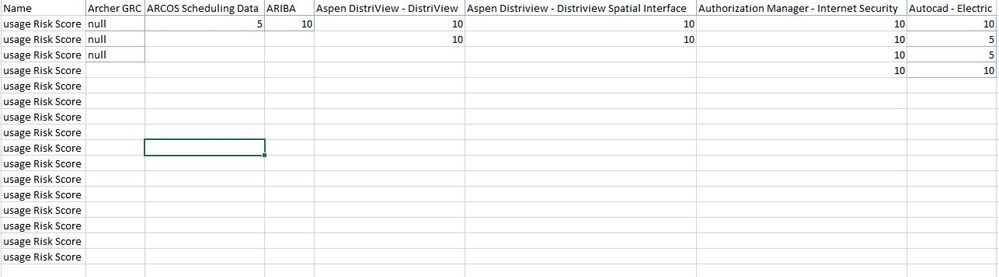
Is there a way to transpose/pivot this (Current picture) table to (Transpose picture) So each name is across the top and the usage risk scores listed below?
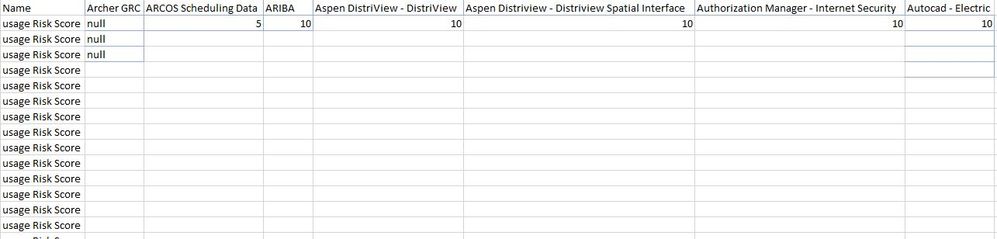
Then ultimatly I want to take highest number to from each list as shown in (Finish picture).
Current
Transpose
Finsh
Solved! Go to Solution.


- Mark as New
- Bookmark
- Subscribe
- Mute
- Subscribe to RSS Feed
- Permalink
- Report Inappropriate Content
Hi @bman6074 ,
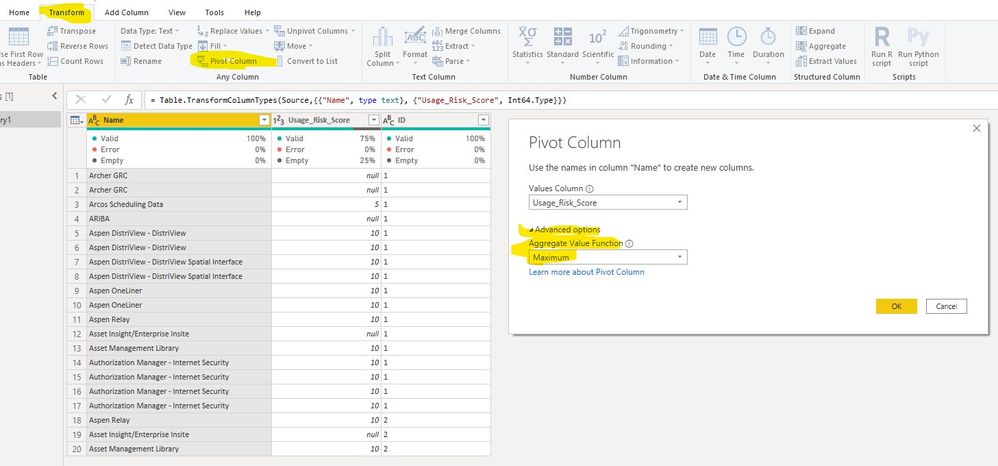
We can transpose it by using "Transform" - "Povit Column" in Power Query Editor, then select maximum as aggreration function:

Or we can append this step in your queries
let
Source = Sql.Databases("database.power bi"),
Powerbi= Source{[Name="powerbi"]}[Data],
snow_AllRelationshipsKeyTable = powerbi{[Schema="snow",Item="AllRelationshipsKeyTable"]}[Data],
#"Changed Type" = Table.TransformColumnTypes(snow_AllRelationshipsKeyTable,{{"EOL", type date}, {"EOSL", type date}, {"LCS_GA", type date}}),
#"Removed Other Columns" = Table.SelectColumns(#"Changed Type",{"Name", "Usage_Risk_Score"}),
PivotStep = Table.Pivot(#"Removed Other Columns", List.Distinct(#"Changed Type"[Name]), "Name", "Usage_Risk_Score", List.Max)
in
PivotStep
By the way, PBIX file as attached.
Best regards,
If this post helps, then please consider Accept it as the solution to help the other members find it more quickly.
- Mark as New
- Bookmark
- Subscribe
- Mute
- Subscribe to RSS Feed
- Permalink
- Report Inappropriate Content
Hi @bman6074 ,
Please try to change the data type of Usage_Risk_Score column to whole number before unpivot,

Or use the following query:
let
Source = Sql.Databases("database.power bi"),
Powerbi= Source{[Name="powerbi"]}[Data],
snow_AllRelationshipsKeyTable = powerbi{[Schema="snow",Item="AllRelationshipsKeyTable"]}[Data],
#"Changed Type" = Table.TransformColumnTypes(snow_AllRelationshipsKeyTable,{{"EOL", type date}, {"EOSL", type date}, {"LCS_GA", type date}}),
#"Removed Other Columns" = Table.SelectColumns(#"Changed Type",{"Name", "Usage_Risk_Score"}),
ChangeType = Table.TransformColumnTypes(#"Removed Other Columns",{{"Name", type text}, {"Usage_Risk_Score", Int64.Type}}),
PivotStep = Table.Pivot(#"ChangeType", List.Distinct(#"Changed Type"[Name]), "Name", "Usage_Risk_Score", List.Max)
in
PivotStep
Best regards,
If this post helps, then please consider Accept it as the solution to help the other members find it more quickly.


- Mark as New
- Bookmark
- Subscribe
- Mute
- Subscribe to RSS Feed
- Permalink
- Report Inappropriate Content


- Mark as New
- Bookmark
- Subscribe
- Mute
- Subscribe to RSS Feed
- Permalink
- Report Inappropriate Content
Hi @bman6074 ,
Try this code on Advanced Editor:
let
Source = Table.FromRows(Json.Document(Binary.Decompress(Binary.FromText("i45WcixKzkgtUnAPclbSUcorzclRitXBI5pfrBAMlEopzcnMS1dwSSxJBCowhcgGeTo5oigvLkjNU3DJLC4pygzLTC1X0EXiABUaEaXK0ICwMoXggsSSzMQcBc+8ktSitMTkVISrSNYHsjAWAA==", BinaryEncoding.Base64), Compression.Deflate)), let _t = ((type text) meta [Serialized.Text = true]) in type table [Name = _t, Usage_Risk_Score = _t]),
#"Changed Type" = Table.TransformColumnTypes(Source,{{"Name", type text}, {"Usage_Risk_Score", Int64.Type}}),
#"Pivoted Column" = Table.Pivot(#"Changed Type", List.Distinct(#"Changed Type"[Name]), "Name", "Usage_Risk_Score", List.Max)
in
#"Pivoted Column"
Ricardo
Did I answer your question? Mark my post as a solution!
Proud to be a Super User!
- Mark as New
- Bookmark
- Subscribe
- Mute
- Subscribe to RSS Feed
- Permalink
- Report Inappropriate Content
Hi Ricardo,
thanks for replying.
How do i add it to the current code in the advance editor?
let
Source = Sql.Databases("database.power bi"),
Powerbi= Source{[Name="powerbi"]}[Data],
snow_AllRelationshipsKeyTable = powerbi{[Schema="snow",Item="AllRelationshipsKeyTable"]}[Data],
#"Changed Type" = Table.TransformColumnTypes(snow_AllRelationshipsKeyTable,{{"EOL", type date}, {"EOSL", type date}, {"LCS_GA", type date}}),
#"Removed Other Columns" = Table.SelectColumns(#"Changed Type",{"Name", "Usage_Risk_Score"})
in
#"Removed Other Columns"
- Mark as New
- Bookmark
- Subscribe
- Mute
- Subscribe to RSS Feed
- Permalink
- Report Inappropriate Content
Hi @bman6074 ,
We can transpose it by using "Transform" - "Povit Column" in Power Query Editor, then select maximum as aggreration function:
Or we can append this step in your queries
let
Source = Sql.Databases("database.power bi"),
Powerbi= Source{[Name="powerbi"]}[Data],
snow_AllRelationshipsKeyTable = powerbi{[Schema="snow",Item="AllRelationshipsKeyTable"]}[Data],
#"Changed Type" = Table.TransformColumnTypes(snow_AllRelationshipsKeyTable,{{"EOL", type date}, {"EOSL", type date}, {"LCS_GA", type date}}),
#"Removed Other Columns" = Table.SelectColumns(#"Changed Type",{"Name", "Usage_Risk_Score"}),
PivotStep = Table.Pivot(#"Removed Other Columns", List.Distinct(#"Changed Type"[Name]), "Name", "Usage_Risk_Score", List.Max)
in
PivotStep
By the way, PBIX file as attached.
Best regards,
If this post helps, then please consider Accept it as the solution to help the other members find it more quickly.
- Mark as New
- Bookmark
- Subscribe
- Mute
- Subscribe to RSS Feed
- Permalink
- Report Inappropriate Content
Hi Community Support Team _ Dong Li
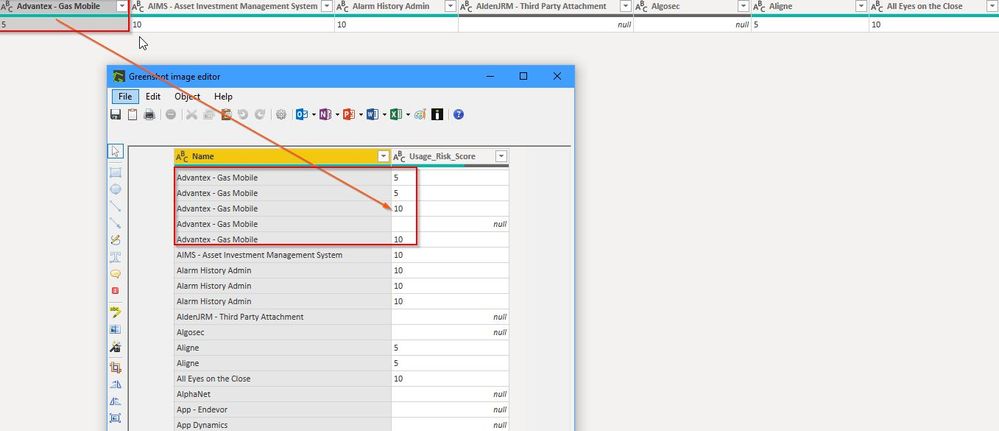
Thanks for the reply. Unfortunatly that doesn't acheive what I need. Its not ending with highest value in the list of usage risk score.
For example the Advantex Gas modile has 4 scores and 2 are 10. Result should end with highest value which would be 10 but it ended up with 5
- Mark as New
- Bookmark
- Subscribe
- Mute
- Subscribe to RSS Feed
- Permalink
- Report Inappropriate Content
Hi @bman6074 ,
Please try to change the data type of Usage_Risk_Score column to whole number before unpivot,
Or use the following query:
let
Source = Sql.Databases("database.power bi"),
Powerbi= Source{[Name="powerbi"]}[Data],
snow_AllRelationshipsKeyTable = powerbi{[Schema="snow",Item="AllRelationshipsKeyTable"]}[Data],
#"Changed Type" = Table.TransformColumnTypes(snow_AllRelationshipsKeyTable,{{"EOL", type date}, {"EOSL", type date}, {"LCS_GA", type date}}),
#"Removed Other Columns" = Table.SelectColumns(#"Changed Type",{"Name", "Usage_Risk_Score"}),
ChangeType = Table.TransformColumnTypes(#"Removed Other Columns",{{"Name", type text}, {"Usage_Risk_Score", Int64.Type}}),
PivotStep = Table.Pivot(#"ChangeType", List.Distinct(#"Changed Type"[Name]), "Name", "Usage_Risk_Score", List.Max)
in
PivotStep
Best regards,
If this post helps, then please consider Accept it as the solution to help the other members find it more quickly.

Helpful resources

FabCon & SQLCon – Barcelona 2026
Join us in Barcelona for FabCon and SQLCon, the Fabric, Power BI, SQL, and AI community event. Save €200 with code FABCMTY200.

Fabric Community Sticker Challenge - Barcelona 2026
If you love stickers, then you will definitely want to check out our community sticker challenge, Barcelona edition!

Power BI Monthly Update - July 2026
Check out the July 2026 Power BI update to learn about new features.

Power BI DataViz World Championships - June 2026
A new Power BI DataViz World Championship is coming this June! Don't miss out on submitting your entry.

| User | Count |
|---|---|
| 30 | |
| 23 | |
| 23 | |
| 23 | |
| 14 |


| User | Count |
|---|---|
| 46 | |
| 33 | |
| 20 | |
| 18 | |
| 16 |


