Join us at FabCon Atlanta from March 16 - 20, 2026, for the ultimate Fabric, Power BI, AI and SQL community-led event. Save $200 with code FABCOMM.
Register now!Learn from the best! Meet the four finalists headed to the FINALS of the Power BI Dataviz World Championships! Register now
Hello,
I'm trying to create a report that tracks employees' tasks they've completed and the role they completed it as.
For example, all employees have a role at the beginning of this year, but some may be promoted. These changes are tracked in the Employees table:
UserID Name Role Date 1 EmployeeA Support 1/1/2018 2 EmployeeB Support 1/1/2018 3 EmployeeC Support 1/1/2018 4 EmployeeD Support 1/1/2018 5 EmployeeE Senior Support 1/1/2018 3 EmployeeC Senior Support 3/18/2018 5 EmployeeE Supervisor 6/4/2018
The tasks they've completed over the year so far are in the Tasks table:
TaskName Date UserID Task A 2/1/2018 2 Task B 2/1/2018 1 Task C 3/1/2018 3 Task D 3/25/2018 3 Task E 5/5/2018 4 Task F 6/3/2018 5 Task G 6/4/2018 5
What I was thinking the output would be is similar to this:
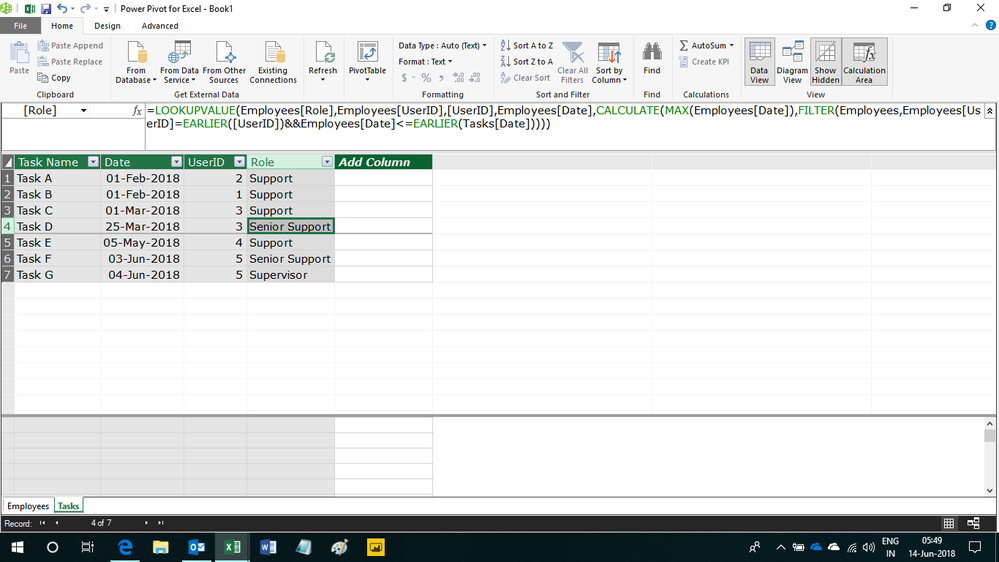
TaskName Date UserID Role Task A 2/1/2018 2 Support Task B 2/1/2018 1 Support Task C 3/1/2018 3 Support Task D 3/25/2018 3 Senior Support Task E 5/5/2018 4 Support Task F 6/3/2018 5 Senior Support Task G 6/4/2018 5 Supervisor
I can sort of achieve this with LOOKUPVALUE and UserID, but I'm having difficulties adding the date part (unless there's a more efficient way to go about doing this?).
Thanks in advance!
Solved! Go to Solution.
Hi,
Write this calculated column formula
=LOOKUPVALUE(Employees[Role],Employees[UserID],[UserID],Employees[Date],CALCULATE(MAX(Employees[Date]),FILTER(Employees,Employees[UserID]=EARLIER([UserID])&&Employees[Date]<=EARLIER(Tasks[Date]))))
Hope this helps.
Hi,
Write this calculated column formula
=LOOKUPVALUE(Employees[Role],Employees[UserID],[UserID],Employees[Date],CALCULATE(MAX(Employees[Date]),FILTER(Employees,Employees[UserID]=EARLIER([UserID])&&Employees[Date]<=EARLIER(Tasks[Date]))))
Hope this helps.
Thank you both! I used Ashish_Mathur's suggested formula and it worked perfectly.
Hey @st-mb
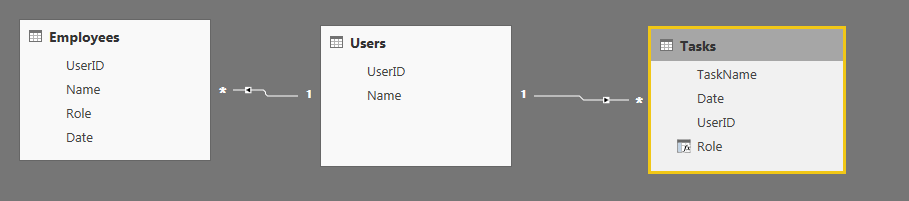
A couple of steps to calculate this. First, I create a table of unique UserID's to connect the Employees and Tasks table.
Then you can calculate the new role column with the following formula:
Role =
VAR CurrentUser = FIRSTNONBLANK(Tasks[UserID],1)
RETURN
CALCULATE(
FIRSTNONBLANK(Employees[Role],1),
TOPN(
1,
FILTER(
Employees,
Employees[UserID] = CurrentUser && Tasks[Date] >= Employees[Date]
),
Employees[Date]
)
)This gives you the desired output, shown below:
Let me know if you have any questions on the formula.
Hope this helps!
Parker
Share feedback directly with Fabric product managers, participate in targeted research studies and influence the Fabric roadmap.
Check out the February 2026 Power BI update to learn about new features.
| User | Count |
|---|---|
| 62 | |
| 54 | |
| 41 | |
| 16 | |
| 14 |
| User | Count |
|---|---|
| 97 | |
| 81 | |
| 35 | |
| 29 | |
| 25 |