Get certified for free when you join Fabric Data Days 2026 and dive into Fabric, Power BI, SQL, AI, and other essential data skills.
Join nowJuly 7 - July 17 | Round 2 of the Power BI Dataviz World Championships. Don't miss your chance! Learn more
Hi,
I have the following code:
_CumulativeFrequencyRateThisYear =
var _table = SUMMARIZECOLUMNS(
'EventYearMonth'[CalendarMonthId],
FILTER(
KEEPFILTERS(VALUES('EventYearMonth'[DateValue])),
AND(
'EventYearMonth'[DateValue] >= DATE(2022, 1, 1),
'EventYearMonth'[DateValue] < DATE(2023, 1, 1)
)),
"_CumulativeFrequencyRateLocal", 'SHEQ'[_CumulativeFrequencyRate]
)
RETURN
AVERAGEX(_table,[_CumulativeFrequencyRateLocal])
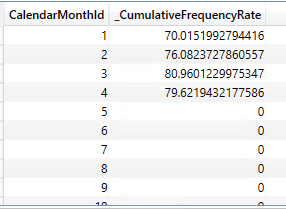
I want to return a visual such as:
However, when I place the measure in the visual with the 'EventYearMonth'[CalendarMonthId] as the axis I get the follwoing error:
SummarizeColumns() and AddMissingItems() may not be used in this context.
Any ideas?
Solved! Go to Solution.
The reason for this is that "SUMMARIZECOLUMNS cannot be used in a context transition. You could use it in a filter, but you cannot invoke SUMMARIZECOLUMNS in a measure because the measure is often called in a context transition." (From Marco's reply to a comment on this article.)
SUMMARIZECOLUMNS is great for writing DAX queries but if you're writing a measure, then you almost always need to use SUMMARIZE instead.
The reason for this is that "SUMMARIZECOLUMNS cannot be used in a context transition. You could use it in a filter, but you cannot invoke SUMMARIZECOLUMNS in a measure because the measure is often called in a context transition." (From Marco's reply to a comment on this article.)
SUMMARIZECOLUMNS is great for writing DAX queries but if you're writing a measure, then you almost always need to use SUMMARIZE instead.
@VendettaBob , try like
_CumulativeFrequencyRateThisYear =
var _table = ADDCOLUMNS(Summarize('SHEQ'
'EventYearMonth'[CalendarMonthId] ),
"_CumulativeFrequencyRateLocal", calculate('SHEQ'[_CumulativeFrequencyRate],FILTER(
KEEPFILTERS(VALUES('EventYearMonth'[DateValue])),
AND(
'EventYearMonth'[DateValue] >= DATE(2022, 1, 1),
'EventYearMonth'[DateValue] < DATE(2023, 1, 1)
)) ))
)
RETURN
AVERAGEX(_table,[_CumulativeFrequencyRateLocal])
Join us in Barcelona for FabCon and SQLCon, the Fabric, Power BI, SQL, and AI community event. Save €200 with code FABCMTY200.
Join Fabric Data Days 2026: 60 days of free live/on-demand sessions, challenges, study groups, and certification opportunities.
| User | Count |
|---|---|
| 22 | |
| 20 | |
| 14 | |
| 13 | |
| 13 |
| User | Count |
|---|---|
| 62 | |
| 40 | |
| 39 | |
| 39 | |
| 38 |