FabCon is coming to Atlanta
Join us at FabCon Atlanta from March 16 - 20, 2026, for the ultimate Fabric, Power BI, AI and SQL community-led event. Save $200 with code FABCOMM.
Register now!- Power BI forums
- Get Help with Power BI
- Desktop
- Service
- Report Server
- Power Query
- Mobile Apps
- Developer
- DAX Commands and Tips
- Custom Visuals Development Discussion
- Health and Life Sciences
- Power BI Spanish forums
- Translated Spanish Desktop
- Training and Consulting
- Instructor Led Training
- Dashboard in a Day for Women, by Women
- Galleries
- Data Stories Gallery
- Themes Gallery
- Contests Gallery
- QuickViz Gallery
- Quick Measures Gallery
- Visual Calculations Gallery
- Notebook Gallery
- Translytical Task Flow Gallery
- TMDL Gallery
- R Script Showcase
- Webinars and Video Gallery
- Ideas
- Custom Visuals Ideas (read-only)
- Issues
- Issues
- Events
- Upcoming Events
The Power BI Data Visualization World Championships is back! Get ahead of the game and start preparing now! Learn more
- Power BI forums
- Forums
- Get Help with Power BI
- Desktop
- Re: Running Total for workdays
- Subscribe to RSS Feed
- Mark Topic as New
- Mark Topic as Read
- Float this Topic for Current User
- Bookmark
- Subscribe
- Printer Friendly Page

- Mark as New
- Bookmark
- Subscribe
- Mute
- Subscribe to RSS Feed
- Permalink
- Report Inappropriate Content
Running Total for workdays
I need some help about making a different calculation.
I have a dataset like that.
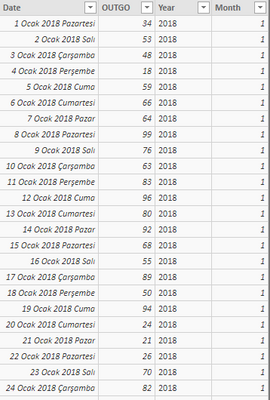
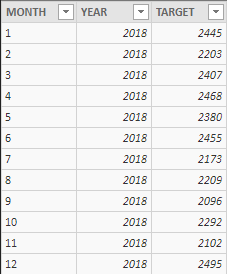
The first table shows how much spent did i for each day, and the second table shows what is the opening target for this month.
The target value only shows the value for first day of month. To calculatate other days target, substract the sum of OUTGO Values.
Example for this dataset to target calculation.
Target For TargetCalculated
1.1.2018 ---- 2445
2.1.2018 ---- 2445 - 34 = 2411
3.1.2018 ---- 2445 - 34 - 53 = 2358
4.1.2018 ---- 2445 - 34 - 53 - 48 = 2310
...
.
.
(The targets in the month table is completly independent from another table)
I want to make a calculation like that,
Firstly it will calculate for each date, how many workdays have after that till the end of month.
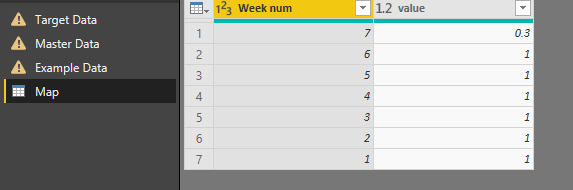
(The workdays logic is like that
| Monday | 1 |
| Tuesday | 1 |
| Wednesday | 1 |
| Thursday | 1 |
| Friday | 1 |
| Saturday | 1 |
| Sunday | 0,3 |
)
The example dataset for this calculation.
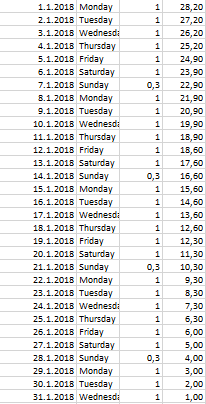
After
It will divide for each day the TargetCalculation and the remaining workdays value.
The expected values for January 2018 first 4 days,
Date NewCalculation
1.1.2018 ---- 86,7021 (2445/28,2)
2.1.2018 ---- 88,6397 (2411/27.2)
3.1.2018 ---- 90 (2358/26.2)
4.1.2018 ---- 91,6667 (2310/25.2)
Pbix File
Solved! Go to Solution.


- Mark as New
- Bookmark
- Subscribe
- Mute
- Subscribe to RSS Feed
- Permalink
- Report Inappropriate Content
Hi @Anonymous,
Based on my test, you could refer to below steps:
Created two columns in 'Master Data' table:
Column = CALCULATE(MAX('Target Data'[TARGET]),FILTER('Target Data','Target Data'[MONTH]='Master Data'[Month]))
Column 2 = [Column]-CALCULATE(SUM('Master Data'[OUTGO]),FILTER('Master Data','Master Data'[Date]<EARLIER('Master Data'[Date])&&'Master Data'[Month]=EARLIER('Master Data'[Month])))
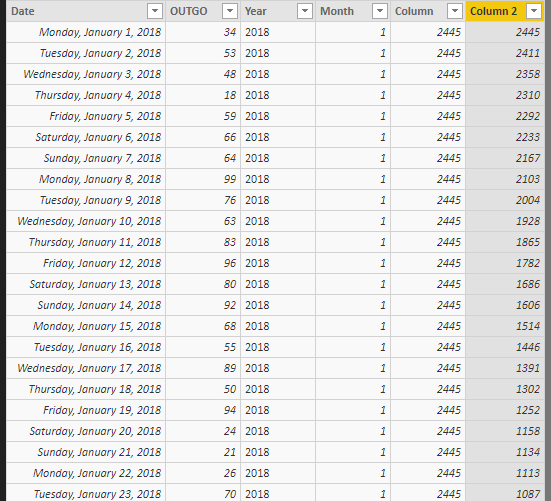
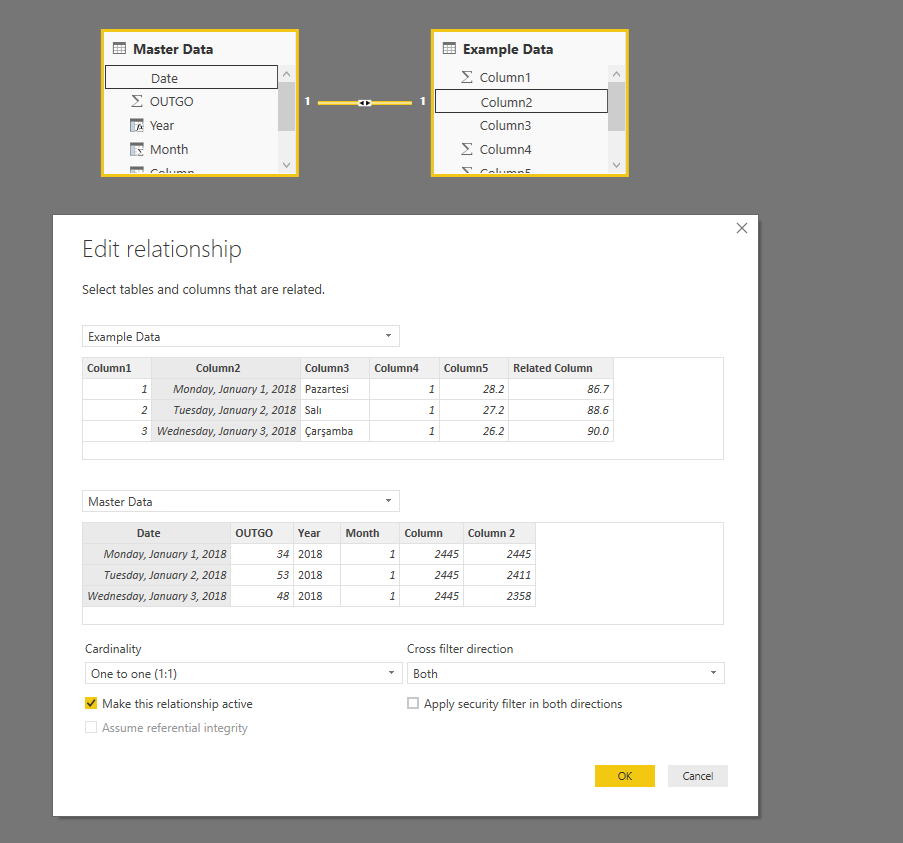
Related Column = DIVIDE(RELATED('Master Data'[Column 2]),'Example Data'[Column5])
Result: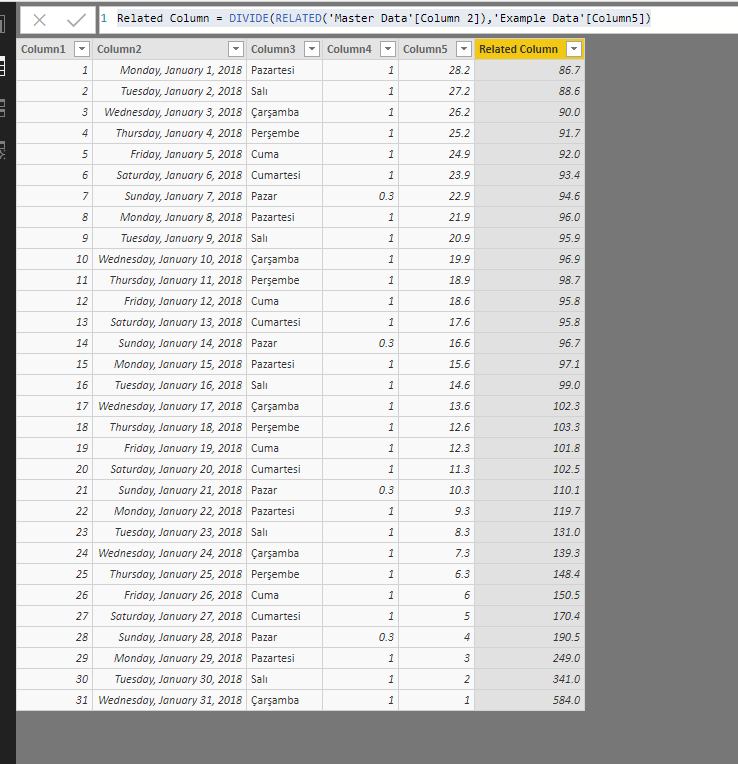
If this post helps, then please consider Accept it as the solution to help the other members find it more quickly.
- Mark as New
- Bookmark
- Subscribe
- Mute
- Subscribe to RSS Feed
- Permalink
- Report Inappropriate Content
Firstly thank you for your reply.
It looks like fine but one case was missed.
Actually i don't have ExampleData table. I was added it for show to 'column5' calculation logic.
I have to make this calculation in MasterData table.
In summary this solution is okey but i need to create a new column like 'Column5' in MasterData table.
- Mark as New
- Bookmark
- Subscribe
- Mute
- Subscribe to RSS Feed
- Permalink
- Report Inappropriate Content
Hi @Anonymous,
Based on my test, you could refer to below steps:
Enter a map table like below:
Create a week number column in 'Master Data' table:
Weeknum = WEEKDAY('Master Data'[Date],2)
Create relationship between two tables:
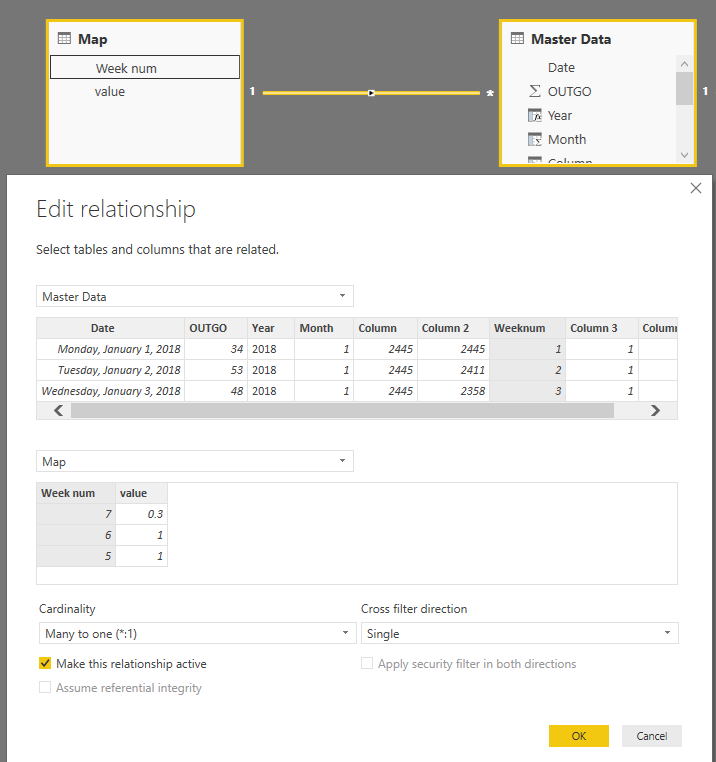
Create below calculated columns:
Column 3 = RELATED(Map[value])
Column 4 = CALCULATE(SUM('Master Data'[Column 3]),FILTER('Master Data','Master Data'[Date]>=EARLIER('Master Data'[Date])&&'Master Data'[Month]=EARLIER('Master Data'[Month])))
Result:
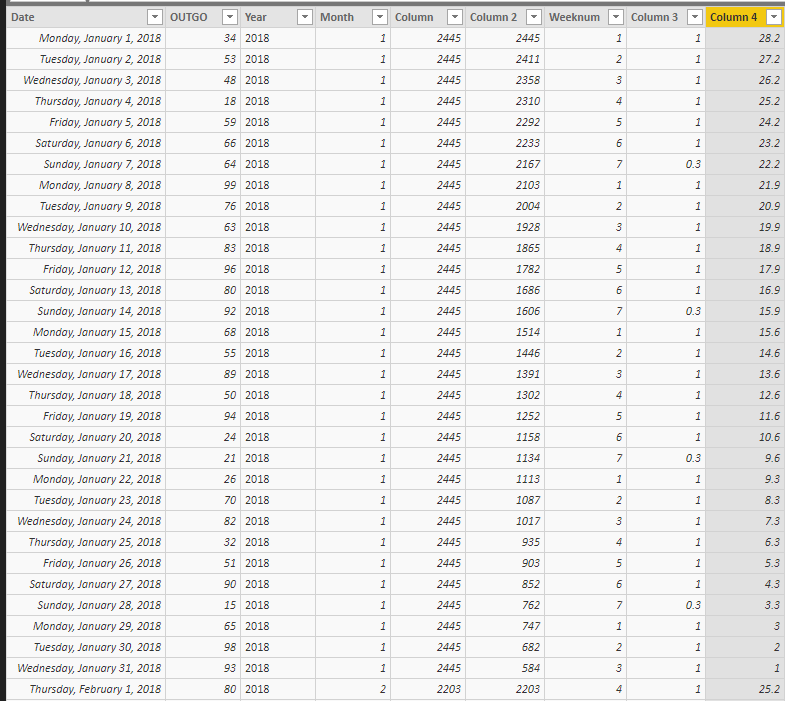
You could also download the pbix file to have a view.
Regards,
Daniel He
If this post helps, then please consider Accept it as the solution to help the other members find it more quickly.
- Mark as New
- Bookmark
- Subscribe
- Mute
- Subscribe to RSS Feed
- Permalink
- Report Inappropriate Content
Hi @Anonymous,
Based on my test, you could refer to below steps:
Created two columns in 'Master Data' table:
Column = CALCULATE(MAX('Target Data'[TARGET]),FILTER('Target Data','Target Data'[MONTH]='Master Data'[Month]))
Column 2 = [Column]-CALCULATE(SUM('Master Data'[OUTGO]),FILTER('Master Data','Master Data'[Date]<EARLIER('Master Data'[Date])&&'Master Data'[Month]=EARLIER('Master Data'[Month])))
Related Column = DIVIDE(RELATED('Master Data'[Column 2]),'Example Data'[Column5])
Result:If this post helps, then please consider Accept it as the solution to help the other members find it more quickly.
- Mark as New
- Bookmark
- Subscribe
- Mute
- Subscribe to RSS Feed
- Permalink
- Report Inappropriate Content
Firstly thank you for your reply.
It looks like fine but one case was missed.
Actually i don't have ExampleData table. I was added it for show to 'column5' calculation logic.
I have to make this calculation in MasterData table.
In summary this solution is okey but i need to create a new column like 'Column5' in MasterData table.
- Mark as New
- Bookmark
- Subscribe
- Mute
- Subscribe to RSS Feed
- Permalink
- Report Inappropriate Content
Hi @Anonymous,
Based on my test, you could refer to below steps:
Enter a map table like below:
Create a week number column in 'Master Data' table:
Weeknum = WEEKDAY('Master Data'[Date],2)
Create relationship between two tables:
Create below calculated columns:
Column 3 = RELATED(Map[value])
Column 4 = CALCULATE(SUM('Master Data'[Column 3]),FILTER('Master Data','Master Data'[Date]>=EARLIER('Master Data'[Date])&&'Master Data'[Month]=EARLIER('Master Data'[Month])))
Result:
You could also download the pbix file to have a view.
Regards,
Daniel He
If this post helps, then please consider Accept it as the solution to help the other members find it more quickly.
Helpful resources

Power BI Dataviz World Championships
The Power BI Data Visualization World Championships is back! Get ahead of the game and start preparing now!

Power BI Monthly Update - December 2025
Check out the December 2025 Power BI Holiday Recap!

FabCon Atlanta 2026
Join us at FabCon Atlanta, March 16-20, for the ultimate Fabric, Power BI, AI and SQL community-led event. Save $200 with code FABCOMM.

| User | Count |
|---|---|
| 38 | |
| 37 | |
| 33 | |
| 32 | |
| 29 |


| User | Count |
|---|---|
| 129 | |
| 88 | |
| 79 | |
| 68 | |
| 63 |


