Don't miss your chance to take the Fabric Data Engineer (DP-600) exam for FREE! Find out how by attending the DP-600 session on April 23rd (pacific time), live or on-demand.
Learn moreNext up in the FabCon + SQLCon recap series: The roadmap for Microsoft SQL and Maximizing Developer experiences in Fabric. All sessions are available on-demand after the live show. Register now
This is my measure for row level security. I look up the username and match the manager should be able to see the employee IDs corresponding to the manager ID.
1 = var stock = LOOKUPVALUE(user_security_dynamic[employee_id]; user_security_dynamic[username]; USERNAME()) RETURN IF(
stock = table1[Manager ID]; 1; 0); but i get this error that a single value for column Manager ID cannot be determined. How can I change this? Thanks
Solved! Go to Solution.
Hi @Anonymous ,
You may refer to Row-level security (RLS) with Power BI.
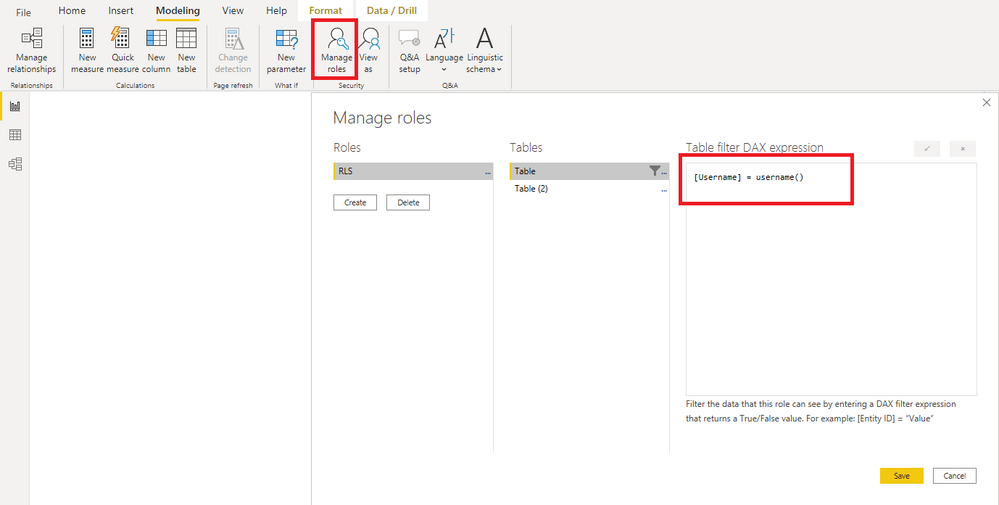
According to your sample data. I create a role in the Manage roles as follows.
[Username] = username()
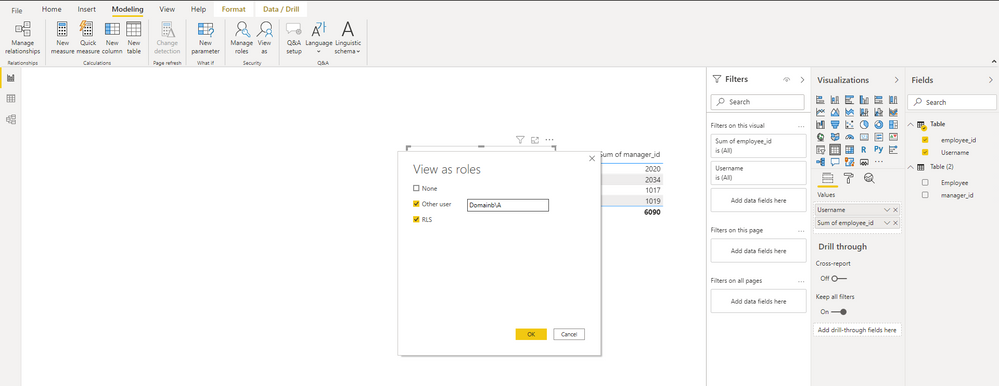
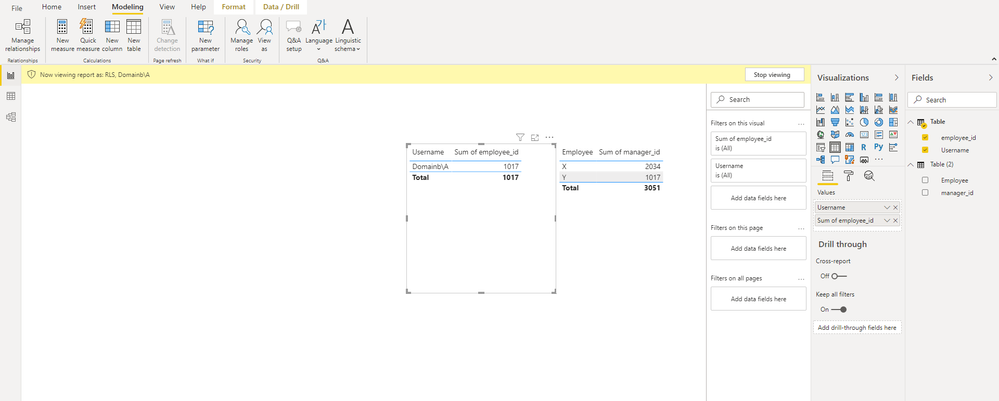
The test is this.
You can check more details from here.
Best Regards,
Stephen Tao
If this post helps, then please consider Accept it as the solution to help the other members find it more quickly.
Hi @Anonymous ,
You may refer to Row-level security (RLS) with Power BI.
According to your sample data. I create a role in the Manage roles as follows.
[Username] = username()
The test is this.
You can check more details from here.
Best Regards,
Stephen Tao
If this post helps, then please consider Accept it as the solution to help the other members find it more quickly.
@Anonymous , how is your data structured? Can you share sample data
In between see if these two can help
https://radacad.com/dynamic-row-level-security-with-organizational-hierarchy-power-bi
https://www.blue-granite.com/blog/using-dynamic-row-level-security-with-organizational-hierarchies
Hi thanks for the link; I did try to impelemnt the links you sent; but those are not for my case.
My user security dynamic looks like this. An employee ID can have multiple usernames.
| Username | employee_id |
| Domain\A | 1017 |
| Domainb\A | 1017 |
| Domain\B | 1019 |
| Domain\C | 2020 |
The rows Im trying to filter looks like this. If employee ID from above table matches with Manager_ID; then those rows should be seen.
| Employee | manager_id |
| X | 1017 |
| X | 1017 |
| Y | 1017 |
| Z | 1019 |
| E | 2020 |
@Anonymous That error regarding multiple values generally means you need to wrap a column reference in an aggregation function like MAX or MIN. This may help: https://community.powerbi.com/t5/Quick-Measures-Gallery/Dynamic-Hierarchical-Row-Level-Security/m-p/889567#M406
Create a calulated column with name "Flag"
FLAG=1
Now write the RLS code on Flag
Flag=IF(table1[employee_id] IN SELECTCOLUMNS(Filter('user_security_dynamic','user_security_dynamic'[UserName]=UserName()),"Id",[Emplyee_id]),1,0)
If you have recently started exploring Fabric, we'd love to hear how it's going. Your feedback can help with product improvements.
A new Power BI DataViz World Championship is coming this June! Don't miss out on submitting your entry.
Share feedback directly with Fabric product managers, participate in targeted research studies and influence the Fabric roadmap.
| User | Count |
|---|---|
| 48 | |
| 43 | |
| 39 | |
| 19 | |
| 17 |
| User | Count |
|---|---|
| 69 | |
| 63 | |
| 32 | |
| 30 | |
| 23 |