This time we’re going bigger than ever. Fabric, Power BI, SQL, AI and more. We're covering it all. You won't want to miss it.
Learn moreDid you hear? There's a new SQL AI Developer certification (DP-800). Start preparing now and be one of the first to get certified. Register now
Dear All,
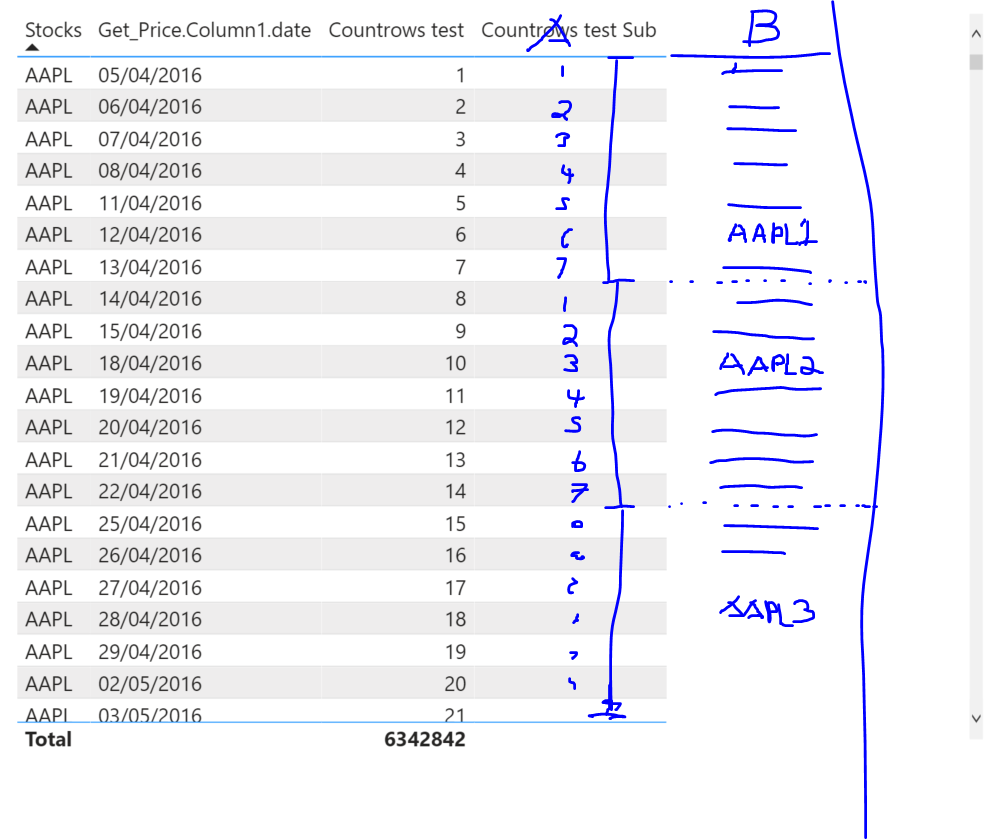
I need to produce two columns, A & B.
In column A : I need to count rows from 1 till 7 and the restart the counter in next row just as in the visual below until the end of the paticular stock eg AAPL.
In column B : I need to give a consecutive unique ID per group of 7 eg. AAPL1 ... AAPL2 ... AAPL3 ...
Would need to create this using calculated columns, i have been trying for hours whithout any luck.
Thnak you for any possible help
Solved! Go to Solution.
@Anonymous , create a new column like
New column = "APPL" & (Quotient([countrows test] -1,7) +1 )
Hi @Anonymous 👋
Can you explain how you generated the "Countrows test" column in the first place ? I need a similar field to create an id identifying which data came before which.
Many thanks and have a great day, 🙂
Hi,
Paste data in a format that can be taken to an MS Excel file. Also, against which number of column A do you want see AAPL1 or AAPL2 - should it be against 1 or 7?
Can you please do such calculations in Power Query, not in DAX? Power Query is the right place for this. In DAX it's possible but will be 1) ugly and 2) slow.
Hi,
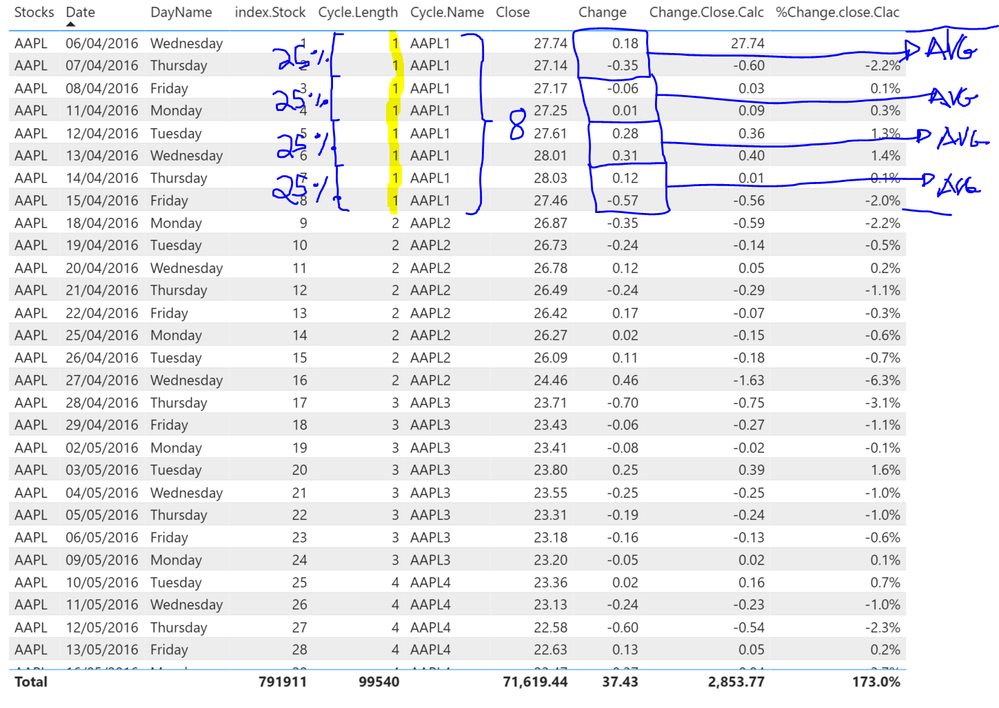
How about doing somting like the following:
Dividing the cycle length into 4 pieces each piece has 2 rows (Dates). Then take the sum of the change column and avarege it out. How would you implement something along those line?
THanks for any help
Hi Amitchandak,
Uuff!!! Thank you very much for the reply, supper easy solution. I was able to create both needed column with your Dax formula.
Million thanks,
Kr
Check out the April 2026 Power BI update to learn about new features.
Sign up to receive a private message when registration opens and key events begin.
If you have recently started exploring Fabric, we'd love to hear how it's going. Your feedback can help with product improvements.
| User | Count |
|---|---|
| 36 | |
| 33 | |
| 31 | |
| 21 | |
| 16 |
| User | Count |
|---|---|
| 66 | |
| 55 | |
| 31 | |
| 26 | |
| 23 |