Get Fabric or SQL Certified for Free.
Get certified for free when you join Fabric Data Days 2026 and dive into Fabric, Power BI, SQL, AI, and other essential data skills.
Join now- Power BI forums
- Get Help with Power BI
- Desktop
- Service
- Report Server
- Power Query
- Mobile Apps
- Developer
- DAX Commands and Tips
- Custom Visuals Development Discussion
- Health and Life Sciences
- Power BI Spanish forums
- Translated Spanish Desktop
- Training and Consulting
- Instructor Led Training
- Dashboard in a Day for Women, by Women
- Galleries
- Data Stories Gallery
- Themes Gallery
- Contests Gallery
- QuickViz Gallery
- Quick Measures Gallery
- Visual Calculations Gallery
- Fabric Apps Gallery
- Notebook Gallery
- Translytical Task Flow Gallery
- TMDL Gallery
- R Script Showcase
- Webinars and Video Gallery
- Ideas
- Custom Visuals Ideas (read-only)
- Issues
- Issues
- Events
- Upcoming Events
July 28 - August 9 | Final Round of the Power BI Dataviz World Championships. This is your chance. Learn more
- Power BI forums
- Forums
- Get Help with Power BI
- Desktop
- Re: Rolling dates
- Subscribe to RSS Feed
- Mark Topic as New
- Mark Topic as Read
- Float this Topic for Current User
- Bookmark
- Subscribe
- Printer Friendly Page


- Mark as New
- Bookmark
- Subscribe
- Mute
- Subscribe to RSS Feed
- Permalink
- Report Inappropriate Content
Rolling dates
Dear all,
I've searched in the community, got some good info and I'm close but still can't get it fixed.
I have the following tables:
- Employees table which contains the columns: "EmployeeID", "Start Date" and "End Date"
- Absence table which containes the columsn: "Employee ID", "Start Date" and "End Date"
My ultimate goal is to calculate the absence hours and divide them by the number of employees in a specific weeknumber and show it on a linechart.
The number of employees I use:
NumberOfEmployees=

CALCULATE (
    DISTINCTCOUNT(Employees[ID]);
    FILTER(
        Employees;
        Employees[Start date]
            <= LASTDATE ( 'Date'[Date])
            && Employees[End date]
                >= FIRSTDATE ( 'Date'[Date]) || ISBLANK(Employees [End date])
    )
)
To get this worked I created a datetable without a relationship.
In this datetable is the weeknumber defined aswell, which I use in the linechart.
Unfortunatly I cant get it done to calculate the absence hours for a given time.
Hope anyone can help me.
Many thanks!
Solved! Go to Solution.
- Mark as New
- Bookmark
- Subscribe
- Mute
- Subscribe to RSS Feed
- Permalink
- Report Inappropriate Content
Hi @dax ,
After some real DAX struggles I found a solution, it might be not the perfect DAX, but for now it works.
I had three tables:
1. Employee table 1 - N 2, Absence table
3. Date table
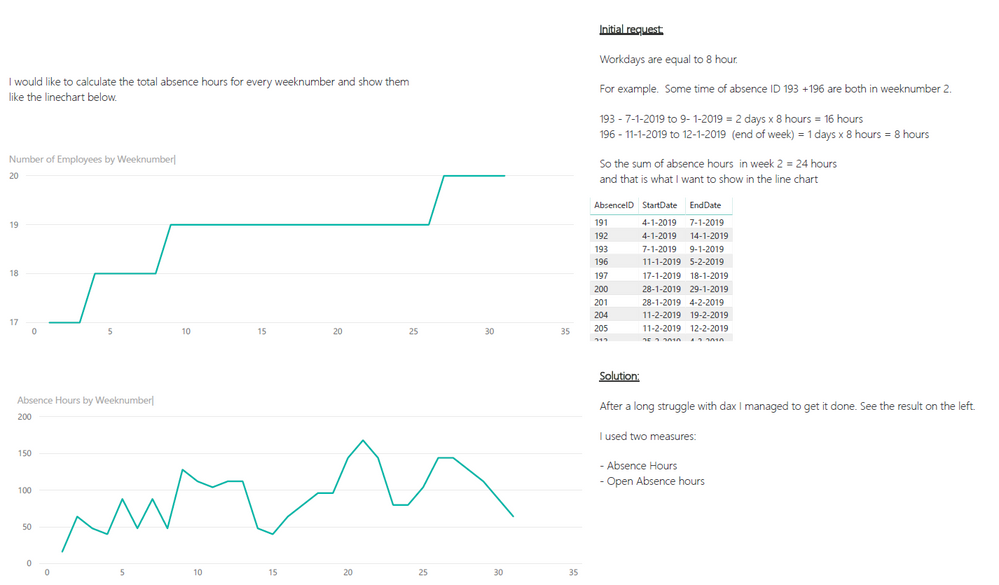
Absence Hours =
VAR OutsideWeek =       //time between start week ---> end week (+1 to exclude sunday)
    SUMX (
        FILTER (
            Absence;
            Absence[StartDate]
                <= FIRSTDATE ( 'Date'[Date] )
                && Absence[EndDate]
                    >= LASTDATE ( 'Date'[Date]))
        ;

            DATEDIFF (
                (FIRSTDATE( 'Date'[Date] ) + 1);
                LASTDATE(  'Date'[Date] );
                DAY
            ) * 8

    )
VAR StartIsOutSideWeek =  // time between start absence ---> end week
    SUMX (
        FILTER (
            Absence;
            Absence[StartDate]
                > FIRSTDATE ( 'Date'[Date] )
                && Absence[StartDate]
                    < LASTDATE ( 'Date'[Date] )
                && Absence[EndDate]
                    >= LASTDATE ( 'Date'[Date] )) ;

        DATEDIFF (
            Absence[StartDate];
            LASTDATE ( 'Date'[Date] );
            DAY
        ) * 8
    )

VAR EndOutsideWeek = // time between start week  ---> end absence (+1 day to exclude sunday)
    SUMX (
        FILTER (
            Absence;
            Absence[StartDate]
                < FIRSTDATE ( 'Date'[Date] )
                && Absence[EndDate]
                > FIRSTDATE( 'Date'[Date] )
                && Absence[EndDate]
                < LASTDATE ( 'Date'[Date] )

        );
        DATEDIFF (
            (FIRSTDATE('Date'[Date])+1);
            Absence[EndDate];
            DAY
        ) * 8
    )


VAR InsideWeek =  // time between start absence ---> end absence
    SUMX (
        FILTER (
            Absence;
            Absence[StartDate]
                >= FIRSTDATE ( 'Date'[Date] )
                && Absence[EndDate]
                <= LASTDATE ( 'Date'[Date] )

        );
        DATEDIFF (
            Absence[StartDate];
            Absence[EndDate];
            DAY
        ) * 8
    )


RETURN
   OutsideWeek + StartIsOutSideWeek + EndOutsideWeek + InsideWeek +[Open Absence Hours]
Open Absence Hours = // calculates the hours for absence with end day blank()
VAR StartPreviousWeek = // time between start absence in previous week ---> end week
SUMX (
FILTER (
Absence;
Absence[StartDate]
< LASTDATE ( 'Date'[Date] )
&& Absence[StartDate]
> FIRSTDATE ( 'Date'[Date] )
&& Absence[EndDate]
= BLANK ()
);
DATEDIFF (
Absence[StartDate];
LASTDATE ( 'Date'[Date] );
DAY
) * 8
)
VAR StartOutsideWeek =
SUMX (
FILTER (
Absence;
Absence[StartDate]
<= FIRSTDATE ( 'Date'[Date] )
&& Absence[EndDate]
= BLANK ()
);
DATEDIFF (
(
FIRSTDATE ( 'Date'[Date] ) + 1
);
LASTDATE ( 'Date'[Date] );
DAY
) * 8
)
RETURN
StartOutsideWeek + StartPreviousWeek
For more details, you can check the file here:
https://www.dropbox.com/s/jte4onfidloiepz/Example.pbix?dl=0
Thanks,
Bwl.
- Mark as New
- Bookmark
- Subscribe
- Mute
- Subscribe to RSS Feed
- Permalink
- Report Inappropriate Content
Hi @dax ,
After some real DAX struggles I found a solution, it might be not the perfect DAX, but for now it works.
I had three tables:
1. Employee table 1 - N 2, Absence table
3. Date table
Absence Hours =
VAR OutsideWeek =       //time between start week ---> end week (+1 to exclude sunday)
    SUMX (
        FILTER (
            Absence;
            Absence[StartDate]
                <= FIRSTDATE ( 'Date'[Date] )
                && Absence[EndDate]
                    >= LASTDATE ( 'Date'[Date]))
        ;

            DATEDIFF (
                (FIRSTDATE( 'Date'[Date] ) + 1);
                LASTDATE(  'Date'[Date] );
                DAY
            ) * 8

    )
VAR StartIsOutSideWeek =  // time between start absence ---> end week
    SUMX (
        FILTER (
            Absence;
            Absence[StartDate]
                > FIRSTDATE ( 'Date'[Date] )
                && Absence[StartDate]
                    < LASTDATE ( 'Date'[Date] )
                && Absence[EndDate]
                    >= LASTDATE ( 'Date'[Date] )) ;

        DATEDIFF (
            Absence[StartDate];
            LASTDATE ( 'Date'[Date] );
            DAY
        ) * 8
    )

VAR EndOutsideWeek = // time between start week  ---> end absence (+1 day to exclude sunday)
    SUMX (
        FILTER (
            Absence;
            Absence[StartDate]
                < FIRSTDATE ( 'Date'[Date] )
                && Absence[EndDate]
                > FIRSTDATE( 'Date'[Date] )
                && Absence[EndDate]
                < LASTDATE ( 'Date'[Date] )

        );
        DATEDIFF (
            (FIRSTDATE('Date'[Date])+1);
            Absence[EndDate];
            DAY
        ) * 8
    )


VAR InsideWeek =  // time between start absence ---> end absence
    SUMX (
        FILTER (
            Absence;
            Absence[StartDate]
                >= FIRSTDATE ( 'Date'[Date] )
                && Absence[EndDate]
                <= LASTDATE ( 'Date'[Date] )

        );
        DATEDIFF (
            Absence[StartDate];
            Absence[EndDate];
            DAY
        ) * 8
    )


RETURN
   OutsideWeek + StartIsOutSideWeek + EndOutsideWeek + InsideWeek +[Open Absence Hours]
Open Absence Hours = // calculates the hours for absence with end day blank()
VAR StartPreviousWeek = // time between start absence in previous week ---> end week
SUMX (
FILTER (
Absence;
Absence[StartDate]
< LASTDATE ( 'Date'[Date] )
&& Absence[StartDate]
> FIRSTDATE ( 'Date'[Date] )
&& Absence[EndDate]
= BLANK ()
);
DATEDIFF (
Absence[StartDate];
LASTDATE ( 'Date'[Date] );
DAY
) * 8
)
VAR StartOutsideWeek =
SUMX (
FILTER (
Absence;
Absence[StartDate]
<= FIRSTDATE ( 'Date'[Date] )
&& Absence[EndDate]
= BLANK ()
);
DATEDIFF (
(
FIRSTDATE ( 'Date'[Date] ) + 1
);
LASTDATE ( 'Date'[Date] );
DAY
) * 8
)
RETURN
StartOutsideWeek + StartPreviousWeek
For more details, you can check the file here:
https://www.dropbox.com/s/jte4onfidloiepz/Example.pbix?dl=0
Thanks,
Bwl.


- Mark as New
- Bookmark
- Subscribe
- Mute
- Subscribe to RSS Feed
- Permalink
- Report Inappropriate Content
Hi BWL,
I can’t reproduce your design just based on your description, so if possible , could you please inform me more detailed information (such as your sample data and your expecting output)? Then I will help you more correctly.
You could refer to How to Get Your Question Answered Quickly for details.
Best Regards,
Zoe Zhi
If this post helps, then please consider Accept it as the solution to help the other members find it more quickly.
- Mark as New
- Bookmark
- Subscribe
- Mute
- Subscribe to RSS Feed
- Permalink
- Report Inappropriate Content
Hi @dax,
Just created at example pbix file.
Can I share it directly with you, because I don't see where I can upload it in this forum.
KInd regards.
- Mark as New
- Bookmark
- Subscribe
- Mute
- Subscribe to RSS Feed
- Permalink
- Report Inappropriate Content
Hi BWL,
You could try to upload pbix file in onedrive or other place which we could access to .
Best Regards,
Zoe Zhi

Helpful resources

FabCon & SQLCon – Barcelona 2026
Join us in Barcelona for FabCon and SQLCon, the Fabric, Power BI, SQL, and AI community event. Save €200 with code FABCMTY200.

Fabric Community Sticker Challenge - Barcelona 2026
If you love stickers, then you will definitely want to check out our community sticker challenge, Barcelona edition!

Power BI Monthly Update - July 2026
Check out the July 2026 Power BI update to learn about new features.

Power BI DataViz World Championships - June 2026
A new Power BI DataViz World Championship is coming this June! Don't miss out on submitting your entry.

| User | Count |
|---|---|
| 30 | |
| 28 | |
| 25 | |
| 24 | |
| 16 |


| User | Count |
|---|---|
| 48 | |
| 32 | |
| 17 | |
| 16 | |
| 16 |


