FabCon is coming to Atlanta
Join us at FabCon Atlanta from March 16 - 20, 2026, for the ultimate Fabric, Power BI, AI and SQL community-led event. Save $200 with code FABCOMM.
Register now!- Power BI forums
- Get Help with Power BI
- Desktop
- Service
- Report Server
- Power Query
- Mobile Apps
- Developer
- DAX Commands and Tips
- Custom Visuals Development Discussion
- Health and Life Sciences
- Power BI Spanish forums
- Translated Spanish Desktop
- Training and Consulting
- Instructor Led Training
- Dashboard in a Day for Women, by Women
- Galleries
- Data Stories Gallery
- Themes Gallery
- Contests Gallery
- QuickViz Gallery
- Quick Measures Gallery
- Visual Calculations Gallery
- Notebook Gallery
- Translytical Task Flow Gallery
- TMDL Gallery
- R Script Showcase
- Webinars and Video Gallery
- Ideas
- Custom Visuals Ideas (read-only)
- Issues
- Issues
- Events
- Upcoming Events
The Power BI Data Visualization World Championships is back! Get ahead of the game and start preparing now! Learn more
- Power BI forums
- Forums
- Get Help with Power BI
- Desktop
- Re: Renewed Tenancy Value KPI
- Subscribe to RSS Feed
- Mark Topic as New
- Mark Topic as Read
- Float this Topic for Current User
- Bookmark
- Subscribe
- Printer Friendly Page


- Mark as New
- Bookmark
- Subscribe
- Mute
- Subscribe to RSS Feed
- Permalink
- Report Inappropriate Content
Renewed Tenancy Value KPI
Hi all, @Greg_Deckler
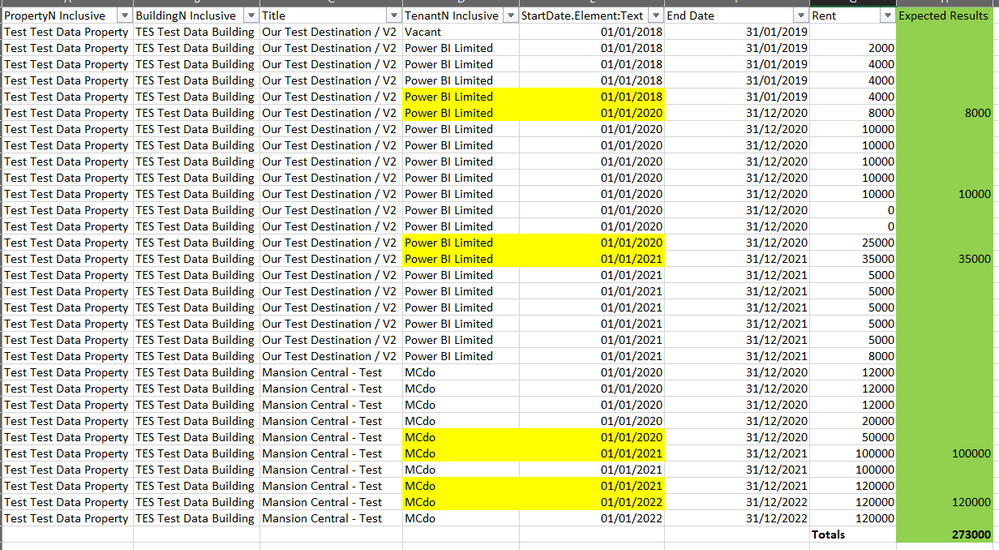
I am required to build a KPI that shows the total value of rent originated from any current tenant that had their Contract renewed.
Table containing the data contains many properties, buildings & units: (Expected Results columns is what I am looking for to achieve) I arranged the data by "Start Date" value but it is not arranged in that order in the actual data table.
Can anyone kindly help?
Thanks
H
Solved! Go to Solution.


- Mark as New
- Bookmark
- Subscribe
- Mute
- Subscribe to RSS Feed
- Permalink
- Report Inappropriate Content
Hi @Calvin69 ,
First create an index column;
Then create 2 columns as below:
_index = CALCULATE(MIN('Table'[Index]),FILTER('Table','Table'[Title]=EARLIER('Table'[Title])&&'Table'[TenantN]=EARLIER('Table'[TenantN])&&'Table'[StartDate]>EARLIER('Table'[StartDate])))
Column =
VAR _previousindex =
    CALCULATE (
        MAX ( 'Table'[_index] ),
        FILTER ( 'Table', 'Table'[Index] = EARLIER ( 'Table'[Index] ) - 1 )
    )
VAR _previousrent =
    CALCULATE (
        MAX ( 'Table'[Rent] ),
        FILTER (
            'Table',
            'Table'[Index]
                = EARLIER ( 'Table'[Index] ) - 1
                && 'Table'[Title] = EARLIER ( 'Table'[Title] )
                && 'Table'[TenantN] = EARLIER ( 'Table'[TenantN] )
        )
    )
RETURN
    IF (
        'Table'[Index] = _previousindex,
        IF ( 'Table'[Rent] > _previousrent, 'Table'[Rent], _previousrent )
    )
And you will see:
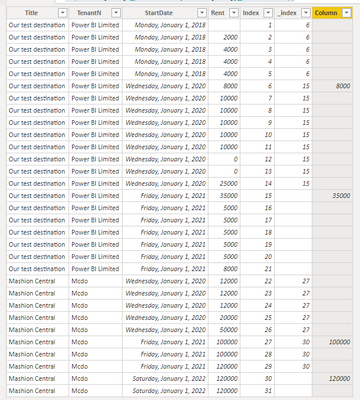
For the related .pbix file,pls see attached.
Best Regards,
Kelly
Did I answer your question? Mark my reply as a solution!
- Mark as New
- Bookmark
- Subscribe
- Mute
- Subscribe to RSS Feed
- Permalink
- Report Inappropriate Content
Hi @Calvin69 ,
How to get the expected output you show?
Best Regards,
Kelly
Did I answer your question? Mark my areply as a solution!
- Mark as New
- Bookmark
- Subscribe
- Mute
- Subscribe to RSS Feed
- Permalink
- Report Inappropriate Content
Hi @v-kelly-msft ,
Logic should be as follow:
When a start date for a Location"Title" is changed to Greater value and the Client"Tenant Inclusive" is still the same comparing it with previous (Location "Title") entries show the "Rent" value.
Thanks for looking into this 🙂
H
- Mark as New
- Bookmark
- Subscribe
- Mute
- Subscribe to RSS Feed
- Permalink
- Report Inappropriate Content
Hi @Calvin69 ,
First create an index column;
Then create 2 columns as below:
_index = CALCULATE(MIN('Table'[Index]),FILTER('Table','Table'[Title]=EARLIER('Table'[Title])&&'Table'[TenantN]=EARLIER('Table'[TenantN])&&'Table'[StartDate]>EARLIER('Table'[StartDate])))
Column =
VAR _previousindex =
    CALCULATE (
        MAX ( 'Table'[_index] ),
        FILTER ( 'Table', 'Table'[Index] = EARLIER ( 'Table'[Index] ) - 1 )
    )
VAR _previousrent =
    CALCULATE (
        MAX ( 'Table'[Rent] ),
        FILTER (
            'Table',
            'Table'[Index]
                = EARLIER ( 'Table'[Index] ) - 1
                && 'Table'[Title] = EARLIER ( 'Table'[Title] )
                && 'Table'[TenantN] = EARLIER ( 'Table'[TenantN] )
        )
    )
RETURN
    IF (
        'Table'[Index] = _previousindex,
        IF ( 'Table'[Rent] > _previousrent, 'Table'[Rent], _previousrent )
    )
And you will see:
For the related .pbix file,pls see attached.
Best Regards,
Kelly
Did I answer your question? Mark my reply as a solution!
- Mark as New
- Bookmark
- Subscribe
- Mute
- Subscribe to RSS Feed
- Permalink
- Report Inappropriate Content
- Mark as New
- Bookmark
- Subscribe
- Mute
- Subscribe to RSS Feed
- Permalink
- Report Inappropriate Content
Hi @Calvin69 ,
It's fine.Glad to help.
Best Regards,
Kelly
Did I answer your question? Mark my reply as a solution!


- Mark as New
- Bookmark
- Subscribe
- Mute
- Subscribe to RSS Feed
- Permalink
- Report Inappropriate Content
@Calvin69 Can you paste that as text or provide a link to a file with sample data? That will speed the entire process.
Follow on LinkedIn
@ me in replies or I'll lose your thread!!!
Instead of a Kudo, please vote for this idea
Become an expert!: Enterprise DNA
External Tools: MSHGQM
YouTube Channel!: Microsoft Hates Greg
Latest book!: DAX For Humans
DAX is easy, CALCULATE makes DAX hard...

Helpful resources

Power BI Dataviz World Championships
The Power BI Data Visualization World Championships is back! Get ahead of the game and start preparing now!

Power BI Monthly Update - December 2025
Check out the December 2025 Power BI Holiday Recap!

FabCon Atlanta 2026
Join us at FabCon Atlanta, March 16-20, for the ultimate Fabric, Power BI, AI and SQL community-led event. Save $200 with code FABCOMM.

| User | Count |
|---|---|
| 39 | |
| 37 | |
| 33 | |
| 32 | |
| 29 |


| User | Count |
|---|---|
| 133 | |
| 88 | |
| 85 | |
| 68 | |
| 64 |


