Don't miss your chance to take the Fabric Data Engineer (DP-600) exam for FREE! Find out how by watching the DP-600 session on-demand now through April 28th.
Learn moreJoin the FabCon + SQLCon recap series. Up next: Power BI, Real-Time Intelligence, IQ and AI, and Data Factory take center stage. All sessions are available on-demand after the live show. Register now
Hello everyone,
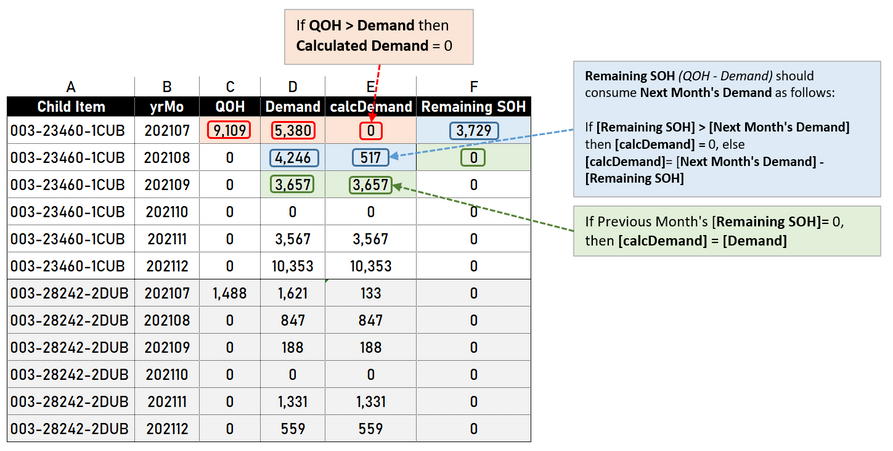
I'm trying to calculate the Remaining Demand (calcDemand) for multiple items by subtracting Current Inventory (QOH) from each Month's Demand. The data is stored in a table like the one shown below:
| Child Item | yrMo | QOH | Demand |
| 003-23460-1CUB | 202107 | 9,109 | 5,380 |
| 003-23460-1CUB | 202108 | 0 | 4,246 |
| 003-23460-1CUB | 202109 | 0 | 3,657 |
| 003-23460-1CUB | 202110 | 0 | 0 |
| 003-23460-1CUB | 202111 | 0 | 3,567 |
| 003-23460-1CUB | 202112 | 0 | 10,353 |
The goal is to obtain a value as shown on Column E on the image below.
Thanks in advance!
Don't bother waiting for a DAX solution to such an issue involving recursion.
| Thanks to the great efforts by MS engineers to simplify syntax of DAX! Most beginners are SUCCESSFULLY MISLED to think that they could easily master DAX; but it turns out that the intricacy of the most frequently used RANKX() is still way beyond their comprehension! |
DAX is simple, but NOT EASY! |
What is the issue here ?
Hi gauravtanwar - I'm looking for a measure/calculation that can deliver the result on column E (calcDemand) which will basically consume demand until Inventory (QOH) drops to zero. Once Inventory has been completely depleted, calcDemand will be equal to Demand (Column D)
In the example shown on the original post
Check out the April 2026 Power BI update to learn about new features.
If you have recently started exploring Fabric, we'd love to hear how it's going. Your feedback can help with product improvements.
A new Power BI DataViz World Championship is coming this June! Don't miss out on submitting your entry.
| User | Count |
|---|---|
| 41 | |
| 37 | |
| 34 | |
| 21 | |
| 16 |
| User | Count |
|---|---|
| 65 | |
| 62 | |
| 31 | |
| 26 | |
| 25 |