Don't miss your chance to take the Fabric Data Engineer (DP-700) exam on us!
Learn moreThe FabCon + SQLCon recap series starts April 14th at 8am Pacific. If you’re tracking where AI is going inside Fabric, this first session is a can't miss. Register now
I have a data that records the member upgrade assessment of our member as below:
customer date prev_member_level current_member_level
John 1Jan2017 Classic Gold
John 4Apr2017 Gold Gold
John 15 Jun2017 Gold Platinum
John 1Dec2017 Platinum Gold
Mary 2Feb2017 Silver Gold
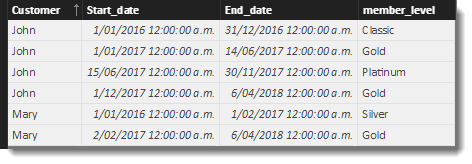
How can i reform the information above to be like table below?
customer start_date end_date member_level
John 1Jan2016 31Dec2016 Classic
John 1Jan2017 14Jun2017 Gold
John 15Jun2017 Today() Platinum
Mary 1Jan2016 1Feb2017 Silver
Mary 2Feb2017 6Apr2018 Gold
Solved! Go to Solution.
HI @Anonymous
This calculated table is getting close. There is a bit going on, but I think it addresses most of the quirks.
I have attached a PBIX file as well
New Table =
VAR RetVal =
ADDCOLUMNS(
'Table',
"Next Date",
MINX(
FILTER(
'Table',
'Table'[Customer] = EARLIER('Table'[Customer]) &&
'Table'[Date] > EARLIER('Table'[Date]) &&
[pre_member_level]<> [current_member_level]
),
[Date]-1)
)
VAR cleanTable = FILTER(RetVal,[current_member_level]<>[pre_member_level])
VAR Step2 =
SELECTCOLUMNS(
cleanTable ,
"Customer" , [Customer] ,
"Start_date" , [Date] ,
"end_date" , if(
ISBLANK([Next Date]),
TODAY(),
[Next Date]) ,
"member_level" , [current_member_level]
)
VAR FirstLines =
SELECTCOLUMNS(
GENERATE(SELECTCOLUMNS(SUMMARIZECOLUMNS('Table'[Customer],"end_date" , MIN('Table'[Date])),"C",[Customer],"D",[end_date]),filter('Table','Table'[Customer]=[C] && 'Table'[Date]=[D])),
"Customer",[Customer] ,
"Start_date",DATE(2016,1,1) ,
"End_date",[Date]-1,
"member_level",[pre_member_level]
)
RETURN UNION( FirstLines,Step2)
HI @Anonymous
This calculated table is getting close. There is a bit going on, but I think it addresses most of the quirks.
I have attached a PBIX file as well
New Table =
VAR RetVal =
ADDCOLUMNS(
'Table',
"Next Date",
MINX(
FILTER(
'Table',
'Table'[Customer] = EARLIER('Table'[Customer]) &&
'Table'[Date] > EARLIER('Table'[Date]) &&
[pre_member_level]<> [current_member_level]
),
[Date]-1)
)
VAR cleanTable = FILTER(RetVal,[current_member_level]<>[pre_member_level])
VAR Step2 =
SELECTCOLUMNS(
cleanTable ,
"Customer" , [Customer] ,
"Start_date" , [Date] ,
"end_date" , if(
ISBLANK([Next Date]),
TODAY(),
[Next Date]) ,
"member_level" , [current_member_level]
)
VAR FirstLines =
SELECTCOLUMNS(
GENERATE(SELECTCOLUMNS(SUMMARIZECOLUMNS('Table'[Customer],"end_date" , MIN('Table'[Date])),"C",[Customer],"D",[end_date]),filter('Table','Table'[Customer]=[C] && 'Table'[Date]=[D])),
"Customer",[Customer] ,
"Start_date",DATE(2016,1,1) ,
"End_date",[Date]-1,
"member_level",[pre_member_level]
)
RETURN UNION( FirstLines,Step2)
If you have recently started exploring Fabric, we'd love to hear how it's going. Your feedback can help with product improvements.
A new Power BI DataViz World Championship is coming this June! Don't miss out on submitting your entry.
Share feedback directly with Fabric product managers, participate in targeted research studies and influence the Fabric roadmap.
| User | Count |
|---|---|
| 53 | |
| 40 | |
| 37 | |
| 19 | |
| 18 |
| User | Count |
|---|---|
| 69 | |
| 67 | |
| 34 | |
| 33 | |
| 30 |