Get Fabric or SQL Certified for Free.
Get certified for free when you join Fabric Data Days 2026 and dive into Fabric, Power BI, SQL, AI, and other essential data skills.
Join now- Power BI forums
- Get Help with Power BI
- Desktop
- Service
- Report Server
- Power Query
- Mobile Apps
- Developer
- DAX Commands and Tips
- Custom Visuals Development Discussion
- Health and Life Sciences
- Power BI Spanish forums
- Translated Spanish Desktop
- Training and Consulting
- Instructor Led Training
- Dashboard in a Day for Women, by Women
- Galleries
- Data Stories Gallery
- Themes Gallery
- Contests Gallery
- QuickViz Gallery
- Quick Measures Gallery
- Visual Calculations Gallery
- Fabric Apps Gallery
- Notebook Gallery
- Translytical Task Flow Gallery
- TMDL Gallery
- R Script Showcase
- Webinars and Video Gallery
- Ideas
- Custom Visuals Ideas (read-only)
- Issues
- Issues
- Events
- Upcoming Events
July 28 - August 9 | Final Round of the Power BI Dataviz World Championships. This is your chance. Learn more
- Power BI forums
- Forums
- Get Help with Power BI
- Desktop
- Re: Recursive query
- Subscribe to RSS Feed
- Mark Topic as New
- Mark Topic as Read
- Float this Topic for Current User
- Bookmark
- Subscribe
- Printer Friendly Page

- Mark as New
- Bookmark
- Subscribe
- Mute
- Subscribe to RSS Feed
- Permalink
- Report Inappropriate Content
Recursive query
Hello,
It is possible to execute recursive query (something similar to SQL CTE recursive)? I have table with following data (there is no limit of data rows count):
| -0,5 |
| -0,5 |
| 0,25 |
| -0,5 |
My goal is to get previous row result and add to it value from current row with rule: if result < 0,5 then result= 0,5 and if result> 3 then result = 3.
So the final table should be:
| Value | Result | Previous row Result + Current row Value |
| -0,5 | 1 | Previous row is null so we take initial value '1' |
| -0,5 | 0,5 | (1 + (- 0,5)) |
| 0,25 | 0,75 | (0,5 + 0,25) |
| -0,5 | 0,5 | (0,75 + (-0,5)) |
Solved! Go to Solution.


- Mark as New
- Bookmark
- Subscribe
- Mute
- Subscribe to RSS Feed
- Permalink
- Report Inappropriate Content
Piece of cake for Power Query's List.Accumulate:
let
    Source = Table1,
    ResultLists = List.Accumulate(List.Skip(Source[Value]),{1},(Result,Value) => Result & {List.Min({3,List.Max({0.5,List.Last(Result) + Value})})}),
    TableFromColumns = Table.FromColumns({Source[Value],ResultLists},type table[Value = number, Result = number])
in
    TableFromColumns
I share the doubt regarding the first result: according to the information provided, it should be 1, regardless of the first value.
I would expect some initial value (e.g. 1.5) and the first result would be that initial value plus the first value (1.5 - 0.5 = 1), not lower than 0.5 and not higher than 3.0.
Anyhow the code is based on the information provided, so the first value is skipped.
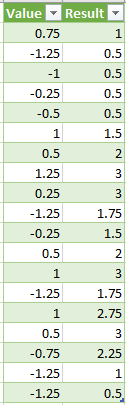
A screenshot with the result from a larger sample:

- Mark as New
- Bookmark
- Subscribe
- Mute
- Subscribe to RSS Feed
- Permalink
- Report Inappropriate Content
Hi there,
I just want to do a very simple loop a list and each of loop add a column to table; after many seacrh and test , still don't know how to do it. Could you give a simple example? Thank you very much.


- Mark as New
- Bookmark
- Subscribe
- Mute
- Subscribe to RSS Feed
- Permalink
- Report Inappropriate Content
yes you will find many examples of running totals. the arbitrary rule of starting with 1 is the only twist that I see.
- Mark as New
- Bookmark
- Subscribe
- Mute
- Subscribe to RSS Feed
- Permalink
- Report Inappropriate Content
It's not that easy I think. I need to calculate value of Result column based on previous row Result column value. That's why recursion could be proper solution, but I dont't know if it's possible with Power BI.
- Mark as New
- Bookmark
- Subscribe
- Mute
- Subscribe to RSS Feed
- Permalink
- Report Inappropriate Content
Piece of cake for Power Query's List.Accumulate:
let
    Source = Table1,
    ResultLists = List.Accumulate(List.Skip(Source[Value]),{1},(Result,Value) => Result & {List.Min({3,List.Max({0.5,List.Last(Result) + Value})})}),
    TableFromColumns = Table.FromColumns({Source[Value],ResultLists},type table[Value = number, Result = number])
in
    TableFromColumns
I share the doubt regarding the first result: according to the information provided, it should be 1, regardless of the first value.
I would expect some initial value (e.g. 1.5) and the first result would be that initial value plus the first value (1.5 - 0.5 = 1), not lower than 0.5 and not higher than 3.0.
Anyhow the code is based on the information provided, so the first value is skipped.
A screenshot with the result from a larger sample:
- Mark as New
- Bookmark
- Subscribe
- Mute
- Subscribe to RSS Feed
- Permalink
- Report Inappropriate Content
Hi there,
Is there a way to loop a list, each of the loop I will insert a new column name and calculate values. I did many search and test, still not success. Could you tell me a simple example? Thank you.
- Mark as New
- Bookmark
- Subscribe
- Mute
- Subscribe to RSS Feed
- Permalink
- Report Inappropriate Content
Wow, Power BI has so great community! Thank you for your solution.

Helpful resources

Fabric Community Sticker Challenge - Barcelona 2026
If you love stickers, then you will definitely want to check out our community sticker challenge, Barcelona edition!

Power BI Monthly Update - July 2026
Check out the July 2026 Power BI update to learn about new features.

Power BI DataViz World Championships - June 2026
A new Power BI DataViz World Championship is coming this June! Don't miss out on submitting your entry.

| User | Count |
|---|---|
| 30 | |
| 28 | |
| 23 | |
| 21 | |
| 19 |


| User | Count |
|---|---|
| 40 | |
| 31 | |
| 18 | |
| 18 | |
| 15 |


