Get Fabric or SQL Certified for Free.
Get certified for free when you join Fabric Data Days 2026 and dive into Fabric, Power BI, SQL, AI, and other essential data skills.
Join now- Power BI forums
- Get Help with Power BI
- Desktop
- Service
- Report Server
- Power Query
- Mobile Apps
- Developer
- DAX Commands and Tips
- Custom Visuals Development Discussion
- Health and Life Sciences
- Power BI Spanish forums
- Translated Spanish Desktop
- Training and Consulting
- Instructor Led Training
- Dashboard in a Day for Women, by Women
- Galleries
- Data Stories Gallery
- Themes Gallery
- Contests Gallery
- QuickViz Gallery
- Quick Measures Gallery
- Visual Calculations Gallery
- Fabric Apps Gallery
- Notebook Gallery
- Translytical Task Flow Gallery
- TMDL Gallery
- R Script Showcase
- Webinars and Video Gallery
- Ideas
- Custom Visuals Ideas (read-only)
- Issues
- Issues
- Events
- Upcoming Events
July 7 - July 17 | Round 2 of the Power BI Dataviz World Championships. Don't miss your chance! Learn more
- Power BI forums
- Forums
- Get Help with Power BI
- Desktop
- Re: Recursive Calculation current Month different
- Subscribe to RSS Feed
- Mark Topic as New
- Mark Topic as Read
- Float this Topic for Current User
- Bookmark
- Subscribe
- Printer Friendly Page


- Mark as New
- Bookmark
- Subscribe
- Mute
- Subscribe to RSS Feed
- Permalink
- Report Inappropriate Content
Recursive Calculation current Month different
Hello,
I need your help.
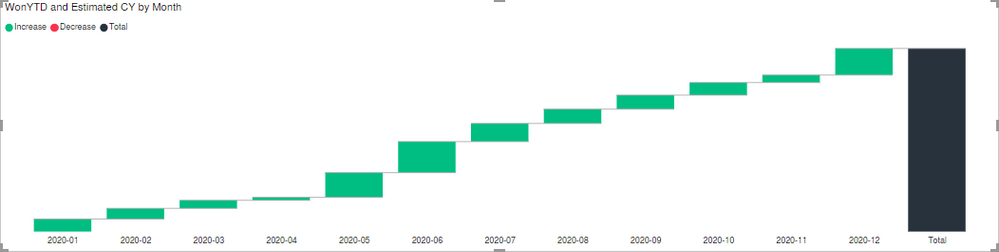
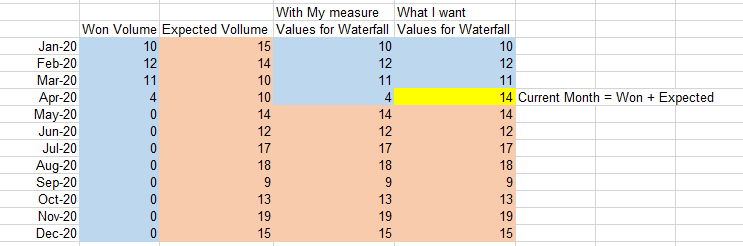
I want to calculate YTD "Won" Volume + expected Volume for next months until 12/20. But the current month should include Won Volume and the expected Volume.
My Dax Code for this measure is:
As visual I use the Waterfall:
Thanks in advance.
Cheers
Imex197
Solved! Go to Solution.
- Mark as New
- Bookmark
- Subscribe
- Mute
- Subscribe to RSS Feed
- Permalink
- Report Inappropriate Content
Hi @Imex197
I have tried to make the below solution which I believe works just fine. I assume you have a calendar table which you should also use on the axis.
Measure =
IF(
    -- VALUES(Calendar[Date]) returns all seletected days in a given context
    TODAY() in VALUES( 'Calendar'[Date]);
    SUM( 'Fact'[Expected]) + SUM( 'Fact'[Won]); -- current month
    IF(
        -- If today is larger than the largest date in the filter context then we are looking at previous months thus use [Won] else [Expected]
        TODAY() > MAXX( VALUES( 'Calendar'[Date]); [Date]);
        SUM( 'Fact'[Won]);
        SUM( 'Fact'[Expected])
    )
)
If this works then please mark it as the accepted solution. Kudos is also appreciated.
BR


- Mark as New
- Bookmark
- Subscribe
- Mute
- Subscribe to RSS Feed
- Permalink
- Report Inappropriate Content
Not Sure I got it completely. Can you share sample data and sample output?
You can use time intelligence for YTD with date calendar
YTD Sales = CALCULATE(SUM(Sales[Sales Amount]),DATESYTD(('Date'[Date]),"12/31"))
This Sales = CALCULATE(SUM(Sales[Sales Amount]),DATESYTD((ENDOFYEAR('Date'[Date])),"12/31"))
To get the best of the time intelligence function. Make sure you have a date calendar and it has been marked as the date in model view. Also, join it with the date column of your fact/s. Refer :
https://radacad.com/creating-calendar-table-in-power-bi-using-dax-functions
https://www.archerpoint.com/blog/Posts/creating-date-table-power-bi
https://www.sqlbi.com/articles/creating-a-simple-date-table-in-dax/
- Mark as New
- Bookmark
- Subscribe
- Mute
- Subscribe to RSS Feed
- Permalink
- Report Inappropriate Content
Hi amitchandak,
thanks for your fast reply. I Can´t share any data.
let me try again:


- Mark as New
- Bookmark
- Subscribe
- Mute
- Subscribe to RSS Feed
- Permalink
- Report Inappropriate Content
Hi @Imex197
Try something like below
Measure =
VAR __dates = DATESYTD( 'Calendar'[Date] )
VAR __endOfMonth =
CALCULATE(
    MAX( 'Calendar'[Date] ),
    FORMAT( 'Calendar'[Date], "YYYYMM" ) = FORMAT( TODAY(), "YYYYMM" )
)
VAR __before = CALCULATE(
    SUM( 'Table'[Value] ),
    FILTER( __dates, 'Calendar'[Date] <= __endOfMonth )
)
VAR __after = CALCULATE(
    SUM( 'Table'[Value] ),
    FILTER( __dates, 'Calendar'[Date] > __endOfMonth )
)
RETURN
__before + __after
Mariusz
If this post helps, then please consider Accepting it as the solution.
Please feel free to connect with me.
- Mark as New
- Bookmark
- Subscribe
- Mute
- Subscribe to RSS Feed
- Permalink
- Report Inappropriate Content
Hi @Mariusz
thanks for your help.
I changed the Format to "YYYYMMDD" now it suits better 🙂
But I wanted to have isolated values.
Is there a chance to have these value isolated per month and not cumulative?
Cheers
Imex197
- Mark as New
- Bookmark
- Subscribe
- Mute
- Subscribe to RSS Feed
- Permalink
- Report Inappropriate Content
Hi @Imex197
I have tried to make the below solution which I believe works just fine. I assume you have a calendar table which you should also use on the axis.
Measure =
IF(
    -- VALUES(Calendar[Date]) returns all seletected days in a given context
    TODAY() in VALUES( 'Calendar'[Date]);
    SUM( 'Fact'[Expected]) + SUM( 'Fact'[Won]); -- current month
    IF(
        -- If today is larger than the largest date in the filter context then we are looking at previous months thus use [Won] else [Expected]
        TODAY() > MAXX( VALUES( 'Calendar'[Date]); [Date]);
        SUM( 'Fact'[Won]);
        SUM( 'Fact'[Expected])
    )
)
If this works then please mark it as the accepted solution. Kudos is also appreciated.
BR
- Mark as New
- Bookmark
- Subscribe
- Mute
- Subscribe to RSS Feed
- Permalink
- Report Inappropriate Content
Hi @Anonymous ,
this is perfect! Thank you!

Helpful resources

FabCon & SQLCon – Barcelona 2026
Join us in Barcelona for FabCon and SQLCon, the Fabric, Power BI, SQL, and AI community event. Save €200 with code FABCMTY200.

Power BI Monthly Update - July 2026
Check out the July 2026 Power BI update to learn about new features.

Data Days 2026
Join Data Days 2026: 60 days of free live/on-demand sessions, challenges, study groups, and certification opportunities.

Power BI DataViz World Championships - June 2026
A new Power BI DataViz World Championship is coming this June! Don't miss out on submitting your entry.

| User | Count |
|---|---|
| 29 | |
| 23 | |
| 23 | |
| 22 | |
| 14 |


| User | Count |
|---|---|
| 48 | |
| 32 | |
| 20 | |
| 18 | |
| 16 |


