Join us in Barcelona for FabCon and SQLCon, September 28 - October 1, 2026.
This is best Fabric, Power BI, SQL and AI community event. How do we know? The last event sold out! Save €200 with code FABCMTY200.
Register now- Power BI forums
- Get Help with Power BI
- Desktop
- Service
- Report Server
- Power Query
- Mobile Apps
- Developer
- DAX Commands and Tips
- Custom Visuals Development Discussion
- Health and Life Sciences
- Power BI Spanish forums
- Translated Spanish Desktop
- Training and Consulting
- Instructor Led Training
- Dashboard in a Day for Women, by Women
- Galleries
- Data Stories Gallery
- Themes Gallery
- Contests Gallery
- QuickViz Gallery
- Quick Measures Gallery
- Visual Calculations Gallery
- Fabric Apps Gallery
- Notebook Gallery
- Translytical Task Flow Gallery
- TMDL Gallery
- R Script Showcase
- Webinars and Video Gallery
- Ideas
- Custom Visuals Ideas (read-only)
- Issues
- Issues
- Events
- Upcoming Events
July 28 - August 9 | Final Round of the Power BI Dataviz World Championships. This is your chance. Learn more
- Power BI forums
- Forums
- Get Help with Power BI
- Desktop
- Re: Rank with multiple fields
- Subscribe to RSS Feed
- Mark Topic as New
- Mark Topic as Read
- Float this Topic for Current User
- Bookmark
- Subscribe
- Printer Friendly Page

- Mark as New
- Bookmark
- Subscribe
- Mute
- Subscribe to RSS Feed
- Permalink
- Report Inappropriate Content
Rank with multiple fields
I have a ranking problem. I need to rank results by alias, ordered by orderid
Positive Result Reporting Table =
SUMMARIZE( Data_File,
Data_File[RESULT ],
Data_File[ALIAS ],
Data_File[ORDERID ],
Data_File[CE_RESOURCE ],
"Test Order",RANKX(ALL( Data_File[ALIAS ], Data_File[CE_RESOURCE ], Data_File[RESULT ]),SUMX( Data_File, Data_File[ORDERQTY ]), Data_File[ORDERID ],ASC,Dense))
yields:
ALIAS CE_RESOURCE ORDERID RESULT Test Order
274 CL Mole cobas 8800-1 483 Not Detected 2
274 CL Mole cobas 8800-1 473 Not Detected 2
274 CL Mole cobas 8800-1 463 Not Detected 2
Expected result:
ALIAS CE_RESOURCE ORDERID RESULT Test Order
274 CL Mole cobas 8800-1 483 Not Detected 1
274 CL Mole cobas 8800-1 473 Not Detected 2
274 CL Mole cobas 8800-1 463 Not Detected 3
What am I doing wrong?
Solved! Go to Solution.


- Mark as New
- Bookmark
- Subscribe
- Mute
- Subscribe to RSS Feed
- Permalink
- Report Inappropriate Content
@nutmegsnot sure if you want a calculated column or a measure, so did both.
Column =
RANKX (
    FILTER ( ranking, EARLIER ( ranking[ALIAS] ) = ranking[ALIAS] ),
    ranking[ORDERID],
    ,
    ASC
)

Measure:=
RANKX (
    FILTER ( ALLSELECTED ( ranking ), ranking[ALIAS] = MAX ( ranking[ALIAS] ) ),
    CALCULATE ( MAX ( ranking[ORDERID] ) ),
    ,
    ASC
)
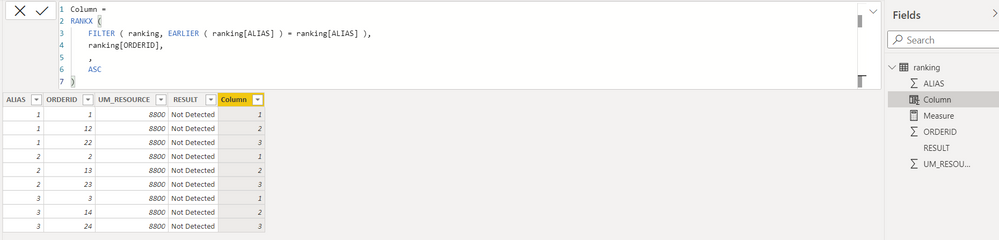
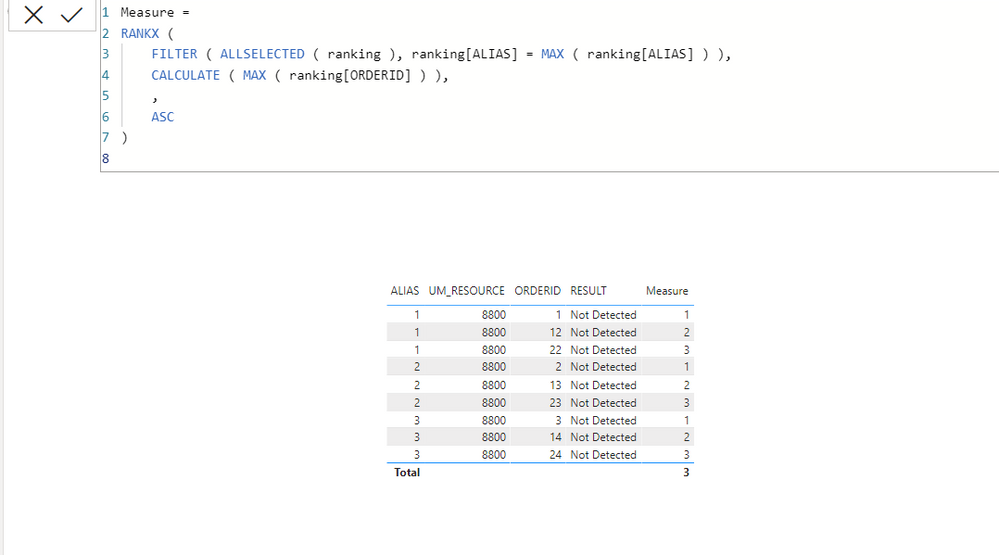
========================
Did I answer your question? Mark my post as a solution!
Proud to be a Super User
My Custom Visualization Projects
• Plotting Live Sound: Live Sound
• Beautiful News: Women in Parliament, Energy Mix, Shrinking Armies
• Visual Capitalist: Working Hrs
• Others: Easing Graph, Animated Calendar
MayViz Submissions
• Week 1: View
• Week 2: View
• Week 3: View
• Week 4: View
========================
- Mark as New
- Bookmark
- Subscribe
- Mute
- Subscribe to RSS Feed
- Permalink
- Report Inappropriate Content
Measure =
RANKX (
    FILTER (
        ALLSELECTED ( 'rank' ),
        'rank'[ALIAS] = MAX ( 'rank'[ALIAS] )
            && 'rank'[TestDate] = MAX ( 'rank'[TestDate] )
    ),
    CALCULATE ( MAX ( 'rank'[ORDERID] ) ),
    ,
    ASC
)
========================
Did I answer your question? Mark my post as a solution!
Proud to be a Super User
My Custom Visualization Projects
• Plotting Live Sound: Live Sound
• Beautiful News: Women in Parliament, Energy Mix, Shrinking Armies
• Visual Capitalist: Working Hrs
• Others: Easing Graph, Animated Calendar
MayViz Submissions
• Week 1: View
• Week 2: View
• Week 3: View
• Week 4: View
========================

- Mark as New
- Bookmark
- Subscribe
- Mute
- Subscribe to RSS Feed
- Permalink
- Report Inappropriate Content
Hi @nutmegs ,
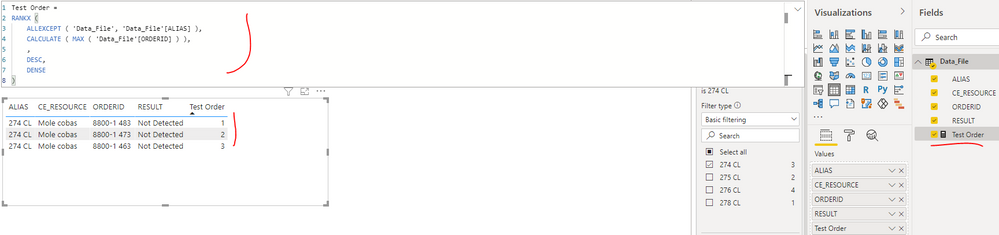
You can create a measure as below:
Test Order =
RANKX (
    ALLEXCEPT ( 'Data_File', 'Data_File'[ALIAS] ),
    CALCULATE ( MAX ( 'Data_File'[ORDERID] ) ),
    ,
    DESC,
    DENSE
)
Best Regards
- Mark as New
- Bookmark
- Subscribe
- Mute
- Subscribe to RSS Feed
- Permalink
- Report Inappropriate Content
@nutmegscan you give a sample data for Data_File?
========================
Did I answer your question? Mark my post as a solution!
Proud to be a Super User
My Custom Visualization Projects
• Plotting Live Sound: Live Sound
• Beautiful News: Women in Parliament, Energy Mix, Shrinking Armies
• Visual Capitalist: Working Hrs
• Others: Easing Graph, Animated Calendar
MayViz Submissions
• Week 1: View
• Week 2: View
• Week 3: View
• Week 4: View
========================
- Mark as New
- Bookmark
- Subscribe
- Mute
- Subscribe to RSS Feed
- Permalink
- Report Inappropriate Content
Unlike Tableau I can't attach anything. I am going to paste the data from a sample csv. Just paste it into notepad and save as csv. The Test Order field is the calculated field (rank) based on the order of the orderids grouped by alias. I am attaching what I want to see (Test order is ranked 1,2,3 for each of these alias)
ALIAS,ORDERID,UM_RESOURCE,RESULT,Test Order
1,1,8800,Not Detected,1
1,12,8800,Not Detected,2
1,22,8800,Not Detected,3
2,2,8800,Not Detected,1
2,13,8800,Not Detected,2
2,23,8800,Not Detected,3
3,3,8800,Not Detected,1
3,14,8800,Not Detected,2
3,24,8800,Not Detected,3
- Mark as New
- Bookmark
- Subscribe
- Mute
- Subscribe to RSS Feed
- Permalink
- Report Inappropriate Content
@nutmegsnot sure if you want a calculated column or a measure, so did both.
Column =
RANKX (
    FILTER ( ranking, EARLIER ( ranking[ALIAS] ) = ranking[ALIAS] ),
    ranking[ORDERID],
    ,
    ASC
)

Measure:=
RANKX (
    FILTER ( ALLSELECTED ( ranking ), ranking[ALIAS] = MAX ( ranking[ALIAS] ) ),
    CALCULATE ( MAX ( ranking[ORDERID] ) ),
    ,
    ASC
)
========================
Did I answer your question? Mark my post as a solution!
Proud to be a Super User
My Custom Visualization Projects
• Plotting Live Sound: Live Sound
• Beautiful News: Women in Parliament, Energy Mix, Shrinking Armies
• Visual Capitalist: Working Hrs
• Others: Easing Graph, Animated Calendar
MayViz Submissions
• Week 1: View
• Week 2: View
• Week 3: View
• Week 4: View
========================
- Mark as New
- Bookmark
- Subscribe
- Mute
- Subscribe to RSS Feed
- Permalink
- Report Inappropriate Content
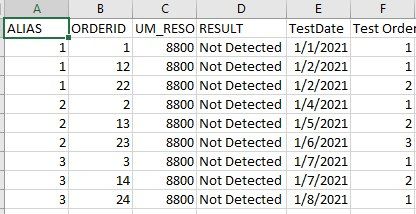
OK. So the meaure works, but I actually need them ranked by date and alias. I've attached the data for a csv that has the expected result with a new date field.
ALIAS,ORDERID,UM_RESOURCE,RESULT,TestDate,Test Order
1,1,8800,Not Detected,1/1/2021,1
1,12,8800,Not Detected,1/2/2021,1
1,22,8800,Not Detected,1/2/2021,2
2,2,8800,Not Detected,1/4/2021,1
2,13,8800,Not Detected,1/5/2021,2
2,23,8800,Not Detected,1/6/2021,3
3,3,8800,Not Detected,1/7/2021,1
3,14,8800,Not Detected,1/7/2021,2
3,24,8800,Not Detected,1/8/2021,1
This picture is an example of what I want the Test Order measure to produce.
I tried this and it did not produce the expected result.
Test Order = calculate (RANKX (
FILTER ( ALLSELECTED ( 'Positive Result Reporting Table' ), 'Positive Result Reporting Table'[ALIAS] = MAX ( 'Positive Result Reporting Table'[ALIAS]) ),
CALCULATE ( MAX ( 'Positive Result Reporting Table'[ORDERID] ) ),
,
ASC
) , ALLEXCEPT('Positive Result Reporting Table','Positive Result Reporting Table'[TestDate]))
- Mark as New
- Bookmark
- Subscribe
- Mute
- Subscribe to RSS Feed
- Permalink
- Report Inappropriate Content
Measure =
RANKX (
    FILTER (
        ALLSELECTED ( 'rank' ),
        'rank'[ALIAS] = MAX ( 'rank'[ALIAS] )
            && 'rank'[TestDate] = MAX ( 'rank'[TestDate] )
    ),
    CALCULATE ( MAX ( 'rank'[ORDERID] ) ),
    ,
    ASC
)
========================
Did I answer your question? Mark my post as a solution!
Proud to be a Super User
My Custom Visualization Projects
• Plotting Live Sound: Live Sound
• Beautiful News: Women in Parliament, Energy Mix, Shrinking Armies
• Visual Capitalist: Working Hrs
• Others: Easing Graph, Animated Calendar
MayViz Submissions
• Week 1: View
• Week 2: View
• Week 3: View
• Week 4: View
========================
Helpful resources

FabCon & SQLCon – Barcelona 2026
Join us in Barcelona for FabCon and SQLCon, the Fabric, Power BI, SQL, and AI community event. Save €200 with code FABCMTY200.

Power BI DataViz World Championships - June 2026
A new Power BI DataViz World Championship is coming this June! Don't miss out on submitting your entry.

| User | Count |
|---|---|
| 27 | |
| 22 | |
| 20 | |
| 18 | |
| 14 |


| User | Count |
|---|---|
| 25 | |
| 20 | |
| 20 | |
| 20 | |
| 20 |


