Don't miss your chance to take the Fabric Data Engineer (DP-700) exam on us!
Learn moreWe've captured the moments from FabCon & SQLCon that everyone is talking about, and we are bringing them to the community, live and on-demand. Starts on April 14th. Register now
I am using rank and have come across a problem.
I want to rank by current month qty, which is fine, however where multiple customers have the same month qty they both get assigned the same rank number, as shown below
I want to rank by current month, and if 2 customers have the same sales qty in a month, then rank by the one with the highest 2018 sales qty , as shown by the example below.
is this possible?
Thanks
| Customer | 2018 Sales | Current Month | Rank by Current Month | Rank by Current Month, By 2018 Sales | |
| a | 1000 | 500 | 4 | 5 | |
| b | 2000 | 100 | 5 | 8 | |
| c | 1500 | 800 | 2 | 3 | |
| d | 500 | 500 | 4 | 7 | |
| e | 80 | 10 | 6 | 9 | |
| f | 3000 | 700 | 3 | 4 | |
| g | 1200 | 1000 | 1 | 2 | |
| h | 5000 | 1000 | 1 | 1 | |
| i | 700 | 500 | 4 | 6 |
Solved! Go to Solution.
you can use this calculated column:
Rank by Current Month, By 2018 Sales = RANKX(Table1, Table1[Current Month]+Table1[2018 Sales]/1000000, ,DESC,Dense)
here is the PBI file
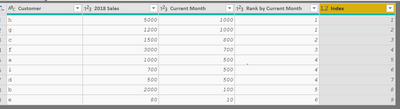
@MNGoodyear In Power Query Editor, just with few clicks based on the sample data provided
1. Sort the CurrentMonth in descending
2. Sort the 2018Sales in descending
3. Add Index column starts with 1
Here is the M-Code for the same
let
Source = Table.FromRows(Json.Document(Binary.Decompress(Binary.FromText("ZY07DsAwCEOvUjFnIKS/u6AMTf/3v0CJUaNKXQx6GFuVFgoUmdnGAO0pB6VimziOfgReuwrcOEMFfGvv35AdLkSYjGCHbcmDJ2gCPqtL3j4M8Msjf/xu/60wPw==", BinaryEncoding.Base64), Compression.Deflate)), let _t = ((type text) meta [Serialized.Text = true]) in type table [Customer = _t, #"2018 Sales" = _t, #"Current Month" = _t, #"Rank by Current Month" = _t]),
#"Changed Type" = Table.TransformColumnTypes(Source,{{"Customer", type text}, {"2018 Sales", Int64.Type}, {"Current Month", Int64.Type}, {"Rank by Current Month", Int64.Type}}),
#"Sorted Rows" = Table.Sort(#"Changed Type",{{"Current Month", Order.Descending}, {"2018 Sales", Order.Descending}}),
#"Added Index" = Table.AddIndexColumn(#"Sorted Rows", "Index", 1, 1)
in
#"Added Index"
Proud to be a PBI Community Champion
you can use this calculated column:
Rank by Current Month, By 2018 Sales = RANKX(Table1, Table1[Current Month]+Table1[2018 Sales]/1000000, ,DESC,Dense)
here is the PBI file
If you have recently started exploring Fabric, we'd love to hear how it's going. Your feedback can help with product improvements.
A new Power BI DataViz World Championship is coming this June! Don't miss out on submitting your entry.
Share feedback directly with Fabric product managers, participate in targeted research studies and influence the Fabric roadmap.
| User | Count |
|---|---|
| 53 | |
| 35 | |
| 31 | |
| 19 | |
| 17 |
| User | Count |
|---|---|
| 75 | |
| 72 | |
| 39 | |
| 35 | |
| 23 |