cancel
Showing results for 
Search instead for 
Did you mean: 

The Power BI Data Visualization World Championships is back! It's time to submit your entry. Live now!

Reply
robarivas
Post Patron
Post Patron

Powery Query #date function

Talking about M (Power Query) language here. How can I parameterize or otherwise make dynamic the 3 arguments in the #date function?


#date(2017, 6, 16)


I have a 1 row, 1 column table with a single date value (which will change dynamically upon refresh) and I want to add rows (future dates) to that table. The #date function seems to want to accept only hard-coded numbers. I've gotta believe that either isn't true or there is another way.


Thanks!!

1 ACCEPTED SOLUTION

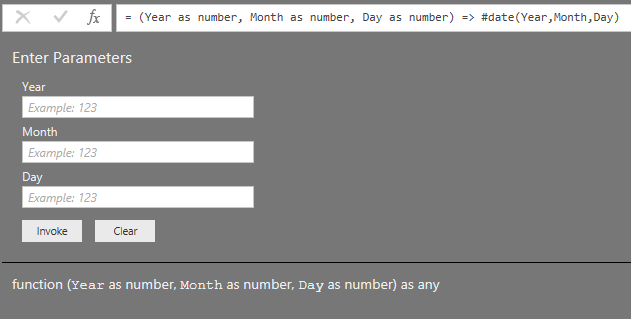
You don't need hard coded values: this function works perfectly fine;

Date parameters.png


Edit: If you are looking for alternatives then please specify exactly what should happen.

E.g. you can create a series of numbers and then change the type to date.

Or you can use List.Dates.


E,g, this fuction creates a table with1 column with 10 dates:

(Year as number, Month as number, Day as number) => Table.FromColumns({List.Dates(#date(Year,Month,Day),10,#duration(1,0,0,0))}, type table[Date as date])
Specializing in Power Query Formula Language (M)

View solution in original post

3 REPLIES 3
MattAllington
Community Champion
Community Champion

You don't need #date if you have a date in a single row, single column table. Just load it up and change to format to type date if needed


* Matt is an 8 times Microsoft MVP (Power BI) and author of the Power BI Book Supercharge Power BI.
I will not give you bad advice, even if you unknowingly ask for it.

You don't need hard coded values: this function works perfectly fine;

Date parameters.png


Edit: If you are looking for alternatives then please specify exactly what should happen.

E.g. you can create a series of numbers and then change the type to date.

Or you can use List.Dates.


E,g, this fuction creates a table with1 column with 10 dates:

(Year as number, Month as number, Day as number) => Table.FromColumns({List.Dates(#date(Year,Month,Day),10,#duration(1,0,0,0))}, type table[Date as date])
Specializing in Power Query Formula Language (M)

Thanks @MarcelBeug. I was able to adopt a concept from your reply to make my effort work. I replicated my single cell query 3 times so that I could convert each component (year, month, and day) into lists. So I ended up with 3 list queries. I was then able to create parameters (query option) on each of those. I was then able to create a new query that used those parameters to generate a list of dates. Not sure if my solution is the best way to go about this but at least its dynamic and automated and gets me what I want.

Helpful resources

Announcements
FabCon Atlanta 2026 carousel

FabCon Atlanta 2026

Join us at FabCon Atlanta, March 16-20, for the ultimate Fabric, Power BI, AI and SQL community-led event. Save $200 with code FABCOMM.