This time we’re going bigger than ever. Fabric, Power BI, SQL, AI and more. We're covering it all. You won't want to miss it.
Learn moreLevel up your Power BI skills this month - build one visual each week and tell better stories with data! Get started
Hi Guys,
can someone help me with getting sum of value of parallel period while using date filter?.
I tried to use the #parallel_period function but I think the Date filttering influnce it.
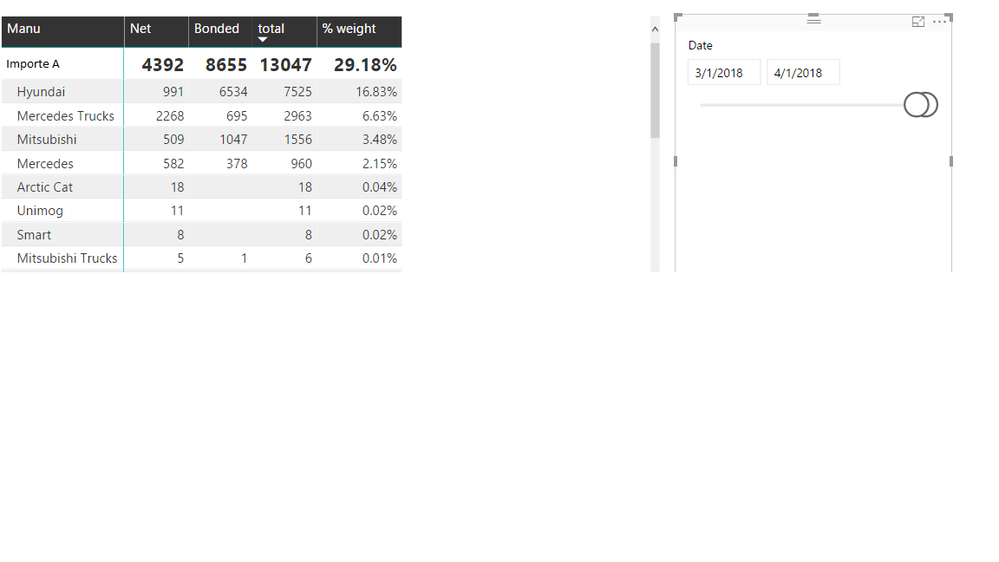
current table:
I would like to add lParallel_Period_total (last year) column to my matrix.
Solved! Go to Solution.
You could use a calculated measure like this:
Parallel Period = VAR MinDate = MIN ( Date[Column] ) VAR StartDate = DATE ( YEAR ( MinDate ) - 1, MONTH ( MinDate ), DAY ( MinDate ) ) VAR MaxDate = MAX ( Date[Column] ) VAR EndDate = DATE ( YEAR ( MaxDate ) - 1, MONTH ( MaxDate ), DAY ( MaxDate ) ) RETURN CALCULATE ( [Measure], FILTER ( ALL ( DateColumn/Table ), Date[Column] >= StartDate && Date[Column] <= EndDate ) )
Check if the following link helps.
https://www.sqlbi.com/articles/compare-equivalent-periods-in-dax/
You could use a calculated measure like this:
Parallel Period = VAR MinDate = MIN ( Date[Column] ) VAR StartDate = DATE ( YEAR ( MinDate ) - 1, MONTH ( MinDate ), DAY ( MinDate ) ) VAR MaxDate = MAX ( Date[Column] ) VAR EndDate = DATE ( YEAR ( MaxDate ) - 1, MONTH ( MaxDate ), DAY ( MaxDate ) ) RETURN CALCULATE ( [Measure], FILTER ( ALL ( DateColumn/Table ), Date[Column] >= StartDate && Date[Column] <= EndDate ) )
Check out the April 2026 Power BI update to learn about new features.
Sign up to receive a private message when registration opens and key events begin.
If you have recently started exploring Fabric, we'd love to hear how it's going. Your feedback can help with product improvements.
| User | Count |
|---|---|
| 36 | |
| 32 | |
| 26 | |
| 24 | |
| 17 |
| User | Count |
|---|---|
| 70 | |
| 50 | |
| 31 | |
| 26 | |
| 22 |