Get certified for free when you join Fabric Data Days 2026 and dive into Fabric, Power BI, SQL, AI, and other essential data skills.
Join nowData Days is here! Join us now for 60+ days of learning, challenges, and connection. Learn more
Easy question:
how to get just a single value from sumQty_by_item column?
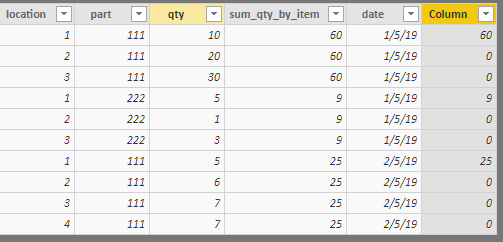
| location | part | qty | sum_qty_by_item | date | expected result |
| 1 | 111 | 10 | 60 | 01.05.2019 | 60 |
| 2 | 111 | 20 | 60 | 01.05.2019 | 0 |
| 3 | 111 | 30 | 60 | 01.05.2019 | 0 |
| 1 | 222 | 5 | 9 | 01.05.2019 | 9 |
| 2 | 222 | 1 | 9 | 01.05.2019 | 0 |
| 3 | 222 | 3 | 9 | 01.05.2019 | 0 |
| 1 | 111 | 5 | 25 | 02.05.2019 | 25 |
| 2 | 111 | 6 | 25 | 02.05.2019 | 0 |
| 3 | 111 | 7 | 25 | 02.05.2019 | 0 |
| 4 | 111 | 7 | 25 | 02.05.2019 | 0 |
is it even possible with dax? i need it in new column as im using it in chart/as slicer etc.
Solved! Go to Solution.
Hi @mhsk
I would suggest you to add an index column in query editor.Then create the column as below:
Column =
VAR pre_sum =
CALCULATE (
MAX ( 'Table'[sum] ),
FILTER ( 'Table', 'Table'[Index] = EARLIER ( 'Table'[Index] ) - 1 )
)
RETURN
IF (
pre_sum <> 'Table'[sum],
CALCULATE ( MAX ( 'Table'[sum] ), ALLEXCEPT ( 'Table', 'Table'[sum] ) ),
0
)
Regards,
Hi @mhsk
You may try below dax.
Column =
IF (
[location] = 1,
CALCULATE (
MAX ( [sum_qty_by_item] ),
ALLEXCEPT ( 'Table', 'Table'[sum_qty_by_item] )
),
0
)
Regards,
thanks for a prompt reply, the thing is I don't want to connect it anyhow to location imagine my table looks:
| part | sum | expected result |
| 111 | 50 | 50 |
| 111 | 50 | 0 |
| 111 | 50 | 0 |
| 222 | 60 | 60 |
| 222 | 60 | 0 |
| 222 | 60 | 0 |
| 333 | 1 | 1 |
| 333 | 1 | 0 |
| 333 | 1 | 0 |
| 444 | 10 | 10 |
| 444 | 10 | 0 |
| 444 | 10 | 0 |
Hi @mhsk
I would suggest you to add an index column in query editor.Then create the column as below:
Column =
VAR pre_sum =
CALCULATE (
MAX ( 'Table'[sum] ),
FILTER ( 'Table', 'Table'[Index] = EARLIER ( 'Table'[Index] ) - 1 )
)
RETURN
IF (
pre_sum <> 'Table'[sum],
CALCULATE ( MAX ( 'Table'[sum] ), ALLEXCEPT ( 'Table', 'Table'[sum] ) ),
0
)
Regards,
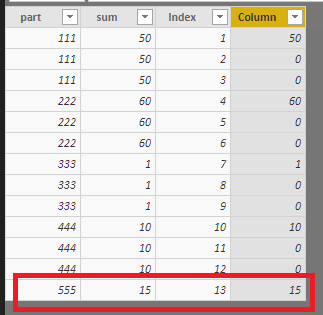
ok this works while parts are always represented in multiple rows, but there are also cases where part can have just one row (no index-1 possible) - like part 555 below, could you have a look ?
| part | sum | expected result |
| 111 | 50 | 50 |
| 111 | 50 | 0 |
| 111 | 50 | 0 |
| 222 | 60 | 60 |
| 222 | 60 | 0 |
| 222 | 60 | 0 |
| 333 | 1 | 1 |
| 333 | 1 | 0 |
| 333 | 1 | 0 |
| 444 | 10 | 10 |
| 444 | 10 | 0 |
| 444 | 10 | 0 |
| 555 | 15 | 15 |
Hi @mhsk
The above workaround could work for your scenario.
Regards,
Don't miss out on Data Days, June 15 through August 7. Learn Fabric, Power BI, SQL, AI and more.
Check out the May 2026 Power BI update to learn about new features.
| User | Count |
|---|---|
| 23 | |
| 21 | |
| 20 | |
| 18 | |
| 13 |
| User | Count |
|---|---|
| 58 | |
| 50 | |
| 38 | |
| 31 | |
| 27 |