cancel
Showing results for 
Search instead for 
Did you mean: 

Data Days is here! Join us now for 60+ days of learning, challenges, and connection. Learn more

Reply
BLM
Helper I
Helper I

Multiple relations

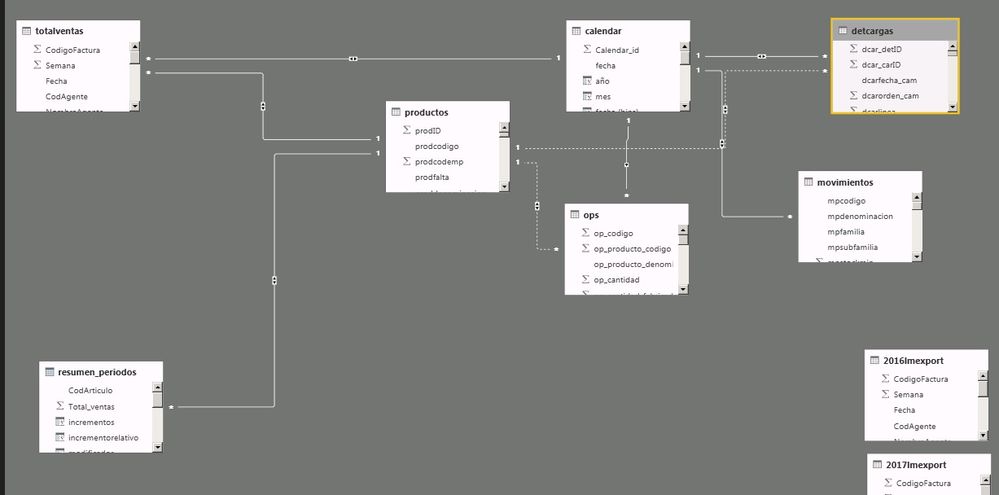
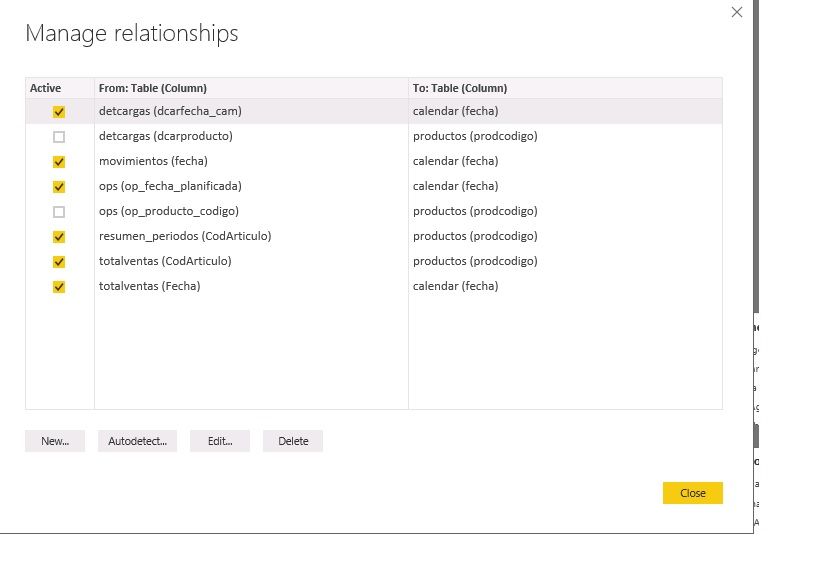
hi guys!! I have many tables with following relations:


relaciones.jpg


relaciones1.jpg


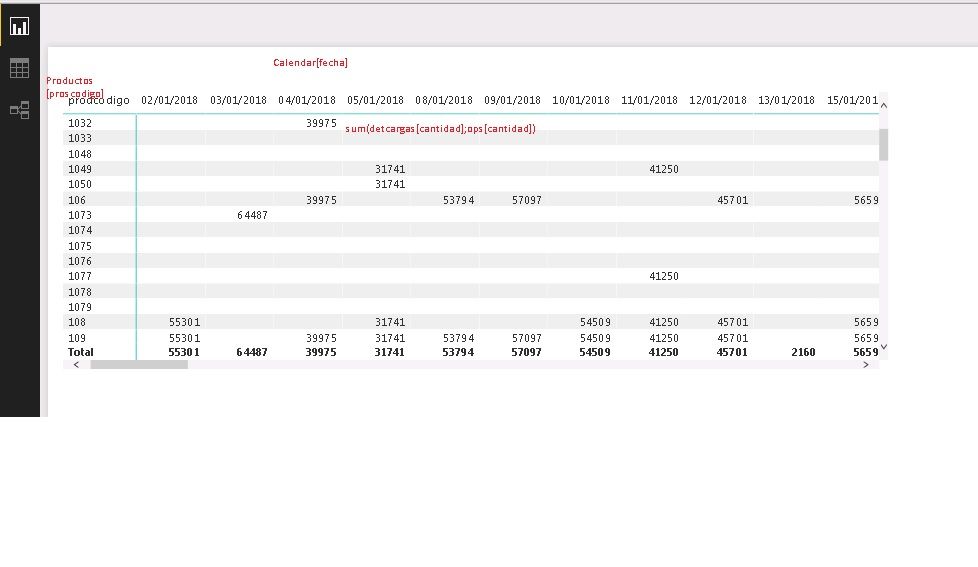
I am doing this table:


table.jpg


I'm not  able to obtain the correct result, I don't understand how to work with the inactive and active relationship.

help me, please

1 ACCEPTED SOLUTION

Thanks so much, If it Work i ‘ll tell you

View solution in original post

6 REPLIES 6
Anonymous
Not applicable

I'm not exactly sure what you are asking, but I guess we can start with what IS the intended result?  Are their not supposed to be blank values?  Are the rows and columns correct?  Are you looking for a calculation? 

I would like obtain a matrix like photo.
Rows: Productos[prodcode]
Columns: calendar[fecha]
Values: sum off ‘cantidad from detcargas and ‘cantidad from ops.
The relations are in the image attached

I want obtain a matrix with dates from several tables.
"detcargas" contain the quantity of product that has been load in a determinate date.
"ops" contain the quantity of product that has been produced in a determinate date.
"Product" it's the table that contain all products of a factory, and "Calendar" is a calendar 🙂
The relations are:

productos[prodcodigo] with ops[op_producto_codigo]

productos[prodcodigo] with detcargas[dcarproducto]

calendar[fecha] with detcargas[dcarfecha_cam]

calendar[fecha] with ops[op_fecha_planificada]

my goal it's obtain a matrix that show the evolution the stock per day, for it, i need a matrix which rows will be all products from "table products", the columns will be a date range from "calendar table" and the values will be an acumulate sum from quantityes of products produced (ops) minus quantityes of product loaded (detcarga)


thank

Anonymous
Not applicable

Okay this is how I would solve this.  I would remove the inactive relationships and only relate tables in one direction.
Ex: 1 ->* and not bi directional.  This will speed up the performance of your report. 
Second I'd create a distinct Product Code Table (=Distinct('productos'[prodcodigo])) to relate to productos, ops, and decargas. 
Use the Products field in the product code table as the rows in your matrix.  That shoudl solve your circular dependancies.

Then use a measure as your value to something like SUM(detcargas[dcarproducto])-SUM(ops[op_producto_codigo]).


If that dosen't work i may need your pbix to try and solve it.

Thanks so much, If it Work i ‘ll tell you

it's work OK

 thank

Helpful resources

Announcements
Fabric Data Days is here Carousel

Fabric Data Days 2026

Don't miss out on Data Days, June 15 through August 7. Learn Fabric, Power BI, SQL, AI and more.

May Power BI Update Carousel

Power BI Monthly Update - May 2026

Check out the May 2026 Power BI update to learn about new features.

Power BI DataViz World Championships carousel

Power BI DataViz World Championships - June 2026

A new Power BI DataViz World Championship is coming this June! Don't miss out on submitting your entry.