cancel
Showing results for 
Search instead for 
Did you mean: 

The Power BI Data Visualization World Championships is back! Get ahead of the game and start preparing now! Learn more

Reply
Rotergnom2
Regular Visitor

Moving Average

Hey,


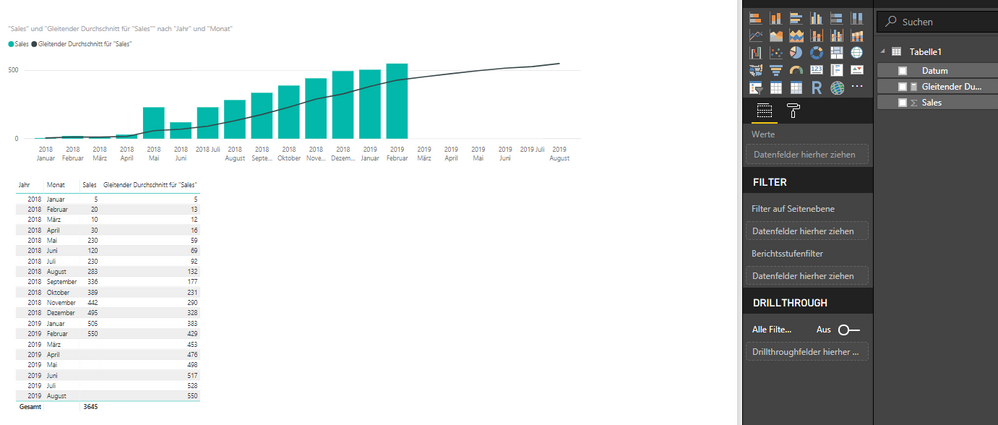
I tried to go for the Moving Average building with PowerBI. 


The problem is that the moving average is calculated for the future, which does not make any sense. 

I wanted to do a six-month-rolling average with the quick measure (problem of above appeared), then with the formula = calculate(average([Sales]), DatesInPeriod([date];Lastdate([date]), -6, MONTH). Same Problem, again. So I do not know what is the problem. Perhaps somebody could offer me a simple sample PBIX data with a 6 month moving average over 2 years data..


Unbenannt.PNG

1 ACCEPTED SOLUTION
v-jiascu-msft
Microsoft Employee
Microsoft Employee

Hi @Rotergnom2,


I would suggest you create a date table in your scenario. Please check out the attached demo and the measure below.

Measure =
VAR maxFactDate =
    CALCULATE ( MAX ( FactTable[Date] ), ALL ( 'Calendar' ) )
RETURN
    IF (
        MAX ( 'Calendar'[Date] ) > maxFactDate,
        BLANK (),
        CALCULATE (
            AVERAGEX (
                SUMMARIZE (
                    'FactTable',
                    'Calendar'[Date].[Year],
                    'Calendar'[Date].[Month],
                    "MonthTotal", SUM ( FactTable[Sales] )
                ),
                [MonthTotal]
            ),
            DATESINPERIOD ( 'Calendar'[date], LASTDATE ( 'Calendar'[date] ), -6, MONTH )
        )
    )

Best Regards,

Dale

Community Support Team _ Dale
If this post helps, then please consider Accept it as the solution to help the other members find it more quickly.

View solution in original post

3 REPLIES 3
v-jiascu-msft
Microsoft Employee
Microsoft Employee

Hi @Rotergnom2,


Could you please mark the proper answer as a solution?


Best Regards,

Dale

Community Support Team _ Dale
If this post helps, then please consider Accept it as the solution to help the other members find it more quickly.
v-jiascu-msft
Microsoft Employee
Microsoft Employee

Hi @Rotergnom2,


I would suggest you create a date table in your scenario. Please check out the attached demo and the measure below.

Measure =
VAR maxFactDate =
    CALCULATE ( MAX ( FactTable[Date] ), ALL ( 'Calendar' ) )
RETURN
    IF (
        MAX ( 'Calendar'[Date] ) > maxFactDate,
        BLANK (),
        CALCULATE (
            AVERAGEX (
                SUMMARIZE (
                    'FactTable',
                    'Calendar'[Date].[Year],
                    'Calendar'[Date].[Month],
                    "MonthTotal", SUM ( FactTable[Sales] )
                ),
                [MonthTotal]
            ),
            DATESINPERIOD ( 'Calendar'[date], LASTDATE ( 'Calendar'[date] ), -6, MONTH )
        )
    )

Best Regards,

Dale

Community Support Team _ Dale
If this post helps, then please consider Accept it as the solution to help the other members find it more quickly.
Greg_Deckler
Community Champion
Community Champion

So, is your calculation correct other than the fact that it includes future estimations?


Follow on LinkedIn
@ me in replies or I'll lose your thread!!!
Instead of a Kudo, please vote for this idea
Become an expert!: Enterprise DNA
External Tools: MSHGQM
YouTube Channel!: Microsoft Hates Greg
Latest book!:
DAX For Humans

DAX is easy, CALCULATE makes DAX hard...

Helpful resources

Announcements
Power BI DataViz World Championships

Power BI Dataviz World Championships

The Power BI Data Visualization World Championships is back! Get ahead of the game and start preparing now!

December 2025 Power BI Update Carousel

Power BI Monthly Update - December 2025

Check out the December 2025 Power BI Holiday Recap!

FabCon Atlanta 2026 carousel

FabCon Atlanta 2026

Join us at FabCon Atlanta, March 16-20, for the ultimate Fabric, Power BI, AI and SQL community-led event. Save $200 with code FABCOMM.