Get certified for free when you join Fabric Data Days 2026 and dive into Fabric, Power BI, SQL, AI, and other essential data skills.
Join nowTry your skills in the Power BI Dataviz World Championship! Round one ends June 26. Join now
I have created a line graph with data along a time point (set by text, not an actual date; i.e. week 1, week 2 etc), but if a series does not have a measurement for a time point that other series do have, the line breaks and re-starts again.
See the pictures below.
What I would like is for all points from a series to be joined until the last data point on that series.
This line is continuous
The pink line has a data point at a time that the grey line does not, so the grey line breaks rather than joing with a line across the points.
Solved! Go to Solution.
Hi @Mesh ,
One sample for your reference, please check the following steps as below.
1. Insert an index by week in power query like this.
let
Source = Table.FromRows(Json.Document(Binary.Decompress(Binary.FromText("Xc47EsAgCATQu1BbBNSYnMWxtMoBcv24foha6Mw+FIiR3pwfJkNcL0qmkZQkoEXYzoLgdhCZBWXbug/yqJd3TuXsElQCYjle5Rr7/N9u9MUADqvVgaLGx75nlb5o+gA=", BinaryEncoding.Base64), Compression.Deflate)), let _t = ((type text) meta [Serialized.Text = true]) in type table [week = _t, value1 = _t, value2 = _t]),
#"Changed Type" = Table.TransformColumnTypes(Source,{{"week", type text}, {"value1", Int64.Type}, {"value2", Int64.Type}}),
#"Added Index" = Table.AddIndexColumn(#"Changed Type", "Index", 1, 1),
#"Added Custom" = Table.AddColumn(#"Added Index", "Custom", each Text.Combine(List.RemoveNulls(List.Transform(Text.ToList([week]),each if Value.Is(Value.FromText(_), type number) then _ else null)))),
#"Changed Type1" = Table.TransformColumnTypes(#"Added Custom",{{"Custom", Int64.Type}})
in
#"Changed Type1"
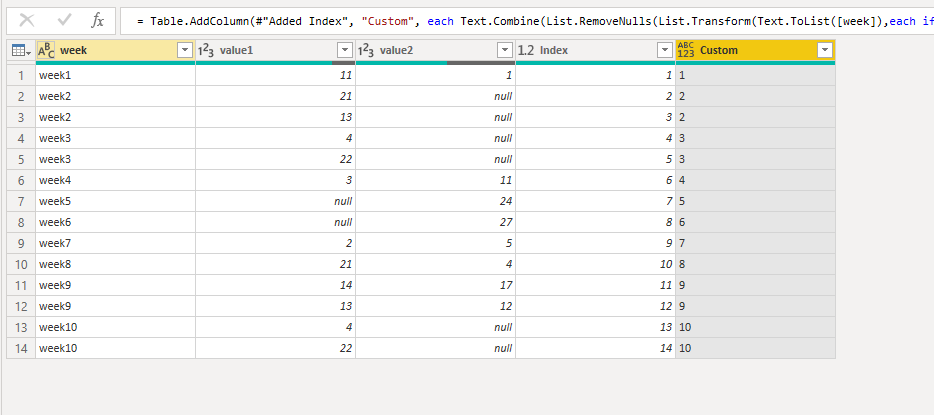
2. Then apply the query and we can create measures as below.
sumvalue1 = SUM('Table'[value1])
value2sum = var minind = CALCULATE(MIN('Table'[Custom]),FILTER(ALLSELECTED('Table'),[sumvalue1] = BLANK()))
var ind = minind-1
return
CALCULATE(SUM('Table'[value2]),FILTER('Table','Table'[Custom]>=ind))
Hi @Mesh ,
One sample for your reference, please check the following steps as below.
1. Insert an index by week in power query like this.
let
Source = Table.FromRows(Json.Document(Binary.Decompress(Binary.FromText("Xc47EsAgCATQu1BbBNSYnMWxtMoBcv24foha6Mw+FIiR3pwfJkNcL0qmkZQkoEXYzoLgdhCZBWXbug/yqJd3TuXsElQCYjle5Rr7/N9u9MUADqvVgaLGx75nlb5o+gA=", BinaryEncoding.Base64), Compression.Deflate)), let _t = ((type text) meta [Serialized.Text = true]) in type table [week = _t, value1 = _t, value2 = _t]),
#"Changed Type" = Table.TransformColumnTypes(Source,{{"week", type text}, {"value1", Int64.Type}, {"value2", Int64.Type}}),
#"Added Index" = Table.AddIndexColumn(#"Changed Type", "Index", 1, 1),
#"Added Custom" = Table.AddColumn(#"Added Index", "Custom", each Text.Combine(List.RemoveNulls(List.Transform(Text.ToList([week]),each if Value.Is(Value.FromText(_), type number) then _ else null)))),
#"Changed Type1" = Table.TransformColumnTypes(#"Added Custom",{{"Custom", Int64.Type}})
in
#"Changed Type1"
2. Then apply the query and we can create measures as below.
sumvalue1 = SUM('Table'[value1])
value2sum = var minind = CALCULATE(MIN('Table'[Custom]),FILTER(ALLSELECTED('Table'),[sumvalue1] = BLANK()))
var ind = minind-1
return
CALCULATE(SUM('Table'[value2]),FILTER('Table','Table'[Custom]>=ind))
Don't miss out on Data Days, June 15 through August 7. Learn Fabric, Power BI, SQL, AI and more.
Check out the May 2026 Power BI update to learn about new features.
| User | Count |
|---|---|
| 24 | |
| 22 | |
| 20 | |
| 20 | |
| 13 |
| User | Count |
|---|---|
| 68 | |
| 55 | |
| 42 | |
| 39 | |
| 30 |