Don't miss your chance to take the Fabric Data Engineer (DP-700) exam on us!
Learn moreNext up in the FabCon + SQLCon recap series: The roadmap for Microsoft SQL and Maximizing Developer experiences in Fabric. All sessions are available on-demand after the live show. Register now
Hello all, I need your help in calculating the forward forecast for sales. I have monthly sales data.
Here is the equation for forecast calculation,
Forecast = SalesLY * CIValue * rValue
SalesLY = Last year same month sales
CIValue = we have this column in the growth projection table
rValue = sum of current year 3 months/sum of last year 3 months
Let's say we are in Aug2019, the sum of August 2020, July 2020 & June 2020 divided by the sum of August 2019, July 2019 & June 2019.
We have to calculate the forecast for a year from the current month. Let's say we are in August 2020 then it should calculate forecast till August 2021.
Here is the file with the sample data Forecast Test.
Thanks
Solved! Go to Solution.
Hi, @Gaurav_Lakhotia ;
You mentioned that sum of current year 3 months is sum of sales? if so , you could create a measure as follows:
1.create SalesLY measure.
SaleLY = CALCULATE(SUM('Sales'[Sales]),FILTER(ALL('Sales'),[Year]+1=MAX('Growth Projection'[Year])&&[Month]=MAX('Growth Projection'[Month])))
2.create rValue measure.
rValue =
VAR _currentq =
CALCULATE (
SUM ( 'Sales'[Sales] ),
FILTER (
ALL ( 'Sales' ),
[Year] = MAX ( 'Growth Projection'[Year] )
&& QUARTER ( [Date] ) = QUARTER ( MAX ( 'Growth Projection'[date] ) ) ))
VAR _lastq =
CALCULATE (
SUM ( 'Sales'[Sales] ),
FILTER (
ALL ( 'Sales' ),
[Year] + 1
= MAX ( 'Growth Projection'[Year] )
&& QUARTER ( [Date] ) = QUARTER ( MAX ( 'Growth Projection'[date] ) )))
RETURN DIVIDE ( _currentq, _lastq )
3.create Forecast measure.
Forecast = [SaleLY]*SUM([CIValue])*[rValue]
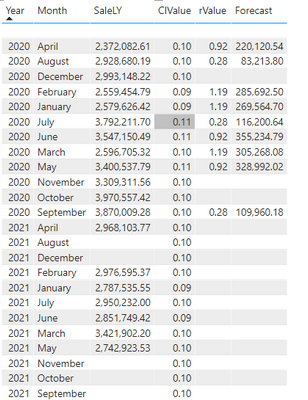
The final output is shown below:
Best Regards,
Community Support Team_ Yalan Wu
If this post helps, then please consider Accept it as the solution to help the other members find it more quickly.
Hi, @Gaurav_Lakhotia ;
You mentioned that sum of current year 3 months is sum of sales? if so , you could create a measure as follows:
1.create SalesLY measure.
SaleLY = CALCULATE(SUM('Sales'[Sales]),FILTER(ALL('Sales'),[Year]+1=MAX('Growth Projection'[Year])&&[Month]=MAX('Growth Projection'[Month])))
2.create rValue measure.
rValue =
VAR _currentq =
CALCULATE (
SUM ( 'Sales'[Sales] ),
FILTER (
ALL ( 'Sales' ),
[Year] = MAX ( 'Growth Projection'[Year] )
&& QUARTER ( [Date] ) = QUARTER ( MAX ( 'Growth Projection'[date] ) ) ))
VAR _lastq =
CALCULATE (
SUM ( 'Sales'[Sales] ),
FILTER (
ALL ( 'Sales' ),
[Year] + 1
= MAX ( 'Growth Projection'[Year] )
&& QUARTER ( [Date] ) = QUARTER ( MAX ( 'Growth Projection'[date] ) )))
RETURN DIVIDE ( _currentq, _lastq )
3.create Forecast measure.
Forecast = [SaleLY]*SUM([CIValue])*[rValue]
The final output is shown below:
Best Regards,
Community Support Team_ Yalan Wu
If this post helps, then please consider Accept it as the solution to help the other members find it more quickly.
If you have recently started exploring Fabric, we'd love to hear how it's going. Your feedback can help with product improvements.
A new Power BI DataViz World Championship is coming this June! Don't miss out on submitting your entry.
Share feedback directly with Fabric product managers, participate in targeted research studies and influence the Fabric roadmap.
| User | Count |
|---|---|
| 48 | |
| 45 | |
| 41 | |
| 19 | |
| 18 |
| User | Count |
|---|---|
| 68 | |
| 67 | |
| 33 | |
| 31 | |
| 29 |