Don't miss your chance to take the Fabric Data Engineer (DP-700) exam on us!
Learn moreWe've captured the moments from FabCon & SQLCon that everyone is talking about, and we are bringing them to the community, live and on-demand. Starts on April 14th. Register now
Hi,
I'm trying to figure out repeat customers (where repeat customers are defined as customers making multiple transactions on different dates (i.e. so if a customer makes 3 transactions in one day but no other transactions they count as a new customer).
Example data:
| Customer ID | Transaction date | Value |
| 1 | 30/12/2017 | 11 |
| 1 | 31/12/2017 | 36 |
| 2 | 01/01/2018 | 54 |
| 2 | 02/01/2018 | 34 |
| 3 | 03/01/2018 | 10 |
| 3 | 03/01/2018 | 22 |
So far I've duplicated the columns, removed everything except date & customer ID and grouped the data on customer ID so the data looks like this:
| Customer ID | Unique transaction dates |
| 1 | 2 |
| 2 | 2 |
| 3 | 1 |
Using % repeats = calculate(count([customer ID]), unique transcation dates >1)/distinctcount([customer ID])
gives a perecent of repeat customers of 66% which is good
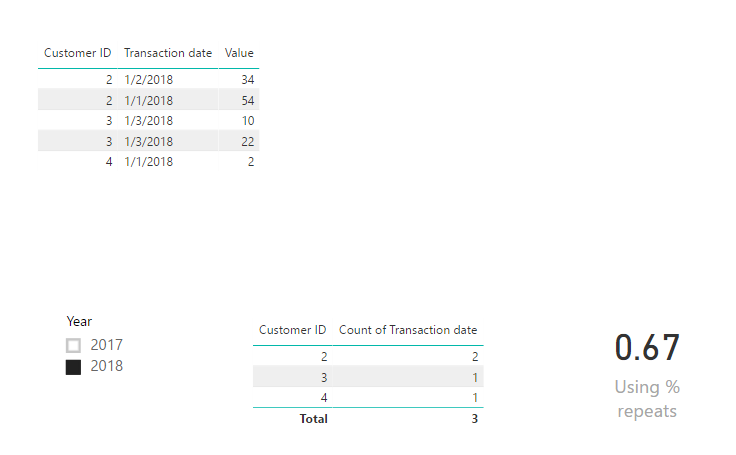
However, if I want to apply a filter in a report to look at transactions made in 2018, my measure doesn't change as the grouping removes the date column. In this case I want my grouped data to look like this:
| Customer ID | Unique transaction dates (2018) |
| 2 | 2 |
| 3 | 1 |
Giving a % repeats of 50%.
Similarly if Customer 1 had made one transaction in 2018 and one in 2017 I'd still like them to appear as a repeat customer, as they've made a transaction in the year filtered for & have made bookings previously.
Hope this makes sense, thank you in advance!
Sarah
Solved! Go to Solution.
Hi @saferguson,
Please try below measures:
Unique transaction dates =
CALCULATE (
DISTINCTCOUNT ( 'Customer Transaction'[Transaction date] ),
ALLEXCEPT ( 'Customer Transaction', 'Customer Transaction'[Customer ID] )
)
Using % repeats =
CALCULATE (
DISTINCTCOUNT ( 'Customer Transaction'[Customer ID] ),
FILTER ( 'Customer Transaction', [Unique transaction dates] > 1 )
)
/ DISTINCTCOUNT ( 'Customer Transaction'[Customer ID] )
Best regards,
Yuliana Gu
Hi @saferguson,
Please try below measures:
Unique transaction dates =
CALCULATE (
DISTINCTCOUNT ( 'Customer Transaction'[Transaction date] ),
ALLEXCEPT ( 'Customer Transaction', 'Customer Transaction'[Customer ID] )
)
Using % repeats =
CALCULATE (
DISTINCTCOUNT ( 'Customer Transaction'[Customer ID] ),
FILTER ( 'Customer Transaction', [Unique transaction dates] > 1 )
)
/ DISTINCTCOUNT ( 'Customer Transaction'[Customer ID] )
Best regards,
Yuliana Gu
Brilliant, that works. Thank you! Could you please explain what exactly you've done just so I understand fully?
If you have recently started exploring Fabric, we'd love to hear how it's going. Your feedback can help with product improvements.
A new Power BI DataViz World Championship is coming this June! Don't miss out on submitting your entry.
Share feedback directly with Fabric product managers, participate in targeted research studies and influence the Fabric roadmap.
| User | Count |
|---|---|
| 53 | |
| 39 | |
| 35 | |
| 19 | |
| 18 |
| User | Count |
|---|---|
| 73 | |
| 73 | |
| 38 | |
| 35 | |
| 26 |