Get certified for free when you join Fabric Data Days 2026 and dive into Fabric, Power BI, SQL, AI, and other essential data skills.
Join nowData Days is here! Join us now for 60+ days of learning, challenges, and connection. Learn more
Hi all
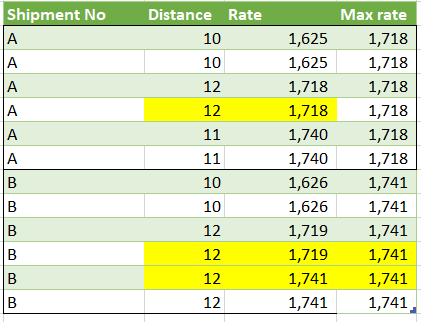
I have below table. Now I wanna create a "Max rate" columns with below logic:
Fill up the Max rate of max distance for 1 shipment in column" Max rate"
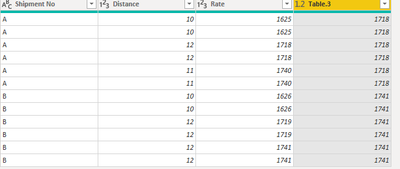
Ex: Shipment B have 2 rates with max distance ( 12) : 1719 and 1741 => fill up 1741 into " Max rate" column
So, is there any way to do it with POWER QUERY?
Thanks in advance for your support!
Solved! Go to Solution.
Hi @ngocnguyen ,
According to you description, You could copy the two tables first, and then group and merge .The steps are as follows:
Step1: Copy two tables
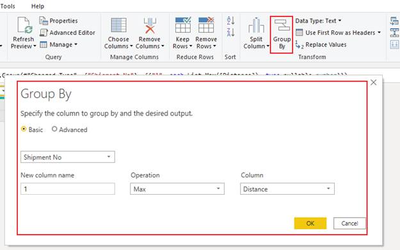
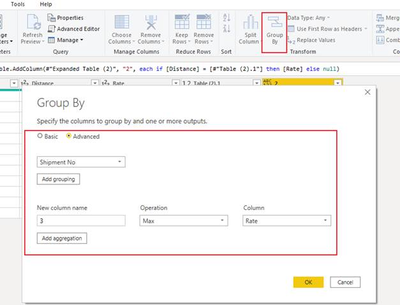
Step2: Group by
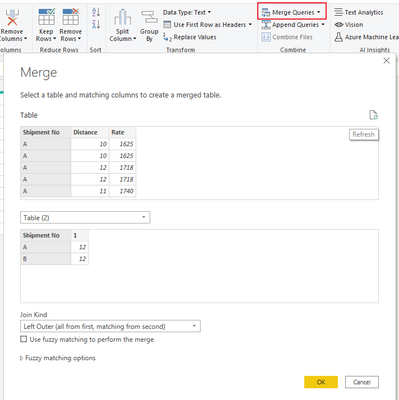
Step3: merge two tables and expanded tables
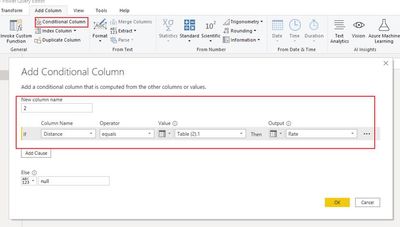
Step4: add conditional column and remove empty rows:
Step5: Group by
Step6 : merge two tables and expanded tables
The final output is shown below:
Best Regards,
Community Support Team_ Yalan Wu
If this post helps, then please consider Accept it as the solution to help the other members find it more quickly.
Hi @ngocnguyen ,
According to you description, You could copy the two tables first, and then group and merge .The steps are as follows:
Step1: Copy two tables
Step2: Group by
Step3: merge two tables and expanded tables
Step4: add conditional column and remove empty rows:
Step5: Group by
Step6 : merge two tables and expanded tables
The final output is shown below:
Best Regards,
Community Support Team_ Yalan Wu
If this post helps, then please consider Accept it as the solution to help the other members find it more quickly.
@ngocnguyen , You have this video deal with category max - if that can help
https://www.youtube.com/watch?v=8KaMj2DFpWg
In DAX you can a new column
new column =
var _1 = maxx(filter(Table, [shipment no] =earlier([shipment no])),[distance])
return
maxx(filter(Table, [shipment no] =earlier([shipment no]) && [distance] =_1),[Rate])
thanks for your rep. However, I wanna create formulas in Power query. So is there any way to do it?
Don't miss out on Data Days, June 15 through August 7. Learn Fabric, Power BI, SQL, AI and more.
Check out the May 2026 Power BI update to learn about new features.
| User | Count |
|---|---|
| 23 | |
| 23 | |
| 21 | |
| 17 | |
| 14 |
| User | Count |
|---|---|
| 58 | |
| 50 | |
| 37 | |
| 29 | |
| 24 |