Join us at FabCon Atlanta from March 16 - 20, 2026, for the ultimate Fabric, Power BI, AI and SQL community-led event. Save $200 with code FABCOMM.
Register now!View all the Fabric Data Days sessions on demand. View schedule
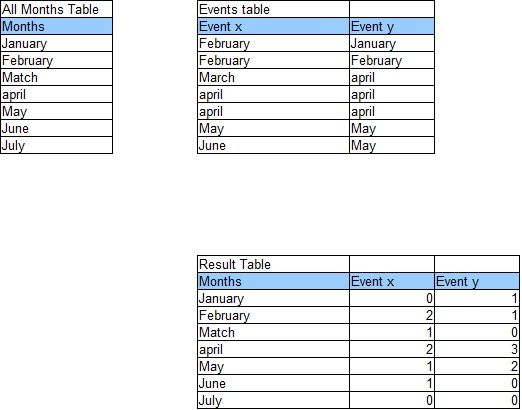
I have 2 tables, 'All months table' and 'Events table'. I would like to get a new table (Result Table) in which the events are summarized and the missing months are filled with zero. Does anyone knows how I can do this?
Solved! Go to Solution.
Hi @Ralf123,
First of all, I would model your data in your Events table differently, like this:
| Events table | |
| EventName | Date |
| Event X | 01/02/2017 |
| Event X | 02/02/2017 |
| Event X | 01/03/2017 |
| Event X | 01/04/2017 |
| Event X | 02/04/2017 |
| Event X | 01/05/2017 |
| Event X | 01/06/2017 |
| Event Y | 01/01/2017 |
| etc… |
I used a "Date" column because you have more than one instance of the same event per month.
Then, I would create a Calendar table, rather than an All Months table, e.g.:
Calendar =
ADDCOLUMNS (
CALENDAR ( "01-Jan-2010", "31-Dec-2020" ),
"Year", YEAR ( [Date] ),
"Month", FORMAT ( [Date], "MM" ),
"Month Name", FORMAT ( [Date], "MMM" )
)Then create a relationship between the two tables using the [Date] column.
Then you should be able to create a Matrix visual that resembles your Result Table.
Let me know how you get on.
Hi @Ralf123,
First of all, I would model your data in your Events table differently, like this:
| Events table | |
| EventName | Date |
| Event X | 01/02/2017 |
| Event X | 02/02/2017 |
| Event X | 01/03/2017 |
| Event X | 01/04/2017 |
| Event X | 02/04/2017 |
| Event X | 01/05/2017 |
| Event X | 01/06/2017 |
| Event Y | 01/01/2017 |
| etc… |
I used a "Date" column because you have more than one instance of the same event per month.
Then, I would create a Calendar table, rather than an All Months table, e.g.:
Calendar =
ADDCOLUMNS (
CALENDAR ( "01-Jan-2010", "31-Dec-2020" ),
"Year", YEAR ( [Date] ),
"Month", FORMAT ( [Date], "MM" ),
"Month Name", FORMAT ( [Date], "MMM" )
)Then create a relationship between the two tables using the [Date] column.
Then you should be able to create a Matrix visual that resembles your Result Table.
Let me know how you get on.
Great, this did the trick.
You saved me a lot of time, thanks
Check out the November 2025 Power BI update to learn about new features.
Advance your Data & AI career with 50 days of live learning, contests, hands-on challenges, study groups & certifications and more!