Get Fabric or SQL Certified for Free.
Get certified for free when you join Fabric Data Days 2026 and dive into Fabric, Power BI, SQL, AI, and other essential data skills.
Join now- Power BI forums
- Get Help with Power BI
- Desktop
- Service
- Report Server
- Power Query
- Mobile Apps
- Developer
- DAX Commands and Tips
- Custom Visuals Development Discussion
- Health and Life Sciences
- Power BI Spanish forums
- Translated Spanish Desktop
- Training and Consulting
- Instructor Led Training
- Dashboard in a Day for Women, by Women
- Galleries
- Data Stories Gallery
- Themes Gallery
- Contests Gallery
- QuickViz Gallery
- Quick Measures Gallery
- Visual Calculations Gallery
- Notebook Gallery
- Translytical Task Flow Gallery
- TMDL Gallery
- R Script Showcase
- Webinars and Video Gallery
- Ideas
- Custom Visuals Ideas (read-only)
- Issues
- Issues
- Events
- Upcoming Events
Try your skills in the Power BI Dataviz World Championship! Round one ends June 26. Join now
- Power BI forums
- Forums
- Get Help with Power BI
- Desktop
- Extract first 4 digits from postcode from text col...
- Subscribe to RSS Feed
- Mark Topic as New
- Mark Topic as Read
- Float this Topic for Current User
- Bookmark
- Subscribe
- Printer Friendly Page

- Mark as New
- Bookmark
- Subscribe
- Mute
- Subscribe to RSS Feed
- Permalink
- Report Inappropriate Content
Extract first 4 digits from postcode from text column
Hi,
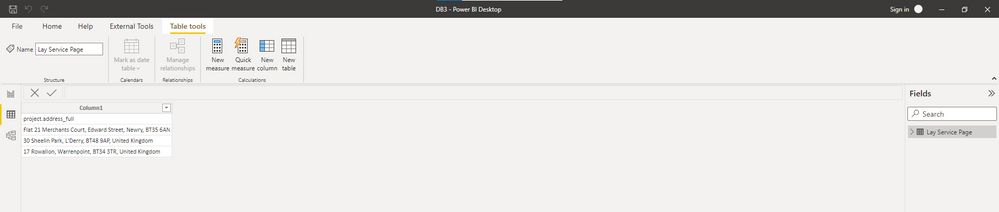
I have a column which has full addresses in it which due to the various ways the addresses have been handed over from the client I can't use the extract by delimiter function. I would like to create a new column which extracts the first 4 digits from the postcode. I have provided a screenshot of what it should look like. Can anyone help me please?

Thanks,
David
Solved! Go to Solution.


- Mark as New
- Bookmark
- Subscribe
- Mute
- Subscribe to RSS Feed
- Permalink
- Report Inappropriate Content
@deefunk1981 , One way is to search position of BT and then take 4 character
mid([column], search("BT",[Column],,len([Column])), 4)


- Mark as New
- Bookmark
- Subscribe
- Mute
- Subscribe to RSS Feed
- Permalink
- Report Inappropriate Content
Steps to follow:
1- Create a new column (by right clicking on a table and selecting new column option) and use the calculation given by @amitchandak
new_Column = mid([column1], search(" BT",[Column1],,len([Column1])), 4)
this will give you a new column with the first 4 digits of your postcode.
search(" BT"...) is going to search in your text if " BT" is there. If it is there then it will take first 4 characters(for which we have used ",4" in the formula) from BT to the right including BT.
- Mark as New
- Bookmark
- Subscribe
- Mute
- Subscribe to RSS Feed
- Permalink
- Report Inappropriate Content
Thank you so much for all your help everyone. The solution is now working 😁
- Mark as New
- Bookmark
- Subscribe
- Mute
- Subscribe to RSS Feed
- Permalink
- Report Inappropriate Content
Do all the postal codes include "BT"?
Did I answer your question? Mark my post as a solution!
In doing so, you are also helping me. Thank you!
Proud to be a Super User!
Paul on Linkedin.
- Mark as New
- Bookmark
- Subscribe
- Mute
- Subscribe to RSS Feed
- Permalink
- Report Inappropriate Content
Yes, all the postcodes are Northern Ireland and thankfully all start with BT which makes things a lot easier.
- Mark as New
- Bookmark
- Subscribe
- Mute
- Subscribe to RSS Feed
- Permalink
- Report Inappropriate Content
Steps to follow:
1- Create a new column (by right clicking on a table and selecting new column option) and use the calculation given by @amitchandak
new_Column = mid([column1], search(" BT",[Column1],,len([Column1])), 4)
this will give you a new column with the first 4 digits of your postcode.
search(" BT"...) is going to search in your text if " BT" is there. If it is there then it will take first 4 characters(for which we have used ",4" in the formula) from BT to the right including BT.
- Mark as New
- Bookmark
- Subscribe
- Mute
- Subscribe to RSS Feed
- Permalink
- Report Inappropriate Content
Try using this M code:
let
    Source = Table.FromRows(Json.Document(Binary.Decompress(Binary.FromText("bc29DoIwFIbhW/nC3IE/RUeMuqiEAMYBGRp6Io21NccS4t1rdNTxHZ68bRtsjfSIIxyI+0Fa/0DvRvYCGzVJVqg9E72zoImfAqsmmWGeFwJHqz0p7LS9KHcLOtEGSYh6IDLaopR8FdifxzCMszXx16YLLPPyr40yVG6SxjiLSgmcJDPZu9PWf64pkqb6ld0L", BinaryEncoding.Base64), Compression.Deflate)), let _t = ((type nullable text) meta [Serialized.Text = true]) in type table [project.address_full = _t]),
    #"Changed Type" = Table.TransformColumnTypes(Source,{{"project.address_full", type text}}),
    #"Duplicated Column" = Table.DuplicateColumn(#"Changed Type", "project.address_full", "project.address_full - Copy"),
    #"Inserted Text Before Delimiter" = Table.AddColumn(#"Duplicated Column", "Text Before Delimiter", each Text.BeforeDelimiter([#"project.address_full - Copy"], ", United Kingdom"), type text),
    #"Inserted Last Characters" = Table.AddColumn(#"Inserted Text Before Delimiter", "Last Characters", each Text.End([Text Before Delimiter], 8), type text),
    #"Inserted First Characters" = Table.AddColumn(#"Inserted Last Characters", "First Characters", each Text.Start([Last Characters], 4), type text),
    #"Removed Columns" = Table.RemoveColumns(#"Inserted First Characters",{"project.address_full - Copy", "Text Before Delimiter", "Last Characters"})
in
    #"Removed Columns"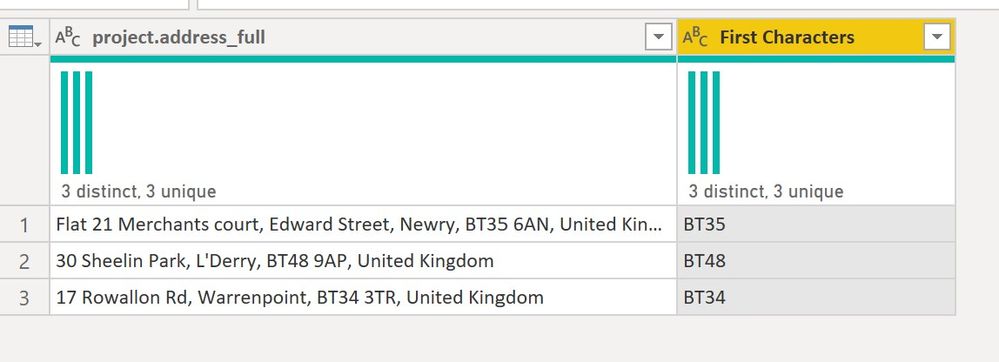
Did I answer your question? Mark my post as a solution!
In doing so, you are also helping me. Thank you!
Proud to be a Super User!
Paul on Linkedin.
- Mark as New
- Bookmark
- Subscribe
- Mute
- Subscribe to RSS Feed
- Permalink
- Report Inappropriate Content
@deefunk1981 , One way is to search position of BT and then take 4 character
mid([column], search("BT",[Column],,len([Column])), 4)
- Mark as New
- Bookmark
- Subscribe
- Mute
- Subscribe to RSS Feed
- Permalink
- Report Inappropriate Content
Thanks for your reply. This solution makes sense and I think it will work. However, I am unsure what process to follow to use this.

Helpful resources

Data Days 2026
Don't miss out on Data Days, June 15 through August 7. Learn Fabric, Power BI, SQL, AI and more.

Power BI Monthly Update - May 2026
Check out the May 2026 Power BI update to learn about new features.

Power BI DataViz World Championships - June 2026
A new Power BI DataViz World Championship is coming this June! Don't miss out on submitting your entry.

| User | Count |
|---|---|
| 25 | |
| 22 | |
| 21 | |
| 19 | |
| 13 |


| User | Count |
|---|---|
| 68 | |
| 57 | |
| 42 | |
| 42 | |
| 30 |


