Join us in Barcelona for FabCon and SQLCon, September 28 - October 1, 2026.
This is best Fabric, Power BI, SQL and AI community event. How do we know? The last event sold out! Save €200 with code FABCMTY200.
Register now- Power BI forums
- Get Help with Power BI
- Desktop
- Service
- Report Server
- Power Query
- Mobile Apps
- Developer
- DAX Commands and Tips
- Custom Visuals Development Discussion
- Health and Life Sciences
- Power BI Spanish forums
- Translated Spanish Desktop
- Training and Consulting
- Instructor Led Training
- Dashboard in a Day for Women, by Women
- Galleries
- Data Stories Gallery
- Themes Gallery
- Contests Gallery
- QuickViz Gallery
- Quick Measures Gallery
- Visual Calculations Gallery
- Fabric Apps Gallery
- Notebook Gallery
- Translytical Task Flow Gallery
- TMDL Gallery
- R Script Showcase
- Webinars and Video Gallery
- Ideas
- Custom Visuals Ideas (read-only)
- Issues
- Issues
- Events
- Upcoming Events
July 28 - August 9 | Final Round of the Power BI Dataviz World Championships. This is your chance. Learn more
- Power BI forums
- Forums
- Get Help with Power BI
- Desktop
- Re: Extract first 4 digits from postcode from text...
- Subscribe to RSS Feed
- Mark Topic as New
- Mark Topic as Read
- Float this Topic for Current User
- Bookmark
- Subscribe
- Printer Friendly Page

- Mark as New
- Bookmark
- Subscribe
- Mute
- Subscribe to RSS Feed
- Permalink
- Report Inappropriate Content
Extract first 4 digits from postcode from text column
Hi,
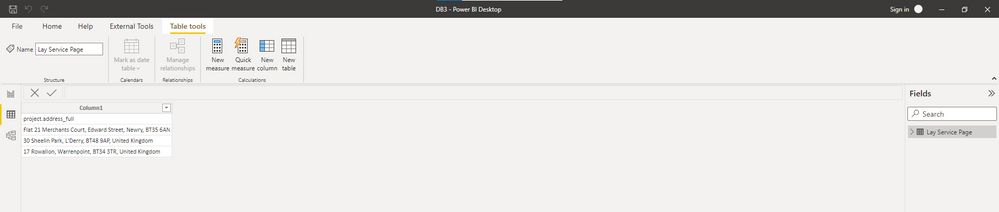
I have a column which has full addresses in it which due to the various ways the addresses have been handed over from the client I can't use the extract by delimiter function. I would like to create a new column which extracts the first 4 digits from the postcode. I have provided a screenshot of what it should look like. Can anyone help me please?

Thanks,
David
Solved! Go to Solution.


- Mark as New
- Bookmark
- Subscribe
- Mute
- Subscribe to RSS Feed
- Permalink
- Report Inappropriate Content
@deefunk1981 , One way is to search position of BT and then take 4 character
mid([column], search("BT",[Column],,len([Column])), 4)


- Mark as New
- Bookmark
- Subscribe
- Mute
- Subscribe to RSS Feed
- Permalink
- Report Inappropriate Content
Steps to follow:
1- Create a new column (by right clicking on a table and selecting new column option) and use the calculation given by @amitchandak
new_Column = mid([column1], search(" BT",[Column1],,len([Column1])), 4)
this will give you a new column with the first 4 digits of your postcode.
search(" BT"...) is going to search in your text if " BT" is there. If it is there then it will take first 4 characters(for which we have used ",4" in the formula) from BT to the right including BT.
- Mark as New
- Bookmark
- Subscribe
- Mute
- Subscribe to RSS Feed
- Permalink
- Report Inappropriate Content
Thank you so much for all your help everyone. The solution is now working 😁
- Mark as New
- Bookmark
- Subscribe
- Mute
- Subscribe to RSS Feed
- Permalink
- Report Inappropriate Content
Do all the postal codes include "BT"?
Did I answer your question? Mark my post as a solution!
In doing so, you are also helping me. Thank you!
Proud to be a Super User!
Paul on Linkedin.
- Mark as New
- Bookmark
- Subscribe
- Mute
- Subscribe to RSS Feed
- Permalink
- Report Inappropriate Content
Yes, all the postcodes are Northern Ireland and thankfully all start with BT which makes things a lot easier.
- Mark as New
- Bookmark
- Subscribe
- Mute
- Subscribe to RSS Feed
- Permalink
- Report Inappropriate Content
Steps to follow:
1- Create a new column (by right clicking on a table and selecting new column option) and use the calculation given by @amitchandak
new_Column = mid([column1], search(" BT",[Column1],,len([Column1])), 4)
this will give you a new column with the first 4 digits of your postcode.
search(" BT"...) is going to search in your text if " BT" is there. If it is there then it will take first 4 characters(for which we have used ",4" in the formula) from BT to the right including BT.
- Mark as New
- Bookmark
- Subscribe
- Mute
- Subscribe to RSS Feed
- Permalink
- Report Inappropriate Content
Try using this M code:
let
    Source = Table.FromRows(Json.Document(Binary.Decompress(Binary.FromText("bc29DoIwFIbhW/nC3IE/RUeMuqiEAMYBGRp6Io21NccS4t1rdNTxHZ68bRtsjfSIIxyI+0Fa/0DvRvYCGzVJVqg9E72zoImfAqsmmWGeFwJHqz0p7LS9KHcLOtEGSYh6IDLaopR8FdifxzCMszXx16YLLPPyr40yVG6SxjiLSgmcJDPZu9PWf64pkqb6ld0L", BinaryEncoding.Base64), Compression.Deflate)), let _t = ((type nullable text) meta [Serialized.Text = true]) in type table [project.address_full = _t]),
    #"Changed Type" = Table.TransformColumnTypes(Source,{{"project.address_full", type text}}),
    #"Duplicated Column" = Table.DuplicateColumn(#"Changed Type", "project.address_full", "project.address_full - Copy"),
    #"Inserted Text Before Delimiter" = Table.AddColumn(#"Duplicated Column", "Text Before Delimiter", each Text.BeforeDelimiter([#"project.address_full - Copy"], ", United Kingdom"), type text),
    #"Inserted Last Characters" = Table.AddColumn(#"Inserted Text Before Delimiter", "Last Characters", each Text.End([Text Before Delimiter], 8), type text),
    #"Inserted First Characters" = Table.AddColumn(#"Inserted Last Characters", "First Characters", each Text.Start([Last Characters], 4), type text),
    #"Removed Columns" = Table.RemoveColumns(#"Inserted First Characters",{"project.address_full - Copy", "Text Before Delimiter", "Last Characters"})
in
    #"Removed Columns"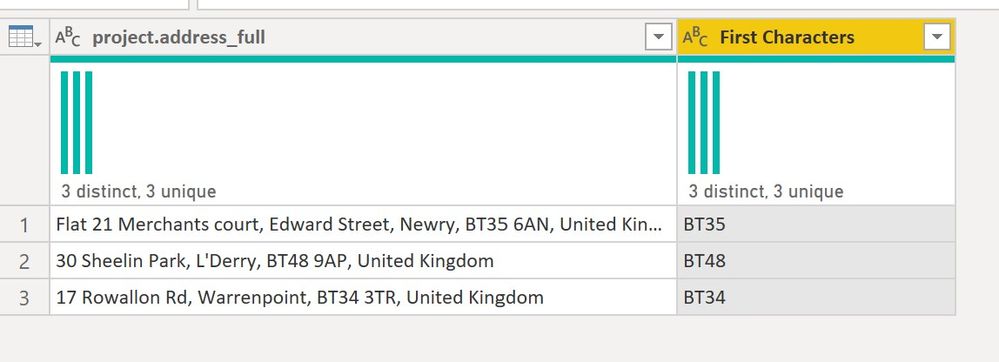
Did I answer your question? Mark my post as a solution!
In doing so, you are also helping me. Thank you!
Proud to be a Super User!
Paul on Linkedin.
- Mark as New
- Bookmark
- Subscribe
- Mute
- Subscribe to RSS Feed
- Permalink
- Report Inappropriate Content
@deefunk1981 , One way is to search position of BT and then take 4 character
mid([column], search("BT",[Column],,len([Column])), 4)
- Mark as New
- Bookmark
- Subscribe
- Mute
- Subscribe to RSS Feed
- Permalink
- Report Inappropriate Content
Thanks for your reply. This solution makes sense and I think it will work. However, I am unsure what process to follow to use this.

Helpful resources

FabCon & SQLCon – Barcelona 2026
Join us in Barcelona for FabCon and SQLCon, the Fabric, Power BI, SQL, and AI community event. Save €200 with code FABCMTY200.

Fabric Community Sticker Challenge - Barcelona 2026
If you love stickers, then you will definitely want to check out our community sticker challenge, Barcelona edition!

Power BI Monthly Update - July 2026
Check out the July 2026 Power BI update to learn about new features.

Power BI DataViz World Championships - June 2026
A new Power BI DataViz World Championship is coming this June! Don't miss out on submitting your entry.

| User | Count |
|---|---|
| 25 | |
| 23 | |
| 19 | |
| 17 | |
| 14 |


| User | Count |
|---|---|
| 25 | |
| 23 | |
| 20 | |
| 20 | |
| 19 |


