This time we’re going bigger than ever. Fabric, Power BI, SQL, AI and more. We're covering it all. You won't want to miss it.
Learn moreDid you hear? There's a new SQL AI Developer certification (DP-800). Start preparing now and be one of the first to get certified. Register now
Solved! Go to Solution.
Hi @yslee ,
You can create a calendar table as a slicer to filter the data in Data table.
Calendar Date = CALENDAR(DATE(2021,04,01),DATE(2021,04,30))
Then create a measure to return the 7 days back production data.
last 7 days products = CALCULATE(SELECTEDVALUE('Table'[Product]),FILTER('Table','Table'[Date]>MAX('Calendar Date'[Date])-7 && 'Table'[Date]<=MAX('Calendar Date'[Date])))
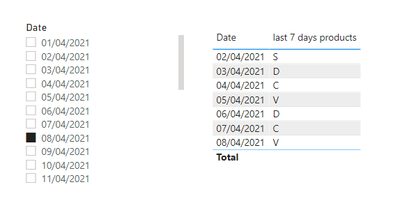
The effect is as shown:
Best Regards
Community Support Team _ Ailsa Tao
If this post helps, then please consider Accept it as the solution to help the other members find it more quickly.
Hi @yslee ,
You can create a calendar table as a slicer to filter the data in Data table.
Calendar Date = CALENDAR(DATE(2021,04,01),DATE(2021,04,30))
Then create a measure to return the 7 days back production data.
last 7 days products = CALCULATE(SELECTEDVALUE('Table'[Product]),FILTER('Table','Table'[Date]>MAX('Calendar Date'[Date])-7 && 'Table'[Date]<=MAX('Calendar Date'[Date])))
The effect is as shown:
Best Regards
Community Support Team _ Ailsa Tao
If this post helps, then please consider Accept it as the solution to help the other members find it more quickly.
@yslee , if you select a date and plot more than that date , you need an independent date table https://www.youtube.com/watch?v=44fGGmg9fHI
Check out the April 2026 Power BI update to learn about new features.
Sign up to receive a private message when registration opens and key events begin.
If you have recently started exploring Fabric, we'd love to hear how it's going. Your feedback can help with product improvements.
| User | Count |
|---|---|
| 34 | |
| 31 | |
| 25 | |
| 20 | |
| 16 |
| User | Count |
|---|---|
| 61 | |
| 49 | |
| 28 | |
| 23 | |
| 23 |