Join us at FabCon Atlanta from March 16 - 20, 2026, for the ultimate Fabric, Power BI, AI and SQL community-led event. Save $200 with code FABCOMM.
Register now!The Power BI Data Visualization World Championships is back! It's time to submit your entry. Live now!
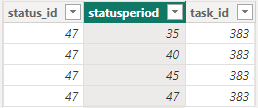
I have a table that looks like this:
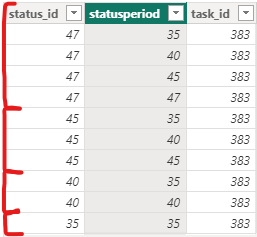
And from that table I want to create a new table that looks like this:
The measure needs to filter the statusperiod (ex. <= 47), add a new column (status_id, 47) and add that to a second table that does the same thing with the next highest statusperiod number (<= 45) and so on until it hits the lowest number in the statusperiod colunm. I know I can do this by creating multiple tables and combining them, but I want it done dynamically so that when more data is added, I don't need to code a new table.
Any help would be appreciated. Thanks!
Hello @vsorensen,
I'd propose such a solution:
However it has limitations - it won't work properly if you have a different combination of task_id and (status_id, statusperiod.
Here's the [DAX] code in text format for convenience:
new_table =
VAR col2 = FILTER ( VALUES( data[statusperiod] ), [statusperiod] < MAX ( data[status_id] ) )
VAR col1 = SELECTCOLUMNS ( col2, "status_id", [statusperiod] )
VAR surplus = CROSSJOIN ( FILTER ( CROSSJOIN ( col1, col2 ), [status_id] >= [statusperiod] ), VALUES ( data[task_id] ) )
RETURN UNION ( data, surplus )
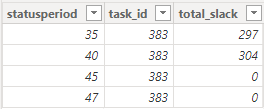
This is great, thank you! Unfortunately, I realized I made a mistake in my initial question: my original table does not have the status_id column but I would like to add it when the new table is generated. How would I do that? Also, how can I tweak this I if I have one more column? I've added a screenshot below of a better representation of my data.
Can you also provide a table which is supposed to be your final result?
The Power BI Data Visualization World Championships is back! It's time to submit your entry.
Check out the January 2026 Power BI update to learn about new features.
| User | Count |
|---|---|
| 61 | |
| 48 | |
| 35 | |
| 25 | |
| 23 |
| User | Count |
|---|---|
| 134 | |
| 110 | |
| 59 | |
| 39 | |
| 32 |