Hi,
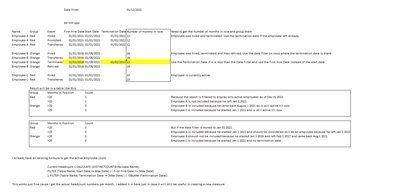
I have a data that looks like this. A person has multiple rows of data. Each event (such as promotion, hire, termination, rehire) equates to one row of data. I need to get each of their tenure and then add group/bin them accordingly.
If the current status is active then Newest Employment Date - Maximum Date based on selected slicer in the report. (if the slicer selected is Mar 2022, the max date is Mar 31 2022). Thus, Newest employment date - mar 31 2022. The max date adjusts based on the selected slicer.
If the current status is terminated then newest employment date - termination date.
If the selected slicer is less than the termination date then use that lesser date (because technically, it makes sense that way)
Then I should group them by 0-6 Months, 1-5 years, 6-10 years and so on and by their teams as well. Result should be a table that looks like this:
| | 0-6 Months | 1-5 Years | 6-10 years |
| IT | 10 | 5 | 2 |
| HR | 2 | 4 | 2 |
| Total | 12 | 9 | 4 |
Raw Data:
| | Newest Employment Date | New Termination Date | Event | Current Status | Team |
| Anne | 20/03/2021 | | Hire | Active | IT |
| Anne | 20/03/2021 | 09/02/2017 | Terminated | Active | IT |
| Anne | 20/03/2021 | | Rehire | Active | IT |
| | | | | | |
| Ben | 19/07/2022 | 29/12/2022 | Hire | Terminated | HR |
| Ben | 19/07/2022 | 29/12/2022 | Terminated | Terminated | HR |
| | | | | | |
| | | | | | |
| Carl | 19/07/2022 | | Hire | Active | IT |
| Carl | 19/07/2022 | | Promotion | Active | IT |
| Carl | 19/07/2022 | | Change in Job Title | Active | IT |